
Returning to the Past: The Key to Understanding the Present and Shaping the Future
Why do we repeatedly return to the past? Not out of nostalgia, nor to blame or boast, but because those who fail to interpret the past correctly, and those who fail to understand tradition and heritage within their proper historical context, will never be able to understand the present. And those who fail to understand the present have no share in the future, nor the ability to shape it.
The Question of Superiority and Decline: The Roots of the Answer Lie in the Historical Trajectory
The fundamental question we must ask today, without hesitation or equivocation, is: Why did the West prevail while the Islamic world declined, despite the depth of its civilization, its vast territory, and the richness of its heritage? The answer does not lie in conspiracies, envy, or external enemies, but rather in a profound internal historical trajectory that began centuries ago. The reality of Western superiority that we see today did not arise from a vacuum, but rather grew from deep roots in the very soil of Western religious and philosophical thought. When Martin Luther decided in the 16th century to reinterpret the Bible and declare that every believer is their own priest, he was not merely reforming a religious rite, but igniting a tremendous intellectual revolution that paved the way for the Renaissance, the Enlightenment, modern science, the Industrial Revolution in Britain, and the political revolution in France. These interconnected milestones formed a cohesive civilizational fabric that transformed Europe from a continent of darkness into the center of the world.
Reform in the Islamic World: A Clash with the Wall of the Establishment
In the Islamic world, despite bold attempts throughout history, any internal reform project has collided with the wall of the religious establishment and political power, its spirit stifled before it could become a popular movement. Islam, which began as a comprehensive spiritual and social revolution, has been gradually transformed into a system of rigid rulings, administered only superficially and to serve specific purposes, not from the heart, the mind, or the realities of life. While Luther was challenging the papacy and translating the Bible into the vernacular, scholars in Baghdad, Qom, and Damascus, for centuries, were writing voluminous books on theological, legal, and sectarian disputes that concerned only a select few. These disputes transformed our religion into a prison for the mind and an arena for conflicts far removed from the essence of Islam’s message: justice, freedom, brotherhood, and mercy.
Sectarian Disputes: From Political Conflict to Ideological Weapon
Indeed, the sectarian disputes between Sunnis and Shiites are among the most dangerous manifestations of this deviation. These disputes arose in specific historical contexts as struggles for power and the caliphate, but over time they have transformed into rigid identities, inherited rather than chosen, and used as tools of division rather than as calls for understanding and independent reasoning. Today, these disputes are no longer mere legal debates among scholars; they have become an ideological weapon in the hands of regional powers to serve their interests. The Iranian regime, for example, does not defend Shiism as a spiritual doctrine or social ideology, but rather employs it as a tool for hegemony. It spreads its militias in the name of resistance and protecting Shiite holy sites, while marginalizing and impoverishing its people, and crushing its opponents, as well as the Sunni regimes that exploit Sunnis to achieve their interests.
Internal Colonialism and the Loss of Islam’s Humanistic Essence
The truth is that this manufactured sectarian conflict is not a manifestation of intellectual disagreement, but rather one of the most dangerous forms of internal colonialism. Each side views the other negatively, seeing the Shia as a heretic and an infidel, and the Sunni as a takfiri Wahhabi. The reality is that both are victims of the same system: the system of religious-capitalist tyranny that fuels discord to keep the people divided, weak, and incapable of uniting against those who exploit them. Islam, in its original essence, was never a sectarian religion but a comprehensive, humanistic message. The society established by the Prophet Muhammad, peace and blessings be upon him, in Medina was not a Sunni or Shiite society, but rather a contractual, diverse society that included Muslims, Jews, Christians, and polytheists, all of whom lived under one covenant, the Charter of Medina, which is considered one of the first constitutions of citizenship in history. Islam in its beginnings was a comprehensive social revolution. It abolished tribal discrimination, granted women the right to inheritance a thousand years before Europe, made justice the basis of governance, and made consultation a method of leadership. But over time, this liberating project was hijacked by caliphates, then empires, and then modern authoritarian regimes that used it to justify their power, not to curb their tyranny. The liberating and democratic dimension of the message was marginalized, replaced by a culture of obedience and blind loyalty. Islam as a religion is not the problem; the problem lies in how it has been transformed into a tool of control instead of remaining a source of liberation. If we want to defend Islam, we must not shout “God is Great” while begging from the West, but rather build a society that proclaims “God is Great” in its justice, in the dignity of its poor, in the freedom of its women, and in its respect for those who differ with it. For Islam, in its essence, is not a set of rituals, but a way of life.
The Call to Return to the Roots: Building a Society on Justice and Diversity
Today, in light of this crisis, I believe we must return to the true roots of Islam brought by the Prophet Muhammad, peace and blessings be upon him. He did not deny historical differences, but he refused to let them be the basis of identity or a cause for enmity. In his view, justice is not achieved by excommunicating others, but by participating with them in shaping life. Freedom is not built on the exclusion of any sect, but on respect for diversity. Therefore, we need to build a society from this perspective, where people are not categorized according to their sect, but according to their contribution to building justice. Christians sit side by side with Muslims, Sunnis with Shiites, Kurds with Arabs, not because they are tolerant, but because they understand that true religion is not built on hatred, but on brotherhood. Thus, it is time to acknowledge that sectarian differences, as they are managed today, are not doctrinal disputes, but rather political constructs. Those who promote them are not concerned with religion, but with maintaining their grip on power. Islam was not created to divide the nation, but to unite it. The message was not revealed to become a commodity in the market of domination, but to be a guiding light for the oppressed.
Religion as a Weapon of Tyranny: Salvation Through Reinterpretation
Indeed, when religion is used to sow division, it becomes the most dangerous weapon in the hands of tyranny. Therefore, salvation does not lie in returning to the past as it was, but in reinterpreting it so that it becomes a path to justice, not a cause for war. Today, while some speak of an Islamic revival or awakening, Islam itself is no longer a voice in the battle of civilizations. The truth is, we have over 300 million Arabs and 1.5 billion Muslims, and we possess oil, history, and holy land. Yet, we cannot raise our heads against a nation with a population of no more than five million, a nation that builds its dominance not on numbers, but on intellect, science, organization, and global intellectual influence.
Islam imprisoned in the bottle of imitation and importation from the West
The truly painful thing is to acknowledge that Islam, as a productive civilizational project, bears a significant portion of the responsibility for this situation, not because it is deficient, but because it has been imprisoned in the bottle of imitation and diverted from its original liberating mission. We continue to practice a form of pretense of Islamism by raising slogans, growing long beards, closing shops on Fridays, and issuing fatwas against Western cultural invasion, while we import everything from the West—from weapons and medicine to software and even our political discourse. The truth is, we defend Islam using a language crafted by Western universities, and we demand our rights through institutions established by neo-colonialism. Islamic movements, from the Muslim Brotherhood to the Salafists, do not employ authentic Islamic concepts; rather, they borrow Western terminology: party, state, constitution, elections, even democracy. However, they strip these concepts of their true participatory content and clothe them in a superficial religious garb. If we defend Islam using the very language of colonialism, how can we possibly prevail? This defense, in its essence, is not a defense of Islam, but rather a defense of a marginalized identity searching for lost dignity, hiding behind religion as a psychological shield, not as a civilizational project.
The Dominance of the Western Vision and the Crisis of the Islamic Project
A fundamental question arises today, without hesitation or pretense: Who is the truly dominant power in this world? Is it Islam or Christianity? The answer is crystal clear: the dominance, by 99%, is Christian-Western. Even if churches no longer fill the streets of London or Washington, the global order today—from the United Nations to the International Monetary Fund, from universities to technology companies, from the media to political systems—is all built upon a worldview that emerged from the womb of Christianity after its reformation. As for Islam, it has become a tool in the hands of regimes to legitimize oppression, or in the hands of groups to mobilize the masses. This manipulation is no longer confined to domestic affairs; it has become part of a larger geopolitical game. Some Western and regional powers have not hesitated to support or amplify certain religious movements when they found in them a tool to weaken adversaries, justify intervention, or even reshape spheres of influence under the guise of the war on terror or religious alliances such as the Abraham Accords. This has led to a double distortion: a distortion of Islam from within and a distortion of its image from without, to the point that Muslims themselves have become victims of this mutual exploitation. Today, we are witnessing a genuine crisis in the relationship between religion and power, and between the sacred and critical thought, which represents the core of the predicament. Islam, as a religion, called for reflection and contemplation, and liberated the mind from myths and extremism. Therefore, true liberation today must begin with the liberation of the mind. No Arab or Islamic renaissance project can succeed unless critical thinking, science, and universal human values such as justice, freedom, and dignity are restored. These values do not contradict the essence of religion; rather, they are its true essence when understood maturely, free from manipulation and intimidation. Our current moment, despite its gloom, may be a historic opportunity to revisit the fundamental question: What does it mean to be Muslim in a world that redefines itself daily? Do we merely repeat slogans, or do we cultivate minds capable of innovation, consciences capable of justice, and visions that contribute to human civilization, not just consume it? Yet, Muslims still cling to empty religious slogans, spending billions on them, building mosques devoid of thought, and pinning their hopes for liberation upon them, while neglecting the fact that true liberation begins with the liberation of the mind. Meanwhile, the world around us is developing artificial intelligence, sending spacecraft to Mars, and redefining the concepts of freedom, justice, and time itself.
A Revolution of Mindset and Rebuilding the Relationship with Heritage
Therefore, we need today a revolution of mindset that begins not only with overthrowing regimes but also with rebuilding our relationship with our heritage. We need a profound reading of Islam that does not deny it but reconnects it to its liberating roots. Islam, in its essence, is not against knowledge, but against ignorance; not against freedom, but against slavery; not against women, but against discrimination. However, these seeds cannot truly take root in the soil of tyranny and stagnation.
The Beautiful Names of God: A Philosophical System for Building a Just Society
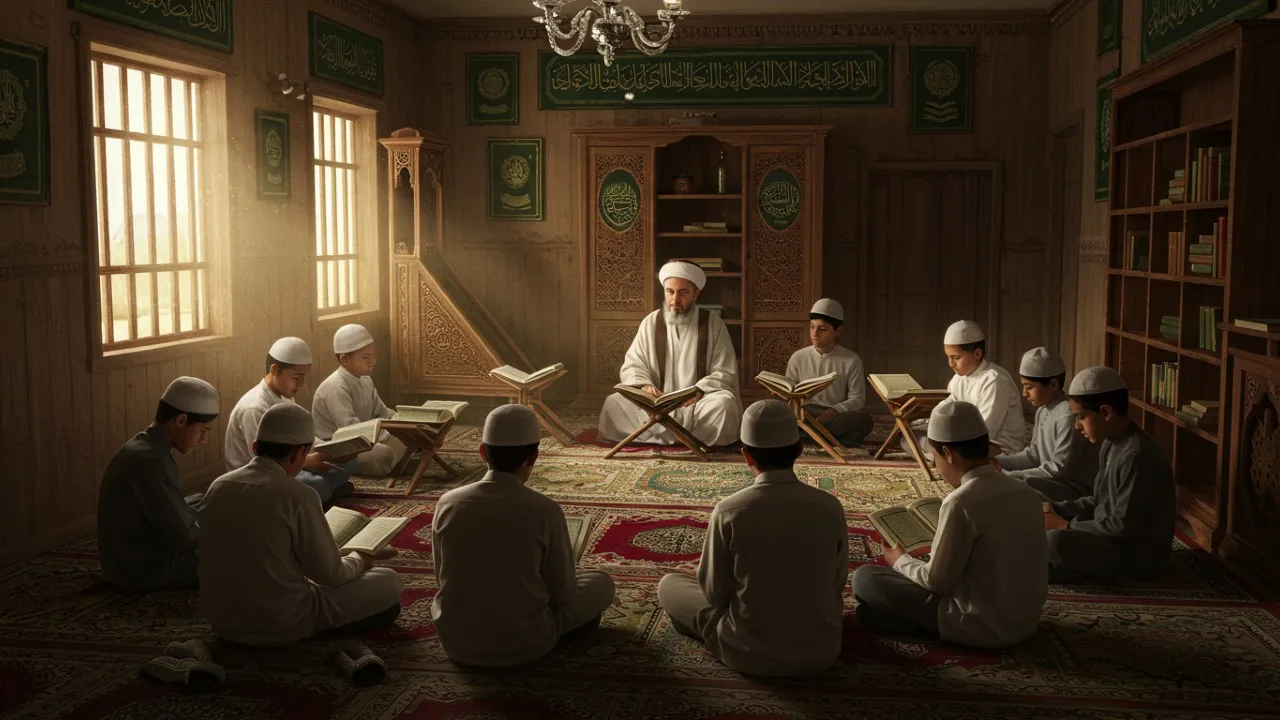
The greatest proof of this lies in the ninety-nine Beautiful Names of God, which are not merely titles for God, but a complete philosophical system and a cosmic blueprint for building a just society. Each name reveals a dimension of existence: the Most Gracious, the Most Merciful, the King, the Most Holy, the Source of Peace, the Giver of Faith, the Guardian, the Mighty, the Compeller, the Supreme, the Creator, the Originator, the Fashioner, the Forgiver, the Subduer, the Bestower, the Provider, the Opener, the All-Knowing… If we truly understood these names, each one would be a social program. The Provider does not mean that God feeds you while you sleep, but rather urges you to build a just economy that guarantees sustenance for all. Justice does not mean waiting until Judgment Day to receive your rights, but rather building just institutions here and now. Being wise does not mean repeating texts without thinking, but rather dealing with reality with a mature mind and a strategic vision.
The Gap Between Recitation and Application: Faith Measured by Changing Reality
But what have we done with these names? We’ve turned them into chants recited in times of crisis, not principles applied in life. We invoke the Healer when a child falls ill, and the Merciful when the body is afflicted, but we’ve forgotten that the Beneficent is the One who bestows dignity, the Generous is the One who feeds the poor, and the Reckoner is the One who does not let injustice go unpunished. We must truly understand that genuine faith is not measured by the number of prostrations, but by the darkness it dispels in people’s lives. This is precisely what we lack today: a religion open to life, not closed in on death; a religion that liberates, not restricts; a religion that produces thought, not merely repeats slogans.
Scenes of Separation from Essence in the Reality of the Middle East
And in the reality of the Middle East, we see this separation with deadly clarity. In Iraq, for example, while intellectuals were imprisoned or killed, religious discourse was used to divide people into Muslims and infidels, Sunnis and Shiites, Arabs and Kurds, forgetting the essence of the message: “O mankind, indeed We have created you from male and female and made you peoples and tribes that you may know one another.” In Gaza, children are killed under the rubble, while martyrdom and martyrs are celebrated in religious sermons, but no one asks: Where is the Compassionate? Where is the Merciful? Where is peace?
Imposed Modernity and the Backlash
As for Turkey, Kemalism, which is said to have enshrined positivist thought, led to a mechanical, top-down leap that did not touch the consciousness of the masses. Instead, it imposed modernity by force, generating a backlash decades later. Today, the conservative movement seeks to impose religious hegemony, while the Western world itself has moved beyond the stage of dry positivism and secularism and entered the postmodern era, which is rethinking religion as an individual spiritual experience, not as an institutional authority. While we continue to debate the hijab and the beard, and inject religion into every administrative detail, it is as if we are punishing ourselves for our backwardness by clinging to the outward appearances of the past, rather than its spirit.
Salvation: Reviving the Islamic Project as a Liberating Experience
Indeed, it is high time we stopped viewing Islam as an ideological commodity to be traded in the marketplace of politics, and returned it to its essence as a spiritual and social experience that illuminates the path to liberation, not the path to servitude. The Islamic project, as a living project, has not died; rather, it awaits those who will revive it, not with weapons, but with thought; not with isolation, but with openness; not with hatred, but with brotherhood. Truly, there is no salvation for the Middle East, where identities clash and societies fragment, except through a project that unites spirit and reason, earth and heaven, past and future, and places social justice, inspired by the Most Beautiful Names of God, at its heart. For justice, in the end, is the Greatest Name.