

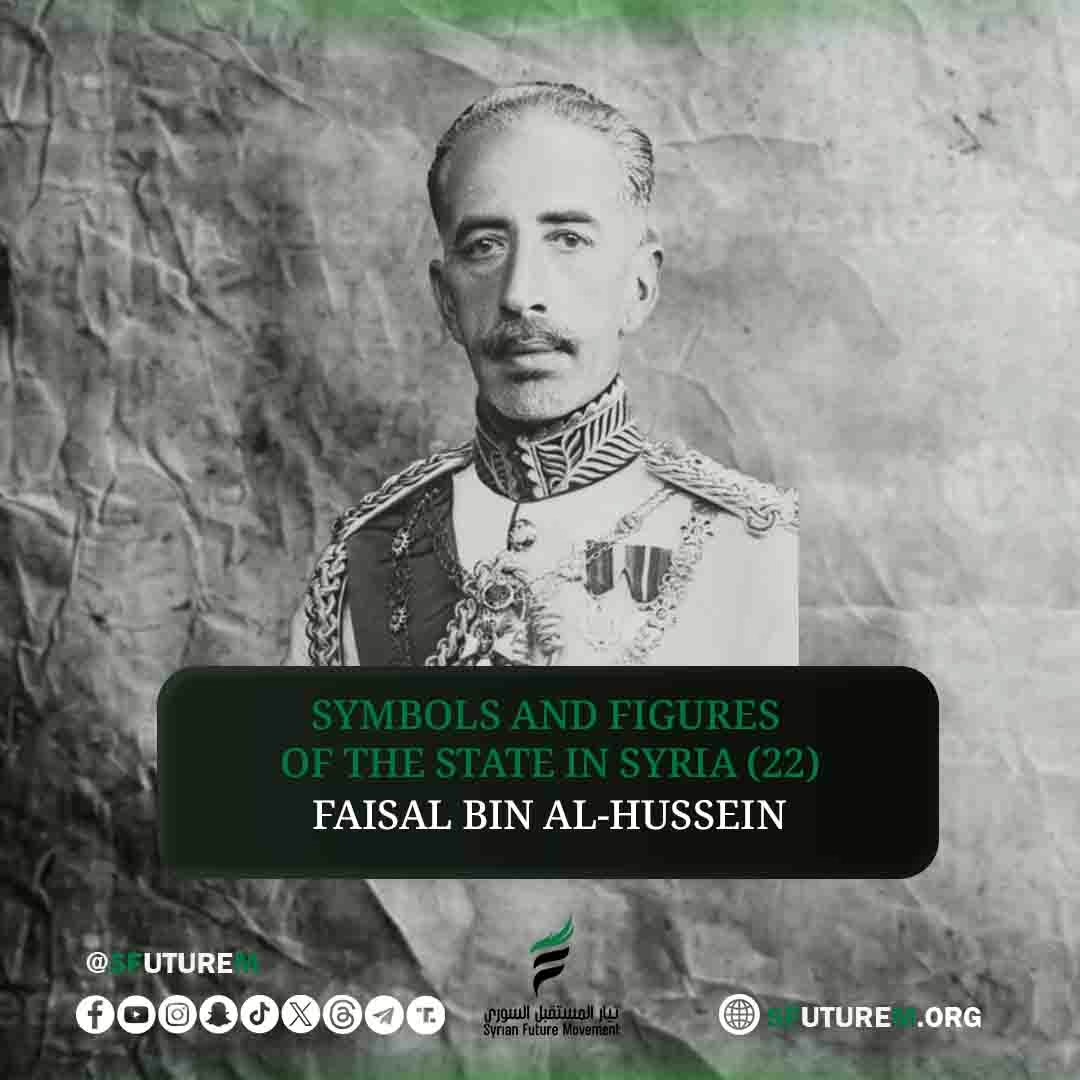
- He was born in the year (1300 AH / 1885 AD) and belonged to the Al Awn Hashemite family.
- He was born in the city of Taif and was raised among the Otaiba tribe in the deserts of Hijaz, growing up with his brothers under the care of his father, Hussein bin Ali Al-Hashemi.
- He completed his primary education alongside his brothers, Prince Ali bin Al-Hussein (later King of Hejaz) and Prince Abdullah bin Al-Hussein (later King of Jordan), where they learned to read and write in Turkish.
- He grew up among the Bedouins, experiencing desert life, austerity, and harsh living conditions, and he learned horsemanship, sword fighting, and rifle shooting.
- In 1896, he traveled with his father, Sharif Hussein bin Ali, to Istanbul, the capital of the Ottoman Empire, at the invitation of Ottoman Sultan Abdul Hamid II. They were placed under house arrest in the Palace of Justice, where a private tutor was assigned to teach him and his three brothers the Turkish language.
- In Istanbul, he studied Turkish, English, and French, as well as history, and his father taught him the Quran.
- In 1905, he married Hazima, the daughter of his cousin Nasser, and had the following children: Princess Azza, Princess Rajha, Princess Raifa, Prince Ghazi (who later became the second King of Iraq), and Prince Muhammad.
- In 1909, he returned to Mecca with the rest of his family after his father was appointed as the Sharif of Mecca, following the rise of the Committee of Union and Progress and the deposition of Sultan Abdul Hamid II.
- His father appointed him as the commander of the Arab battalions responsible for suppressing rebellious Arab tribes against Ottoman rule.
- He was elected as a representative of Jeddah in the Ottoman Parliament (Majlis Al-Mabouthan) and returned to Istanbul, where he gained political experience and comprehensive knowledge of Turkish politics and its leaders.
- While in Damascus, he witnessed the issuance of death sentences against a group of Arabs accused of inviting European countries to occupy their homeland in Beirut and Damascus. He attempted to mediate with Jamal Pasha to pardon them, but Jamal Pasha refused and ordered their execution in Marjeh Square in Damascus and Burj Square in Beirut on May 6, 1916.
- He requested permission to return to Mecca, which Jamal Pasha granted, allowing him to return just one month before the outbreak of the Arab Revolt.
- In June 1916, Sharif Hussein bin Ali Al-Hashemi declared the Arab Revolt against the Ottoman Empire, supported by Britain during World War I.
- His forces managed to sabotage the Hejaz railway with the assistance of British intelligence officer Lawrence and expelled the Ottoman army from Mecca, Medina, Taif, Jeddah, Yanbu, and Aqaba.
- The Arab army formed during the Great Arab Revolt was divided into three sections: one led by Prince Faisal, comprising around ten thousand fighters from the tribes of Medina, stationed in Al-Khif Valley between Medina and Yanbu; another led by his brother, Prince Abdullah; and a third led by his other brother, Prince Ali.
- His capture of Aqaba marked the end of the Arab Revolt battles in Hijaz and the beginning of its campaign in the Levant.
- The Arab army entered Damascus with Prince Faisal, who led the northern army in early October 1918, prompting the Ottoman army to withdraw from Damascus and all Syrian cities.
- His entry into Damascus was met with a grand public and military reception, with widespread support for the Arab Revolt and obedience to the Arab leadership.
- He announced the establishment of an Arab government in Damascus and appointed General Ali Rida Al-Rikabi to form the first Arab government in Syria, granting him the title of Military Governor.
- He appointed Major General Shukri Al-Ayyoubi as Military Governor of Beirut, Jamil Al-Madfa’i as Governor of Amman, Abdul Hamid Al-Shalaji as Commander of the Damascus Garrison, and Ali Joudat Al-Ayyoubi as Governor of Aleppo.
- On March 8, 1920, the Syrian National Congress declared Syria’s independence under the name of the Kingdom of Syria and proclaimed Prince Faisal bin Al-Hussein as its King after extensive negotiations with his supporters. His brother, Zaid bin Al-Hussein, was the first to pledge allegiance to him as King of Syria.
- Under the Sykes-Picot Agreement between Britain and France, the French army advanced toward Damascus after landing on the Lebanese coast. On July 14, 1920, the French issued the infamous “Gouraud Ultimatum” to Prince Faisal, demanding that he not resist the French advance, surrender the railways, accept the circulation of French Syrian banknotes, disband the Arab army, abolish conscription, and accept other terms that would effectively eliminate Syria’s independence and wealth— all within four days.
- He received the ultimatum and hesitated between accepting or rejecting it. Eventually, he and most of his government agreed to comply and sent a telegram to General Henri Gouraud, accepting the ultimatum’s terms. He also ordered the dissolution of the army, a decision strongly opposed by Minister of War Yusuf Al-Azma.
- The French army marched toward Damascus, prompting Prince Faisal to summon the French liaison officer, Colonel Cousse, for clarification. Cousse assured him that he would investigate the matter immediately. However, later that day, Cousse returned and claimed that Faisal’s acceptance telegram had not reached General Gouraud in time due to telegram lines being cut by armed groups.
- Prince Faisal then revoked the dissolution order and announced the formation of a national militia to replace the disbanded army and defend the country. Young and old men from Damascus rushed to fight in the Battle of Maysalun. Minister of War Yusuf Al-Azma led the force of 3,000 volunteers alongside a small number of officers and soldiers against the vastly superior French army, which was equipped with tanks and aircraft. He fought valiantly, but the battle was short-lived. Yusuf Al-Azma was martyred, and the French army entered Damascus on July 24, 1920. The battle later became known as the Battle of Maysalun.
- He left Syria, first heading to Daraa, then to Haifa, then to Como, Italy, and finally to London in October 1920 at the special invitation of the British royal family. With his departure, the monarchy in Syria ended, and the French Mandate over Syria began.
- After preparations began for the Versailles Conference in Paris, Britain informed Sharif Hussein bin Ali about the conference. Prince Faisal received a telegram from his father requesting him to represent him at the peace conference.
- He traveled to Beirut on November 17, 1918, and departed aboard a British warship accompanied by Nuri al-Said, Rustum Haidar, Dr. Ahmed Qadri, Faiz al-Ghusein, and T.E. Lawrence. The ship arrived at the port of Marseille, France, on November 22, 1918.
- He was only able to present his case before the conference on February 6, 1919, while the conference had convened on January 1, 1919. He submitted a first memorandum, followed by a second on February 29, 1919, in which he stated:
- “I have come as a representative of my father, who led the Arab Revolt against the Turks in response to Britain and France’s request. I demand that the Arabic-speaking peoples in Asia, from the line of Iskenderun and Diyarbakir to the Indian Ocean in the south, be recognized for their independence and sovereignty under the guarantee of the League of Nations. Excluded from this request are the Hejaz, which is a sovereign state, and Aden, which is a British protectorate. After verifying the wishes of the population in these areas, we can arrange matters among ourselves, such as confirming existing states in the region, adjusting borders between them and the Hejaz, between them and the British in Aden, and establishing new states as needed. My government will, at the appropriate time, submit detailed proposals on these smaller points. I base my claim on the principles declared by President Wilson (attached to this memorandum), and I trust that the major powers will care for the bodies and souls of the Arabic-speaking peoples more than their own material interests.”
- At the Paris Peace Conference in 1919, he signed an agreement with Chaim Weizmann, then head of the Zionist Organization and later the first president of Israel, to promote Arab-Jewish cooperation in the Middle East. The agreement stated:
- *”Prince Faisal, representing the Kingdom of Hejaz, and Dr. Chaim Weizmann, representing the Zionist Organization, recognize the racial kinship and historical ties between Arabs and the Jewish people and acknowledge that the best means of achieving their national aspirations is through maximum cooperation for the advancement of the Arab state and Palestine. Desiring to strengthen their mutual understanding, they have agreed on the following articles:
- All relations and commitments between the Arab state and Palestine shall be based on goodwill and sincere understanding. To this end, accredited Arab and Jewish agencies shall be established in each other’s countries.
- The final borders between the Arab state and Palestine shall be determined by a committee appointed by both parties after the Peace Conference.
- When establishing Palestine’s administrative constitution, all measures shall be taken to ensure the implementation of the British government’s declaration of November 2, 1917 (Balfour Declaration).
- All efforts shall be made to encourage large-scale Jewish immigration to Palestine and facilitate their settlement through extensive colonization and intensive agriculture. In doing so, the rights of Arab farmers and tenants shall be preserved, and they shall be assisted in their economic progress.
- No law shall be enacted that restricts religious freedom, and full religious practices and rites shall be permitted at all times without discrimination. No religious qualifications shall be required for civil or political rights.
- Islamic holy places shall be under Muslim control.
- The Zionist Organization proposes to send an expert commission to Palestine to study the country’s economic potential and report on the best ways to develop it. This commission shall also assist the Arab state in assessing its own economic resources and potential. The Zionist Organization shall use its best efforts to help the Arab state in utilizing its natural and economic resources.
- Both parties agree to work in full cooperation and understanding on all matters covered by this agreement at the Peace Conference.
- Any dispute arising between the two parties shall be referred to the British government for arbitration.
- Signed in London, England, on January 3, 1919.”*
- Following the outbreak of the 1920 Iraqi Revolt against British occupation, the Cairo Conference of 1920 was held, attended by Winston Churchill, the British Colonial Secretary at the time, to discuss Iraq’s situation. Britain announced a policy shift from direct colonization to governance under a national administration under the British Mandate, prompted by the heavy losses suffered by British forces in Iraq.
- Britain expressed its desire to establish a constitutional monarchy in Iraq and nominated Prince Faisal bin Hussein as king. The founding council was formed, consisting of prominent Iraqi leaders such as Nuri al-Said, Rashid Ali al-Gaylani, Jaafar al-Askari, Yasin al-Hashimi, and Abdul Wahab al-Naqib, who was responsible for documenting the communications related to the establishment of the Kingdom of Iraq. Abdul Rahman al-Kilani, the head of the Baghdad nobility, was elected Prime Minister and proclaimed Faisal as King of Iraq.
- On June 12, 1921, Prince Faisal departed from Jeddah to Iraq aboard the British warship Northbrook, arriving at Basra on June 23, 1921, where he was given a grand official reception. He then traveled by train to Hilla, visited Kufa, Najaf, and Karbala, and reached Baghdad on June 29, 1921. At the railway station, he was welcomed by Sir Percy Cox, the British High Commissioner, General Holden, commander of British forces in Iraq, and Prime Minister Abdul Rahman al-Naqib.
- On July 16, 1921, Sir Percy Cox announced the Iraqi Cabinet’s decision to proclaim Prince Faisal as King of Iraq under a constitutional parliamentary government. He was crowned King Faisal I on August 23, 1921, at the Qishla Clock Square in Baghdad, after winning 96% of the vote in the council election.
- Following his coronation, King Faisal I signed the Anglo-Iraqi Treaty of 1930, which officially ended the British Mandate and granted Iraq independence from British rule while ensuring Britain retained certain military and economic privileges, such as the right to move British forces through Iraq during wartime.
- On September 1, 1933, King Faisal I traveled to Bern, Switzerland, for medical examinations and routine checkups. However, on September 8, 1933, his death was announced due to a heart attack.
- At the time, speculation arose regarding the circumstances of his death, with rumors that the nurse overseeing his treatment had poisoned him by injecting a toxic substance into his prescribed medication. Opposition newspapers in Iraq suggested that his death was not natural and cast suspicion on Britain’s role, hinting that he may have been poisoned through his drinks or medical injections. Swiss doctors had reported two days prior that he was in good health with no severe medical conditions. However, the official death report cited arteriosclerosis as the cause. The British nurse who attended him attributed his death to arsenic poisoning, believing it had been dissolved in the tea he consumed six hours before his demise, as his symptoms matched those of arsenic poisoning. His English physician, Dr. Harry Sanderson, reported that King Faisal’s last words were:
- “I have done my duty. May the nation live on in happiness, strength, and unity.”
- His body was embalmed and transported from Switzerland to Italy, then to the port of Haifa, through Acre, and finally by air to Rutbah, Iraq. His remains arrived in Baghdad on September 15, 1933, and were buried in the royal cemetery in Al-Adhamiyah, Baghdad.
- His eldest son, Ghazi I, succeeded him as King of Iraq in September 1933.
In the Syrian Future Movement, as we commemorate the founding figures of Syria, we recall one of the nation’s influential leaders and a key figure in the early Syrian state who played a vital role in shaping its structure—His Majesty, the Honorable “Abu Ghazi, Faisal I bin Al-Hussein bin Ali Al-Hasani Al-Hashimi.”
This article is part of a series dedicated to the prominent figures and symbols of the Syrian state. Our aim is to connect our present with a strong past, revisiting historical milestones to revive in our people the necessity of building true statesmen.
By learning from their experiences, overcoming their shortcomings, and building upon their legacies, we safeguard the nation, preserve its achievements, and restore Syria’s honor and glory after years of oppression, tyranny, and corruption.