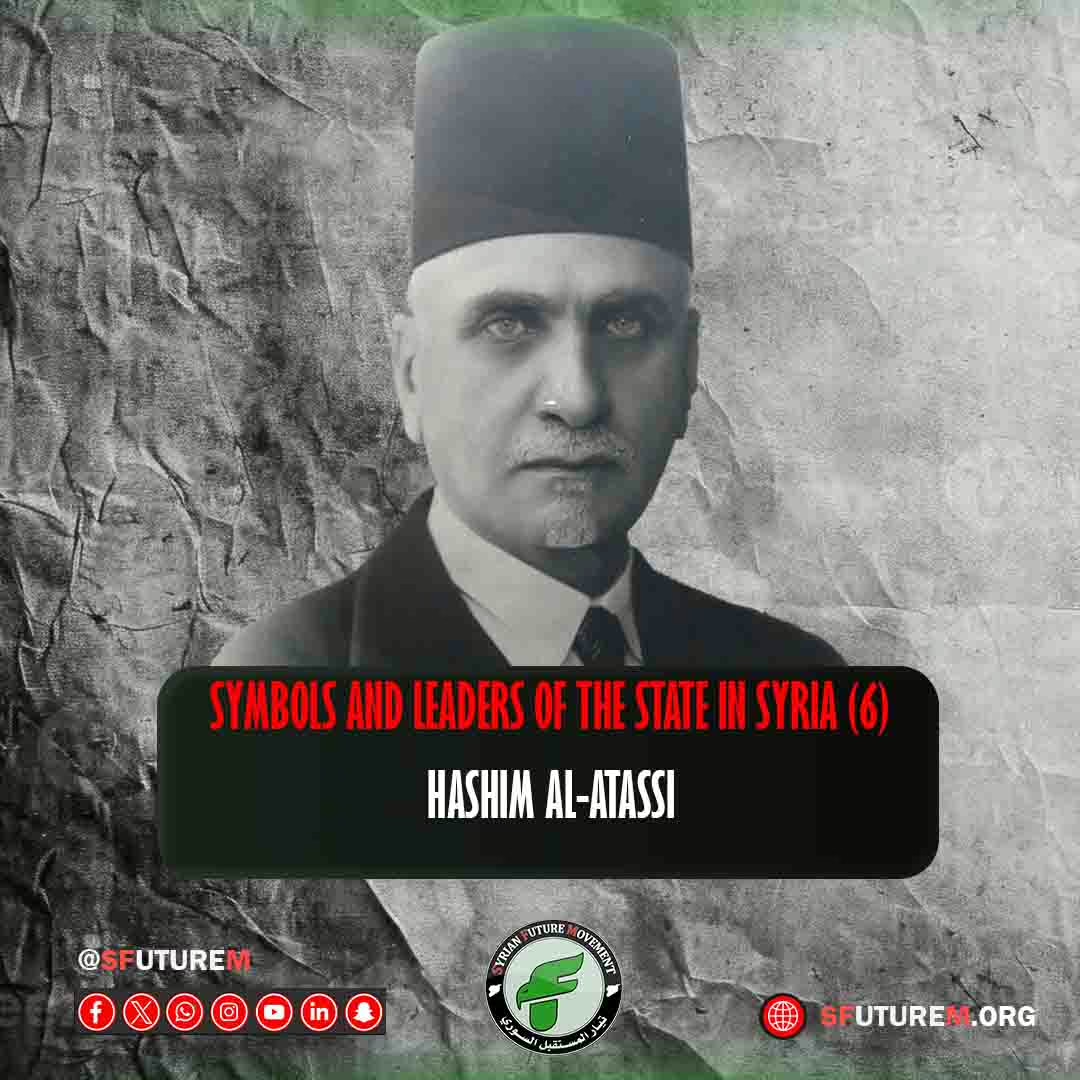
- Hashim al-Atassi was born on December 6, 1875, into a family considered one of the most famous and wealthy feudal families in Homs, with local political activity dating back to the Ottoman Empire.
- He received his primary and secondary education in Homs, then moved to Istanbul, where he studied public administration at the Royal Academy, from which he graduated in 1895.
- His political career began in the Ottoman Empire in 1898, when he was appointed as a prestigious official in the Ottoman province of Beirut.
- After the outbreak of World War I in 1914, he was appointed governor of Homs, Hama, Baalbek, Jaffa and Anatolia.
- Atassi stood on the side of the nationalists demanding independence from the Ottoman Empire, and was elected as a member of the General Syrian Congress, the first Syrian parliament in history, which included the four countries of the Levant, in June 1919.
- On March 8, 1920, he was elected president of the conference, where he declared the establishment of the Syrian Arab Kingdom and crowned Faisal I as king by unanimous vote of the members of the Syrian General Conference.
- Atassi was tasked with heading the drafting committee for the kingdom’s constitution, which was approved in June 1920.
- After the fall of the kingdom following the resignation of al-Rikabi’s second government, King Faisal I appointed him to form a government, which he did on May 2, 1920, making him the second prime minister in Syria.
- The government received and accepted the ultimatum, known as the Goro ultimatum, on June 13, declared a state of emergency on June 15, and announced the dissolution of the Syrian army on June 20, which led to protests and riots in Damascus and other cities as well as the occupation of the Damascus Citadel by protesters.
- His government used live ammunition, killing twenty protesters.
- Henry Gouraud, commander of the French armies in the east, claiming that he had not received the government’s acceptance of the ultimatum, marched on Damascus from Beirut on July 21 and met the remnants of the Syrian army and volunteers at the Battle of Maysaloun on July 24.
- Atassi appointed Abd al-Rahman al-Shahbandar, who is close to France and has prominent relations with European politicians, in order to establish alliances between the kingdom and the West and in an attempt to avoid the French mandate on Syria, but to no avail.
- The French entered Damascus on July 25, and the government moved with the king to Kiswah. It resigned on the same day as a result of the Battle of Maysaloun and the occupation of Damascus, and a pro-Mandate government was formed under the leadership of Alaeddin al-Droubi, and three days later King Faisal was exiled, thus ending the Syrian Kingdom, after Atassi had been in office for about three months.
- During the Great Syrian Revolution, Atassi refused to participate because it was an armed revolution, saying that independence comes as a result of the triumph of right and not violence.
- In October 1927, Atassi met with a number of prominent activists who were known to oppose the French Mandate on Syria, including Shukri al-Qutli, Saadallah al-Jabri, Fares al-Khoury and others, and announced the birth of the National Bloc, which played a prominent role in Syrian political life until 1963.
- He formed individual governments several times during the Mandate and Independence periods.
- The formation of the National Bloc was a response to the People’s Party, which was known to be pro-French and was headed by Abd al-Rahman al-Shahbandar.
- He founded the National Bloc in response to the suppression of the Great Syrian Revolution, which began in 1925 and was suppressed by the French in August 1927. Atassi and his comrades in the National Bloc believed that Syria’s independence and unity could be achieved through peaceful means instead of violent resistance.
- Hashim Atassi was elected president of the National Bloc and a permanent member of its bureau.
- Atassi’s National Bloc included feudal lords, lawyers, employees, students, and all segments of Syrian society.
- Atassi worked to make the national movement active not only within the boundaries of the “Syrian state” declared by the French over Damascus and Aleppo in 1925, but also in Latakia, Suwayda, and other areas.
- After Taj al-Din al-Hassani’s negotiations with French Commissioner Henri Ponceau led to the election of a constituent assembly to draft a constitution in 1928, Atassi chaired the assembly.
- Atassi’s constitution stipulated that the system was a parliamentary republic.
- During protests in Syria in 1930 in response to the failure to publish the constitution and call for parliamentary elections, the French arrested Atassi for several months and transferred him to the island of Arwad.
- When the French called for parliamentary elections in Syria in 1932, the National Bloc won seventeen seats, including Atassi.
- On December 21, 1935, the National Bloc organized a memorial ceremony on the occasion of the fortieth anniversary of the death of Ibrahim Hanano on the amphitheater of the Syrian University. During the ceremony, Fares al-Khoury announced the “National Charter.” Bloody strikes and security disturbances began in its wake, while al-Abid and the government of Sheikh al-Taj were unable to suppress them. Following these protests, the offices of the National Bloc in Damascus and Aleppo were closed and a number of its leaders, such as Saadallah al-Jabri, were arrested. The people responded with a comprehensive strike in Damascus and other cities that lasted sixty days, and the French army was forced to deploy in the streets of the main cities and De Martel threatened to bomb Damascus as in 1925, and Iraq, Lebanon, Jordan, Palestine and Egypt witnessed demonstrations in support of the Syrian people as well as support from Britain, and as a result of international pressure the French Commissioner had to meet with Hashem Atassi, head of the National Bloc, and agreed to form a new government and a Syrian delegation to travel to France to negotiate a new treaty that guarantees the rights of Syrians.
- As a result of the agreement, al-Hasani’s government resigned and the fourth and last government of the Al-Abid era was formed, headed by Atta al-Ayoubi on February 23, 1936.
- About a month later, on March 21, the National Bloc delegation left for France, headed by Atassi. Negotiations lasted six months until September, when the agreement between the delegation and the French government was announced on September 9, and the texts of the draft agreement were published on October 22, to be signed before the end of the year.
- In early October, the national delegation returned from Paris by train to Aleppo, where it received a rousing public reception prepared by the National Bloc office and attended by High Commissioner de Martel, who called the treaty “the miracle of the twentieth century.”
- Abed called for parliamentary elections, the second in Syria’s history, which the bloc won with an overwhelming majority.
- One of the immediate results of the agreement between the bloc and France was the reattachment of the Alawite Mountain State and the Druze Mountain State to the motherland on December 5, 1936, in exchange for retaining their administrative and financial autonomy.
- The parliament of the Alawite Mountain State declared Latakia’s financial and administrative independence to be “equal to other Syrian provinces” and appointed Mazhar Pasha, a pillar of the National Bloc, as its governor.
- The new parliament opened on December 21, 1935, and on the same day Abed resigned.
- In the session that accepted al-Abed’s resignation, Hashim al-Atassi was elected president, and the first government was formed, headed by Jamil Mardam, a key pillar of the National Bloc.
- Atassi submitted his resignation on May 7, 1939. In his resignation statement, he said that France continues to stall over Syrian independence and the withdrawal of all French armies, as well as the declaration of the Iskenderun Brigade as an independent state in 1938, followed by the withdrawal of French armies from it only to be intervened by Turkish armies in 1939.
- Atassi returned to Homs and refused to participate in political activity, announcing his retirement.
- Charles de Gaulle visited him during a visit to Homs and invited him to rescind his resignation, stressing that France would like to recognize Syria’s full independence after the end of the war, but Atassi refused.
- In 1941, Taj al-Din al-Hasani was appointed president of the republic, constitutional life was restored, and parliamentary elections were held in 1943, according to which the National Bloc won again. Atassi supported the candidacy of Shukri al-Qutli, a Damascus leader, as president of the republic, and thus Atassi was known as a president and a maker of presidents.
- During the 1947 government crisis, al-Qutli offered Atassi to become prime minister to head a government of national unity. Atassi stipulated that if he agreed to form the government, he would limit the president’s powers, which were increasing in a way that was incompatible with a parliamentary republic, but al-Qutli refused.
- In March 1949, al-Qutli was overthrown by army chief of staff Hosni al-Zaim in the first military coup in the Middle East. Al-Zaim headed a military government for four months before being overthrown by another military coup in August 1949 led by Sami al-Hinnawi, who called on al-Atassi to come out of retirement and form an interim government that would oversee elections that would restore civilian rule.
- Atassi complied with al-Hanawi’s request and formed a national unity government that included all parties.
- During his tenure, a new electoral law was drafted, and women voted for the first time on November 15 and 16, 1949.
- A Constituent Assembly was formed and Atassi was elected to head it, and then nominated for a second term as president.
- Atassi was elected president for the second time by a unanimous vote of the members in December 1949.
- Atassi allied himself with the People’s Party and appointed its leader, Nazem al-Qudsi, as prime minister.
- During his reign, negotiations for unification with Iraq were opened.
- His second term saw the closure of the border with Lebanon under the pretext of preventing the influx of Lebanese goods that were flooding the Syrian market.
- After Atassi traveled to Baghdad and met with King Faisal II, there was opposition from Adib al-Shishakli, one of the most prominent army commanders, who warned Atassi of the consequences of Baghdad’s seizure of Damascus, but Atassi rejected the military pressure, and al-Shishakli staged a coup in December 1949 and arrested Sami al-Hanawi, a prominent sympathizer of the People’s Party, and a number of pro-Iraqi officers in the Syrian army.
- In the period between the 1949 coup and the 1951 coup, Atassi accepted Shishakli’s terms. For complex reasons, Shishakli staged the 1951 coup, arrested the prime minister and all members of the People’s Party and all ministers and statesmen who supported the Hashemite family, and dissolved the parliament.
- In protest, Atassi submitted his resignation to the dissolved parliament on December 24, 1951, refusing to submit it to Shishakli, as his rule was unconstitutional.
- Throughout Adib Shishakli’s rule from 1951-1954, Atassi led a covert opposition against him, asserting that his rule was unconstitutional.
- Shishakli’s son Adnan was arrested. In response, Shishakli placed Atassi under house arrest and did not put him in prison out of respect for his prominent role in Syrian political life.
- On March 1, Atassi returned from Homs to Damascus and resumed his duties as president. He also reinstated the cabinet and its head, Ma’ruf al-Dawalibi, and restored all ambassadors, ministers, and parliamentarians who had been removed from their previous positions by al-Shishakli.
- As he pursued his second term, Atassi tried with all his might to eradicate every trace of Shishakli for four years.
- At the age of 80, Atassi spent his last years in power fighting the influence of military officers and seeking to limit the influence of leftist parties that were growing in the country along with socialism and sympathy for the Soviet Union, as well as Gamal Abdel Nasser, who was supported by a number of Atassi family figures such as Jamal Atassi and Noureddine Atassi.
- While in power, Atassi was able to neutralize Syria and keep it out of the socialist camp.
- In 1955, Atassi was tempted to accept the Baghdad Pact, a U.S.- and British-sponsored agreement designed to contain Soviet influence in the region, but Nasserist officers in the Syrian army prevented him from doing so.
- During the conflict between Hashemite Iraq and Nasser’s Egypt, Atassi sided with Iraq and allied himself with Nuri al-Said.
- After dismissing al-Asali, Atassi appointed Fares al-Khoury as prime minister.
- Atassi dispatched his Prime Minister al-Khoury to Egypt to lodge a protest with the Egyptian government against Nasser’s domination of Arab affairs.
- Atassi’s term ended in September 1955 and he retired from political life and returned to Homs, where he resided in his home.
- His son Adnan Atassi was convicted of allying with Iraq to stage a military coup to overthrow the pro-Nasser Shukri al-Qutli. Adnan was sentenced to death for high treason, but out of respect for his father, the sentence was commuted to life imprisonment.
- The officers who ran the military court had handed down harsh sentences in retaliation for Atassi’s having reined in military power during his second and third terms, yet he refused to visit his son in prison.
- He died in Homs on December 6, 1960, during the years of the United Arab Republic. His funeral was the largest in the city’s history and was attended by Gamal Abdel Nasser along with senior state officials.
- His vision for the United Arab Republic was realized as it broke away in 1961, three months after his death.
- Atassi was a man of peaceful principles and constitutional methods, in addition to respecting all players in Syrian politics.
- President Hashim Atassi is one of the few members of the Syrian political class from the pre-Baath era who was not criticized and demonized by the Baathists after they came to power in 1963.
- His biography was published in Syria in 2005 by his grandson.
We at Syrian Future Movement, as we recall the memory of the founding statesmen of Syria, we recall one of Syria’s influential men, and one of the symbols of the first Syrian state flags who contributed to influencing its structure, the father of the Republic and the peaceful constitutional approach, His Excellency President “Hashim al-Atassi” within a sequential file that we present to you to include the symbols and flags of the Syrian state In our desire to link our contemporary revolutionary present with a solid past and historical stations, we hope to revive in our people the need to build and create statesmen par excellence, learn from their experiences, build on their history, preserve the homeland, safeguard the gains, and restore the Syrian state to its glory after years of injustice, tyranny and corruption.