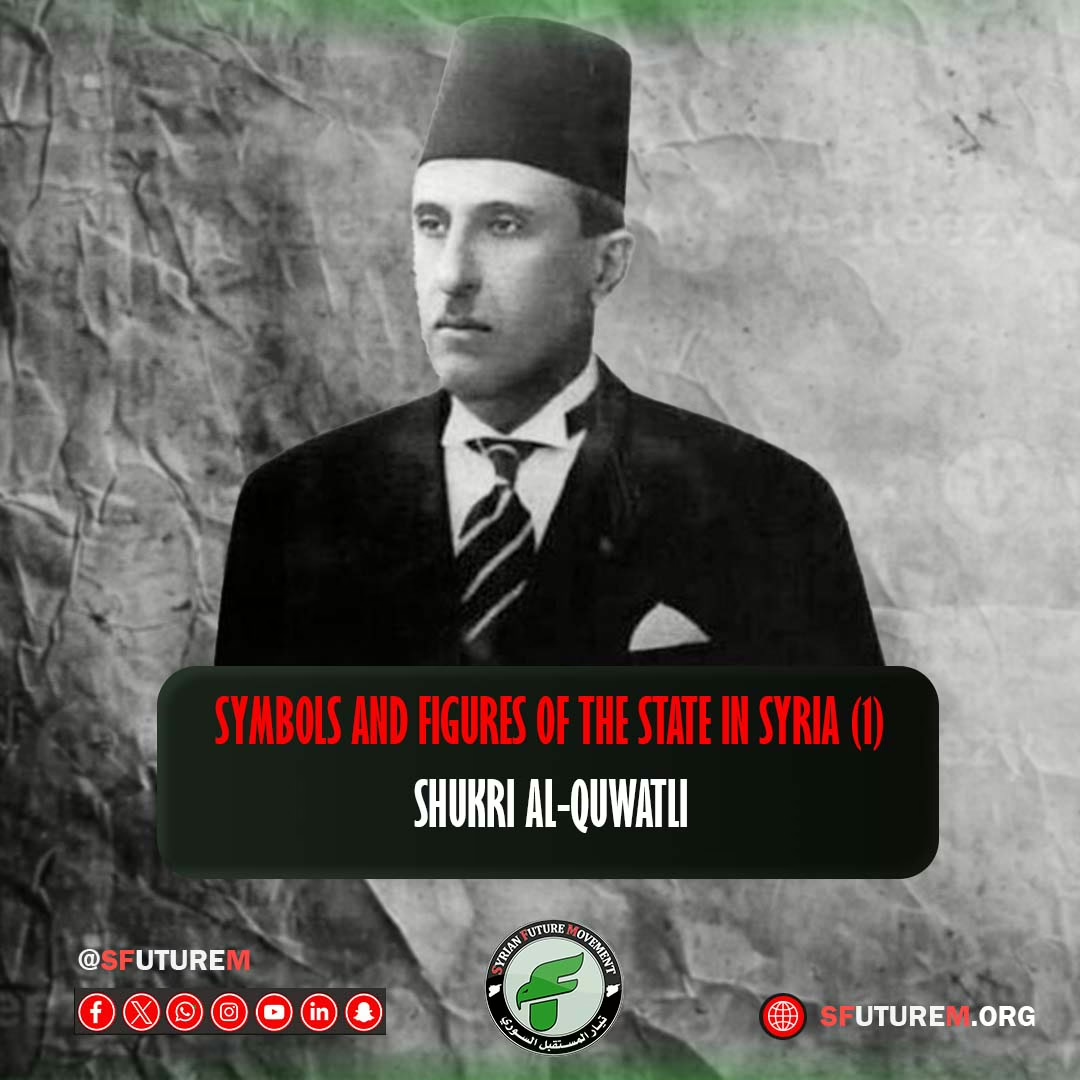
President Shukri al-Qutli (Abu al-Jalaa)
- Shukri al-Qutli was born in the Shaghour neighborhood in Damascus, in 1891 AD, and died in 1949 AD, and the reason for their surname (Qutli) is due to the strength in his family’s physical structure.
- His father “Mahmoud Al-Qutli” is one of the notables of the city of Damascus, and his mother “Najia Muhammad Atta Al-Maqdisi”, which is one of the ancient families in the city of Damascus, and its lineage goes back to the Prophet (peace be upon him), he married Mrs. Bahira Al-Dalati in 1928, from whom he had six children, the eldest of whom “Haytham” died as a child, while the rest of the children are: “Hassan,” “Mahmoud,” “Huda,” “Hanaa,” and “Hala.”
- He studied the Holy Qur’an in Damascus, learned French at the “Azari Fathers” school in Bab Touma, and obtained his high school diploma from the “Anbar” school located behind the Umayyad Mosque in Damascus.
- In 1908, he traveled to Istanbul and graduated in 1913 with an advanced degree in political and administrative sciences from the most prestigious schools in the Ottoman capital, the Royal Shahani Institute.
- He worked as a clerk for the Ottoman governor upon his return to Damascus, and soon became involved against the federalist approach that took over the Ottoman Sultanate and joined the “Arab Girl’s Association”.
- Because of his activity in the Great Arab Revolt, he was arrested by Jamal Pasha, the Ottoman military governor of Syria, and remained in prison until the fall of Ottoman rule after the First World War at the end of September 1918.
- He was appointed director of telegraph and postal services in the province of Damascus during the government of Prince Faisal bin al-Hussein.
- He joined the Arab Independence Party, which advocates the liberation of the Arab nation from foreign occupation.
- After the French occupation of Syria, al-Qutli fled to Egypt as a political refugee at the invitation of King Ahmed Fouad I because he had been sentenced to death by the French High Commissioner.
- He co-founded the Syrian-Palestinian Congress in Geneva, the first political organization that emerged in exile to unite Arab nationalists against the French Mandate, which was divided into two wings, the wing that supported the Saudis, headed by al-Qutli, and the wing that supported the Hashemites.
- Al-Quwatli participated in supporting the establishment of Saudi Arabia, sending advisors, some of whom went on to serve as Saudi Arabia’s foreign minister.
- In 1924, he returned to Damascus after a French pardon.
- He participated in the Great Syrian Revolution in 1925, and went to Sweida and participated in the meeting that was held to nominate “Sultan Pasha al-Atrash” as the general leader of the Great Syrian Revolution.
- He sold his property in Eastern Ghouta, bought weapons for the rebels, and paid the Syrian rebels salaries (two gold liras) every month.
- He was exiled with his comrades after the French arrested them, then left Syria after a death sentence was issued against him and his family home was destroyed in the Shaghour neighborhood, only to return to Syria after a general amnesty was issued for him and his nationalist comrades in 1926.
- He was elected as a member of the “National Bloc” that was established after the failure of the Great Syrian Revolution, which produced the political and legal but not the military line.
- He contributed to the establishment of the Conservatory to finance the work of the “National Bloc” in 1932, which became a national landmark in Syria until the factory was nationalized at the beginning of the Baath Socialist Party era in 1965.
- He was active in the “60th strike” after clashes between the police and the mourners of the body of Ibrahim Hanano, one of the leaders of the National Bloc, in 1935, after which the office of the National Bloc in Damascus was closed, and Al-Qutali was placed under house arrest.
- After the strike was broken, the French signed a twenty-five-year treaty, provided that Syria would gradually be given its independence, then President Muhammad Ali al-Abed resigned and called for early parliamentary and presidential elections in 1936, and Al-Qutli won a parliamentary seat representing the city of Damascus, then was appointed Minister of Defense and Finance in the government of Jamil Mardam Bey, after Hashim Atassi won the presidency of the Syrian Republic.
- After a dispute between him and Prime Minister Khalil Mardam Bey, Al-Qutli resigned in 1938.
- After World War II and the victory of the Allied forces over Germany, the “National Bloc” won the parliamentary elections in 1943, and agreed to nominate Al-Quwatli for the post of President of the Syrian Republic, to win in 1943 the post of President, to repeat the presidential oath under the dome of the Syrian Parliament, and to become the fourth president in the history of modern Syria.
- His presidency was an intensive movement to activate independence from France, and the efforts culminated in inviting Syria to join the United Nations Organization in 1945, and appointing “Fares al-Khoury” as head of the founding Syrian delegation to the United Nations.
- In the same year, a Syrian-Lebanese summit was held in the Lebanese region of Chtaura, and it was agreed to freeze negotiations with France and request a clear time limit for the evacuation of their forces. This prompted French military intervention and aggression against Damascus, including the parliament, the bombing of the Damascus Citadel, and the burning of several areas in Damascus, and Qutli and his companions were labeled as enemies of the French Republic.
- Al-Quwatli’s national and historical positions and diplomatic movements were a reason for the intervention of the British to stop the ceasefire, so that on August 1, 1945, Al-Quwatli declared a national holiday for the establishment of the Syrian army, and on April 17, 1946, he held the first Evacuation Day in Syria with wide Arab participation.
- In 1947, his presidential term was extended for a second time after al-Qutli obtained a parliamentary majority that allowed the amendment of the constitution, which allowed only one four-year presidential term.
- On March 30, 1949, Hosni al-Zaim staged a coup d’état in which al-Qutli and his prime minister were arrested, and al-Qutli announced his resignation, and then he was released with the confiscation of his property and the property of his sons, then he was exiled to Switzerland and then became a guest of King Farouk I in Egypt.
- Al-Qutli returned to Syria in 1954 after Gamal Abdel Nasser became president of Egypt, Hashim al-Atassi became president of Syria, and the Syrian constitution was reinstated.
- He was elected president of Syria in 1955, shifting towards the socialist camp, and the relationship between him and the Americans and the Turks, who considered him a supporter of the Soviet Union during the Cold War.
- In February 1958, al-Qutli signed the “Syrian-Egyptian Unity Pact” after the approval of the Syrian parliament, and relinquished the presidency of the United Arab Republic in favor of Gamal Abdel Nasser, who described al-Qutli as “the first Arab citizen.”
- Abdel Nasser’s policies, especially the issue of nationalization, were a cause of widening differences between him and Al-Qutli. Al-Qutli supported secession in 1961 from Switzerland, where he was receiving treatment, in a televised speech broadcast by Syrian television, and the estrangement between him and Nasser continued until the June War in 1967.
- Al-Quwatli refused the request to return to the presidency of Syria and decided to retire from public life.
- On June 30, 1967, Shukri al-Qutli died in Beirut at the age of 75 after hearing the news of the fall of the Golan Heights to Israel, and his body was returned to Damascus draped with the Syrian flag by King Faisal bin Abdulaziz, and Damascus came out in his funeral, and he was prayed for in the Umayyad Mosque, and buried in the family cemetery in the “Bab al-Saghir” cemetery in Damascus.
We at Syrian Future Movement, as we recall the anniversary of evacuation and independence in the month of April, we recall one of the men of independence and one of the symbols of the flags of the first Syrian state, His Excellency President Shukri al-Qutli, in a sequential file that we present to you to include symbols and flags of the Syrian state, in order to link our contemporary revolutionary present with a solid past and historical stations, hoping to revive in our people the need to build and create statesmen par excellence, to preserve the country, safeguard the achievements, and restore the Syrian state its glory and glory, after the years of injustice, tyranny and corruption.