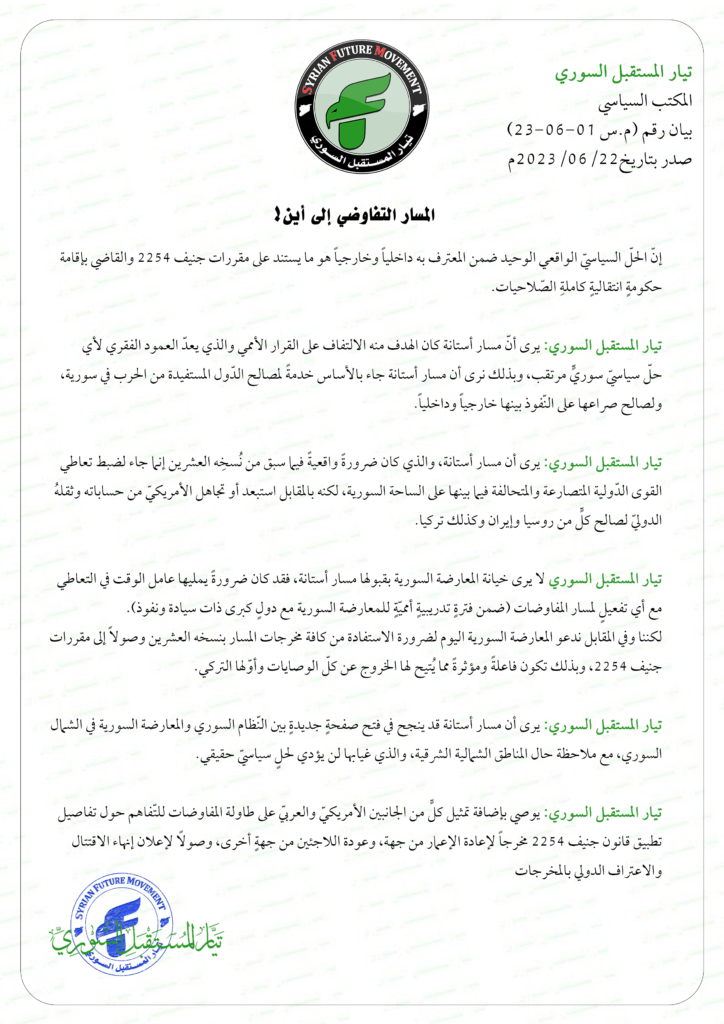
The only realistic political solution, recognized internally and externally, is based on the Geneva 2254 resolutions, which stipulate the establishment of a transitional government with full powers.
The Syrian Future Movement believes that the Astana process was intended to circumvent the UN resolution, which is the backbone of any prospective Syrian political solution. Therefore, we believe that the Astana process primarily served the interests of the countries benefiting from the war in Syria and their struggle for influence, both internally and externally.
The Syrian Future Movement believes that the Astana process, which was a realistic necessity in its twenty previous versions, was intended to regulate the interactions of the conflicting and allied international powers on the Syrian scene. However, it excluded or ignored the United States from its calculations and international influence, in favor of Russia, Iran, and Türkiye.
The Syrian Future Movement does not consider the Syrian opposition’s acceptance of the Astana process a betrayal. It was a necessity dictated by the time factor in dealing with any activation of the negotiations process (within a period of UN training for the Syrian opposition with major sovereign and influential countries).
However, we call on the Syrian opposition today to benefit from all outcomes of the process in its twentieth edition, leading up to the Geneva 2254 resolutions. This will enable it to be effective and influential, allowing it to break free from all tutelage, primarily Turkish.
The Syrian Future Movement believes that the Astana process may succeed in opening a new page between the Syrian regime and the Syrian opposition in northern Syria, noting the situation in the northeastern regions, the absence of which will not lead to a real political solution.
The Syrian Future Movement recommends adding representation from both the American and Arab sides to the negotiating table to reach an understanding on the details of implementing Geneva 2254 as a way out for reconstruction on the one hand, and the return of refugees on the other, leading to an announcement of an end to the fighting and international recognition of the outcomes.