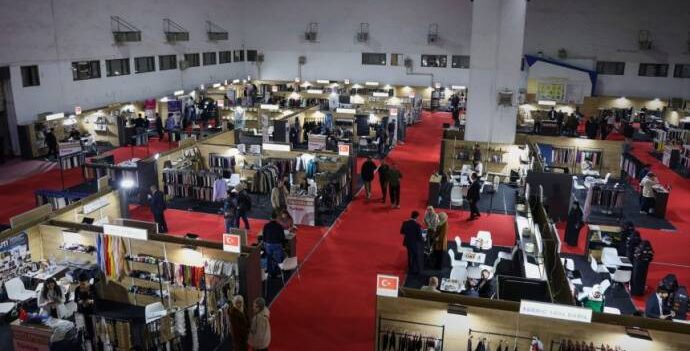
The Syrian Future Movement is closely following the launch of the fifth edition of the International Textile, Fabrics, Textile Machinery, and Production Supplies Exhibition, “TAFMEX SYRIA 2026,” at the Damascus Fairgrounds on Thursday, November 12, 2026. The exhibition, organized by Tamam Al-Tabbaa Exhibitions and Conferences in cooperation with the Syrian Establishment for Exhibitions and International Markets, features 45 companies from Syria and Turkey and will run until November 14.
The Syrian Future Movement commends this initiative, which embodies the continued economic activity in Damascus and provides an opportunity for Syrian and Turkish companies to showcase their products and build commercial partnerships in a sector that is among the oldest and most competitive Syrian industries, both regionally and internationally.
The Syrian Future Movement notes that the textile industry in Syria is a pillar of the national economy and has suffered for years from the destruction of its infrastructure, the displacement of skilled workers, the disruption of supply chains, and a decline in its competitiveness.
The Syrian Future Movement believes that hosting a specialized international exhibition in Damascus, with the participation of established Turkish companies in this field, presents a genuine opportunity for exchanging expertise, transferring technology, and reconnecting Syrian products with regional and international markets, following the successful experiences of countries that witnessed a textile revival after similar crises.
However, the Syrian Future Movement notes that the level of participation in this year’s event (45 companies) raises a legitimate question, especially when compared to the “NAS TEX 2026” exhibition held last July under the patronage of the head of the transitional government, Ahmed al-Sharaa, which featured more than 300 companies representing over 20 countries.
The Syrian Future Movement asks: Does this significant difference reflect a decline in interest in the exhibition, or does it indicate a need for a more effective marketing strategy to attract international participation? And is there a plan to link the exhibition to financing programs and customs facilitations that would incentivize small and medium-sized enterprises to participate?
The Syrian Future Movement points out that the Syrian textile sector continues to face fundamental challenges, most notably: the difficulty of obtaining raw materials at competitive prices, the obsolescence of machinery and equipment in many factories, the shortage of trained technical personnel, and weak financing and export insurance mechanisms.
The Syrian Future Movement believes that an exhibition the size of “TAFMEX SYRIA” can serve as a platform to address these challenges, provided it is linked to specialized workshops, discussion sessions between industrialists and decision-makers, and technical and financial support programs announced during the exhibition.
The Syrian Future Movement reiterates its firm position, published on its official website in its statement entitled “The First Industrial Mall in Aleppo,” dated August 5, 2026, where it emphasized that “industrial development cannot be achieved through isolated decisions, but rather through a comprehensive national strategy that integrates infrastructure development, legislative modernization, attracting investments, and developing human resources.”
The Syrian Future Movement believes that this principle applies perfectly to the textile sector, which needs an integrated vision that goes beyond seasonal exhibitions to building an industrial system capable of sustainable competition.
The Syrian Future Movement values the participation of Turkish companies in the exhibition, viewing it as a natural extension of the developing economic and trade relations between the two countries, which have been embodied in agreements and memoranda of understanding covering the energy, mining, transportation, and trade sectors.
The Syrian Future Movement believes that transferring Turkish expertise in the textile industry, one of the strongest globally, can contribute to modernizing Syrian industry, improving the quality of its products, and increasing its competitiveness in foreign markets.
However, the Syrian Future Movement emphasizes that true partnership is not limited to companies’ participation in exhibitions, but extends to joint investments, training programs for Syrian personnel, the transfer of manufacturing technology, and linking supply chains between the two countries.
The Syrian Future Movement calls for the participation of Turkish companies in the exhibition to translate into concrete industrial partnership agreements, the results of which should be announced at the conclusion of the event, rather than remaining merely a protocolary presence.
Based on its national responsibility, the Syrian Future Movement recommends the following:
First: Announcing a package of incentives during the exhibition, including reductions in export fees, accessible financing mechanisms for exporters, and export risk insurance, to enable participating companies to convert their agreements into actual exports.
Second: Developing a marketing plan to attract companies from other countries (such as China, India, Egypt, Jordan, and Italy) to capitalize on Syria’s geographical location and regional relations, similar to the “NAS TEX” exhibition, which attracted more than 20 countries.
Third: Launching training and development programs for personnel working in the sector, in cooperation with Turkish companies and international organizations, to organize specialized training courses in modern manufacturing technologies, quality management, and design, during or after the exhibition, to ensure knowledge transfer and not just product display.
Fourth: Announcing official figures on the number of deals concluded, the volume of investments attracted, and the number of partnership agreements signed, to enable the public to assess the effectiveness of these events and their impact on the national economy.
Fifth: Linking the exhibition to a comprehensive national strategy for the advancement of the textile industry, making this event part of a broader plan that includes modernizing machinery, upgrading factories, developing local supply chains, training workers, and supporting research and development in designs and fabrics, thereby restoring the Syrian textile industry to its historical prominence.
The Syrian Future Movement appreciates the launch of the “TAFMEX SYRIA 2026” exhibition and sees it as a positive step towards reviving the Syrian textile sector.
However, the Syrian Future Movement reminds everyone that exhibitions alone do not create an industrial renaissance, and that the decisions, facilitations, and support programs that follow the exhibition will determine whether this event is merely a fleeting annual occurrence or a genuine starting point for restoring the Syrian textile industry’s position in global markets.
The Syrian Future Movement affirms that the textile industry, which has always been The pride of Syrian industry deserves more than a limited-participation exhibition; it deserves an ambitious national strategy, genuine international partnerships, sustained government support, and a collective will to rebuild what the war has destroyed.
For its part, the Syrian Future Movement will remain a supporter of all that strengthens economic recovery, critical of all shortcomings, and vigilant observer of all that is accomplished on the ground, striving for a new Syria that regains its industrial and commercial prominence.