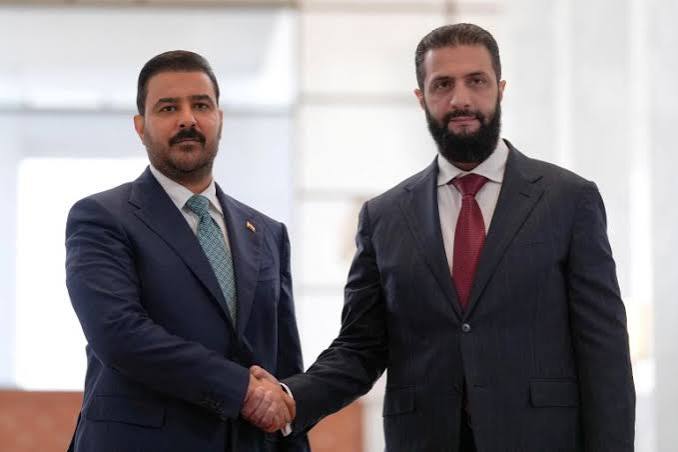
On October 28, 2026, President Ahmed Al-Sharaa received Iraqi Prime Minister Ali Falih Al-Zaidi in Damascus—the first visit at this level since the political transition that took place at the end of 2024.
This visit reflects a shift in the logic governing relations between two countries that share a border of over 600 kilometers, a common history, and intertwined security and economic challenges.
The move also represents a genuine opportunity to rebuild a partnership based on mutual interests; at the same time, however, it tests the capacity of the transitional authority in Damascus to translate political declarations into transparent, sustainable institutions and operational mechanisms.
World Bank estimates indicate that the Syrian economy recorded real growth of 0.8% in 2024, rising to 3.6% in 2025, with projected growth of 8% to 10% in 2026—driven by a relative recovery in the oil and agricultural sectors, as well as reconstruction efforts.
This recovery—though fragile and still subject to inflationary pressures (which had reached high levels in the past)—creates an opening for cooperation with Iraq, which is seeking alternative export routes following disruptions in the Strait of Hormuz.
Consequently, the project to reactivate the Haditha–Baniyas pipeline has taken center stage in the discussions, with a target capacity of up to two million barrels per day.
A memorandum of understanding was previously signed in July 2026, and limited quantities have already begun to be exported via Syrian territory.
If implemented according to transparent technical and financial standards—and with the participation of international consortia (including American companies)—this project could provide Syria with transit revenues and job opportunities in rehabilitation and operations, while granting Iraq a strategic outlet to the Mediterranean. Bilateral trade remains weak; 2024 data indicates a total of only about $124 million—comprising approximately $106.7 million in Syrian exports to Iraq, with Iraqi exports to Syria remaining limited.
Chambers of commerce anticipate that this figure could rise to $300–500 million by 2027, provided that border crossings are rehabilitated and customs procedures are improved—a projection that excludes energy-related trade.
Agricultural cooperation is also being proposed as a pathway toward food integration. Both nations possess significant agricultural potential; however, the lack of sustainable coordination mechanisms, inadequate logistical infrastructure, and the absence of guarantees for investors have thus far prevented the full realization of this potential.
As for the security of the shared border, this remains the most pressing issue.
Smuggling, the movements of armed groups, and the influx of fighters are all common challenges that demand continuous operational coordination—going well beyond the mere issuance of joint statements.
The transitional authority in Damascus has repeatedly affirmed its commitment to consolidating all arms under the control of the state—an objective that aligns with efforts in Baghdad.
Yet, the success of this approach hinges on the development of professional, accountable security institutions—free from the sub-national loyalties or informal arrangements that have long plagued the region.
Politically, the visit reflects a desire by both sides to align their positions regarding regional developments. However, a genuine partnership cannot be built solely at the level of summits. This requires permanent institutional mechanisms, effective joint committees, and broader participation from the private sector and local communities on both sides of the border.
It must be emphasized that while any Syrian would welcome steps that enhance stability, development, and Syria’s national interests, we must caution against the risks of relying too heavily on announcements that lack clear implementation mechanisms.
Past experience in the region has shown that major projects—involving oil, trade, or border management—often falter due to a lack of transparency, weak governance, and the absence of community engagement.
The transitional authority faces a dual challenge:
Demonstrating its capacity to manage sensitive sovereign issues with technical competence.
Building domestic trust that these partnerships serve the interests of the citizenry, rather than merely facilitating narrow, elite-driven arrangements.
Success will necessitate clear accountability standards, the disclosure of contract details and memoranda, and the involvement of independent experts in monitoring progress.
Consequently, several future scenarios are possible:
The First Scenario (Optimistic/Integrative):
Tangible progress is achieved within 12–18 months, including the partial rehabilitation of the Baniyas pipeline, a significant increase in cross-border trade, and the establishment of an effective joint security framework.
This would positively impact economic growth in border regions and help solidify Syria’s image as a reliable regional partner.
However, this scenario requires sustained political will and international technical support. The Second Scenario (Realistic/Gradual):
Limited and slow progress is achieved—specifically, modest oil volumes, partial improvements at border crossings, and situational security coordination.
Administrative and security challenges persist, and the scale of economic gains remains modest relative to the potential.
This scenario appears the most likely in the short term, provided that institutional weaknesses are not addressed.
The Third Scenario (Cautious/Stalled):
Implementation falters due to technical, financial, or security obstacles, or because a lack of transparency fuels internal skepticism.
In this case, visits are reduced to mere protocol-driven events with no tangible developmental impact, and trust gradually erodes.
Based on this, the following recommendations are proposed:
- Establish transparent monitoring mechanisms: Create joint technical committees that publish periodic reports on project progress, particularly regarding the oil pipeline and border crossings.
- Engage the private sector and local communities: Ensure that transit and trade revenues benefit border regions through investments in infrastructure and services.
- Build institutional capacity: Train Syrian personnel in large-scale project management and economic governance, in collaboration with international partners.
- Prioritize sustainable security: Link any security cooperation to human rights standards and accountability to ensure long-term stability.
- Adopt a broader economic vision: Move beyond a focus solely on oil; invest in electrical grid interconnection, transportation, agriculture, and shared religious and historical tourism.
- A parallel internal dialogue: initiating a public discussion within Syria regarding the priorities for regional partnerships, thereby strengthening the popular legitimacy of the transitional process.
Al-Zaidi’s visit opens an important door; yet, a door alone is not enough. What is required is a genuine transition toward robust institutions, real transparency, and tangible gains for the citizens.
For our part—as an independent civil political movement—we follow this path with a perspective of constructive criticism and responsible hope, fully aware that stability Development serves as the true guarantee for any transitional authority seeking to establish its legitimacy upon firm national foundations.