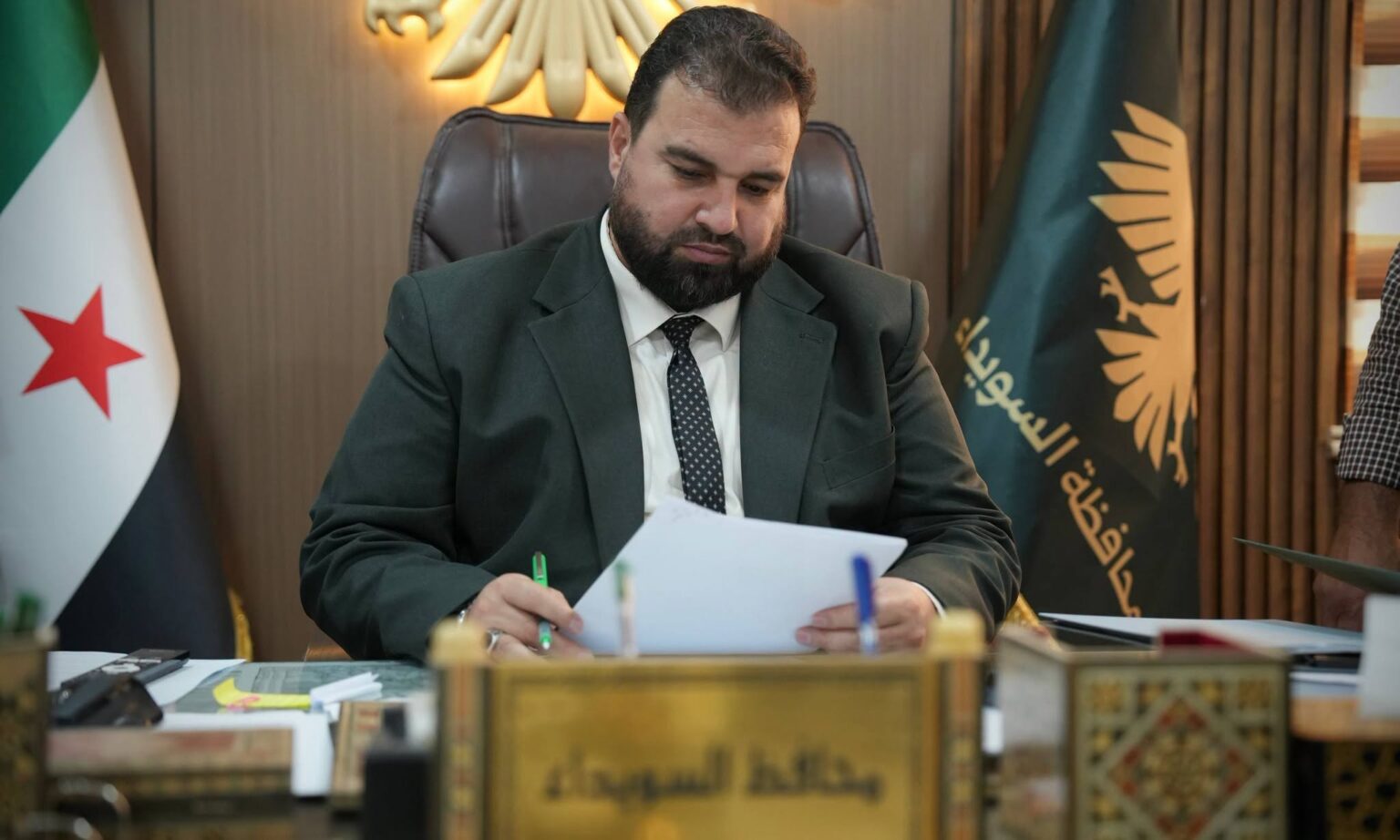
The Syrian Future Movement is following with interest the statements made by the Governor of As-Suwayda, Dr. Mustafa Al-Bakour, on Sunday, October 18, 2026. In these remarks, he affirmed the Syrian state’s readiness to engage in dialogue with the people of the governorate and to bring various outstanding issues to the discussion table. He emphasized that such dialogue does not constitute a concession by the state, nor a defeat for the people of As-Suwayda; rather, it serves as a means to address internal disputes within the nation.
The statements also addressed the deteriorating security and living conditions, the issue of outlawed armed groups, procedures for investigation and accountability, and a roadmap for resolving the crisis. Furthermore, it was announced that initial restoration work is underway in approximately 20 to 25 villages, in preparation for the return of residents to their homes.
Guided by our steadfast national commitment to the unity and sovereignty of Syria, and our dedication to upholding the dignity and rights of all Syrians, the Syrian Future Movement views these statements as an opportunity to revitalize the political and social process—provided that the approach shifts from mere repeated calls for dialogue to the provision of practical guarantees for its success.
First: The Syrian Future Movement welcomes the renewed call for dialogue. We affirm that dialogue between the state and its citizens is neither a concession by the authorities—nor a diminution of their standing—nor is it a defeat for any social or political component.
We believe that the strength of a state is manifested in its capacity to accommodate differences, address grievances, and protect rights—not in the imposition of solutions through force or the exclusion of those who hold opposing views. We also affirm that our people in As-Suwayda are an integral part of the Syrian national fabric. Their legitimate demands must be discussed within an inclusive national framework—free from accusations of treason, sweeping generalizations, or the practice of holding an entire community responsible for the actions of specific individuals or groups.
Second: The Syrian Future Movement recalls its previous positions, notably the statement titled “The Governor of As-Suwayda Calls for National Reconciliation,” issued on January 20, 2026, and the statement titled “Supporting the As-Suwayda Governor’s Call to Form an Inclusive National Dialogue Committee,” issued on January 24, 2026. In both, we emphasized the necessity of establishing dialogue committees that represent all parties and launching a national process to address the root causes of the crisis.
Months after these calls were made, it has become urgently necessary to establish a clear timeline, fair representation mechanisms, and mutual guarantees—ensuring that the dialogue does not merely become a recurring political slogan devoid of tangible results.
Third: The Syrian Future Movement asserts that addressing the events in As-Suwayda cannot be achieved by overlooking violations or disregarding the rights of victims. Instead, it requires an independent judicial process that ensures accountability for everyone proven to be involved in crimes or violations—regardless of their affiliation, position, or the entity to which they belong.
We believe that true reconciliation does not mean simply turning the page on the past without securing justice for those whose rights have been violated; rather, it means preventing the recurrence of such tragedies through justice, accountability, and reparation for the harm caused. We also call for the completion of investigations across all regions, the resolution of cases involving missing and abducted persons, and the provision of necessary guarantees for the return of displaced individuals—free from fear or the threat of reprisal.
Fourth: The Syrian Future Movement reiterates its rejection of the presence of armed factions operating outside legal frameworks and state institutions. Furthermore, it opposes any security practices that transcend the law or infringe upon the dignity of citizens.
We emphasize that addressing this issue requires a phased national plan—one that accounts for the specificities of the social landscape, provides security and judicial safeguards, and prevents any slide toward new confrontations.
The state we aspire to does not monopolize force for the benefit of a specific authority or group; rather, it regulates the use of force under the law to protect all citizens without discrimination.
Fifth: The Syrian Future Movement warns against the danger of exploiting the internal crisis in As-Suwayda to impose security or political arrangements that serve the interests of external powers—foremost among them the occupying Zionist entity, whose interventions cannot be viewed separately from its ambitions in southern Syria.
We further assert that protecting Syria’s sovereignty is inseparable from protecting the rights of its citizens. Addressing the root causes of internal tension, and closing the door on marginalization and discrimination, is a national necessity for fortifying society against foreign interference.
As-Suwayda is neither a bargaining chip for regional negotiations nor an arena for settling scores; it is a Syrian governorate, whose people are partners in the nation’s present and its future.
Sixth: The Syrian Future Movement welcomes the announcement of initial restoration work in several villages across the governorate. It emphasizes the necessity of continuing these efforts within a transparent, government-led plan that includes the rehabilitation of housing and infrastructure, the provision of essential services, compensation for those affected, and the establishment of the security and social conditions required for the return of the local population.
We assert that the success of any political settlement must be measured by its ability to improve the lives of citizens, ensure their return to their homes, and restore trust between society and state institutions.
Seventh: Based on the above, the Syrian Future Movement calls for:
- The formation of an inclusive national dialogue committee, comprising genuine representatives from the various social components and groups in As-Suwayda, free from monopolization or exclusion.
- The announcement of a roadmap with defined stages and timelines, incorporating clear commitments and independent mechanisms to monitor its implementation.
- The completion of judicial investigations into the events in As-Suwayda, and the holding of all those involved in violations accountable, without exception.
- Addressing the cases of missing persons, those abducted, and those detained, while activating mechanisms for humanitarian exchanges and legal releases that uphold rights and judicial guarantees.
- The development of an urgent program for the return of displaced persons and for reconstruction, accompanied by the publication of periodic reports on progress and funding.
- The adoption of administrative and service-related decentralization within the framework of a unified Syrian state, thereby enhancing the participation of local communities in managing their own affairs without compromising national sovereignty.
The shielding of civilians from armed conflict, and the rejection of any foreign interference that threatens Syria’s unity or exploits the suffering of its people. The Syrian Future Movement believes that the statements made by the Governor of As-Suwayda present an opportunity that should be built upon. However, their success will not be measured by good intentions or repeated appeals, but rather by the ability of the concerned parties to translate them into concrete actions that restore security, trust, and rights to those to whom they belong.
Furthermore, we emphasize…The responsibility for ending the crisis does not lie solely with the state, nor with the people of As-Suwayda alone; rather, it is a national responsibility that demands the courage to acknowledge mistakes, a sincere will to address them, and a readiness to prioritize the supreme Syrian interest over factional or personal interests.
Furthermore, we emphasize that restoring the trust of our people in As-Suwayda toward state institutions is a national necessity. Such trust cannot be imposed by force, nor can it be solicited through mere slogans; it must be built upon justice, honesty, transparency, and the fulfillment of commitments.
A Syria that embraces all its children is the only one capable of safeguarding its own unity, and a state that treats its citizens equitably is the best equipped to preserve its sovereignty.