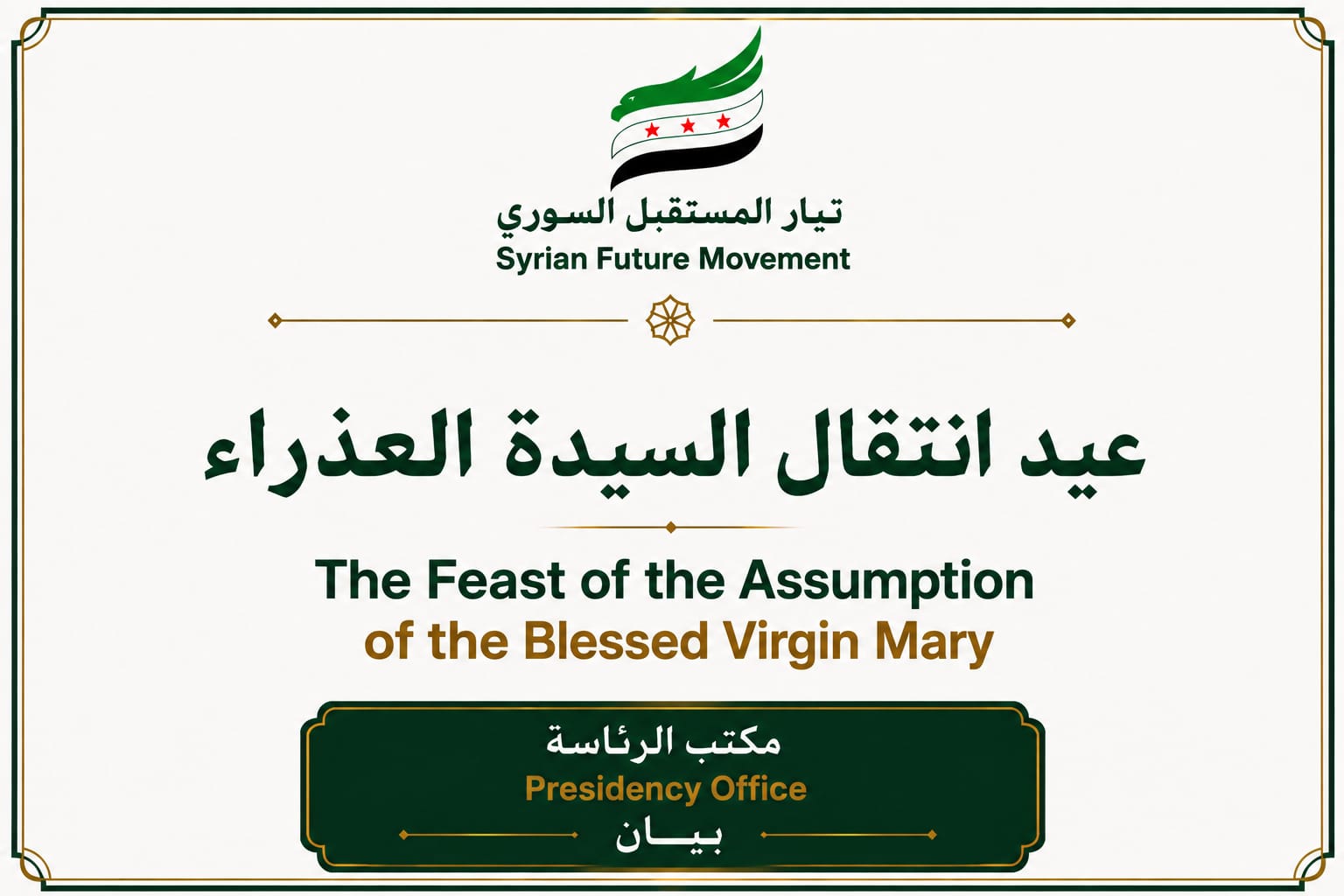
The Syrian Future Movement extends its warmest congratulations and best wishes to the Syrian people in general, and to our Christian brothers and sisters in particular, on the occasion of the Feast of the Assumption of the Virgin Mary, which falls on August 15th each year.
This feast is a unifying national occasion, during which official government offices are closed, and the hearts of Syrians from all walks of life come together in appreciation of the symbolism of the Virgin Mary, whom human thought and holy scriptures have honored with a high status of purity, peace, and justice.
We in the Syrian Future Movement, as we lay the foundations for the Syrian transitional phase, see in these shared holidays a philosophical opportunity to reaffirm the importance of our pluralistic national identity.
The true recovery of Syria begins with the restoration of its spiritual and social fabric, and with the affirmation that the Christian presence in Syria is not a fleeting or minority presence, but rather a deep-rooted and authentic part of this nation, which has contributed for thousands of years to shaping its thought and civilization.
The Syrian Future Movement believes that this day carries within its intellectual dimensions dimensions that Syria needs today more than ever:
- The Value of Lost Peace: The Virgin Mary represents a universal symbol of motherhood, tranquility, and tolerance—values to which the Syrian people aspire to escape the cycles of violence and exclusion.
- Human and Spiritual Integration: The convergence of Muslims and Christians in Syria through their love for the Virgin Mary is conclusive proof of the depth of shared values that transcend attempts at fragmentation and sectarian division.
- Preserving Dignity and Justice: Protecting the rights of all communities and safeguarding their religious freedoms is the essence of the moral struggle to build a sound, democratic society.
The Syrian Future Movement notes that social and statistical projections for 2026 reveal the depth of the demographic loss that requires urgent attention:
- The Forced Emigration of Christians: National and international documentation reports indicate that Syria has lost more than 60% of its Christian population over the past two decades, who were forcibly displaced due to insecurity, extremism, and the targeting of their historical regions. This threatens a structural flaw in Syria’s pluralistic identity.
- Destruction of Historical Heritage: Dozens of ancient churches and monasteries (in Maaloula, Saidnaya, Homs, and Old Aleppo) suffered extensive damage and systematic destruction as a result of the war, requiring massive international and national efforts to rebuild them as endowments and shared human heritage.
- Determination to Survive: Despite all the challenges, spiritual and social institutions in Syria continue to play a relief and developmental role that transcends sectarian divisions, demonstrating the effectiveness of local crisis management.
The Syrian Future Movement affirms the following principles in its vision for building a contemporary social contract:
- Full and equal citizenship. A “new Syria” cannot be built on the foundations of sectarian quotas or exclusion. The alternative is a state of law that protects the individual as a citizen with all rights and responsibilities, regardless of their religious or ethnic affiliation.
- Protecting endowments and holy sites: We consider the maintenance of historical churches, mosques, and monasteries a sovereign responsibility of the state and an integral part of protecting the country’s national and cultural security.
- Facilitating the return of displaced persons and prioritizing the return of Syrian Christian emigrants and the restoration of their confiscated or damaged properties within transitional justice and economic recovery programs.
Based on this national and societal perspective, the Syrian Future Movement recommends the following:
- Institutionalizing a dialogue on citizenship during the transitional phase: We call for the establishment of national councils for cultural and spiritual dialogue, bringing together intellectual elites from all communities to solidify the values of tolerance and combat hate speech and extremism.
- A national program for the reconstruction of historical cities: Coordination with UNESCO and relevant international organizations to restore archaeological villages and towns (such as Maaloula, Saidnaya, and the old quarters of Aleppo and Homs) to support cultural tourism and revitalize the local economy.
- Strict legislative and legal guarantees: The drafts of the upcoming constitution must include clear and codified provisions prohibiting discrimination based on religion and guaranteeing all Syrian communities the freedom and security to manage their religious endowments and personal status laws.
- Educational curricula that foster coexistence: Educational curricula must be reformed to highlight the shared Christian and Muslim history in Syria and to celebrate Syrian scholars and innovators from all backgrounds, thus strengthening pride in a unified Syrian identity.