
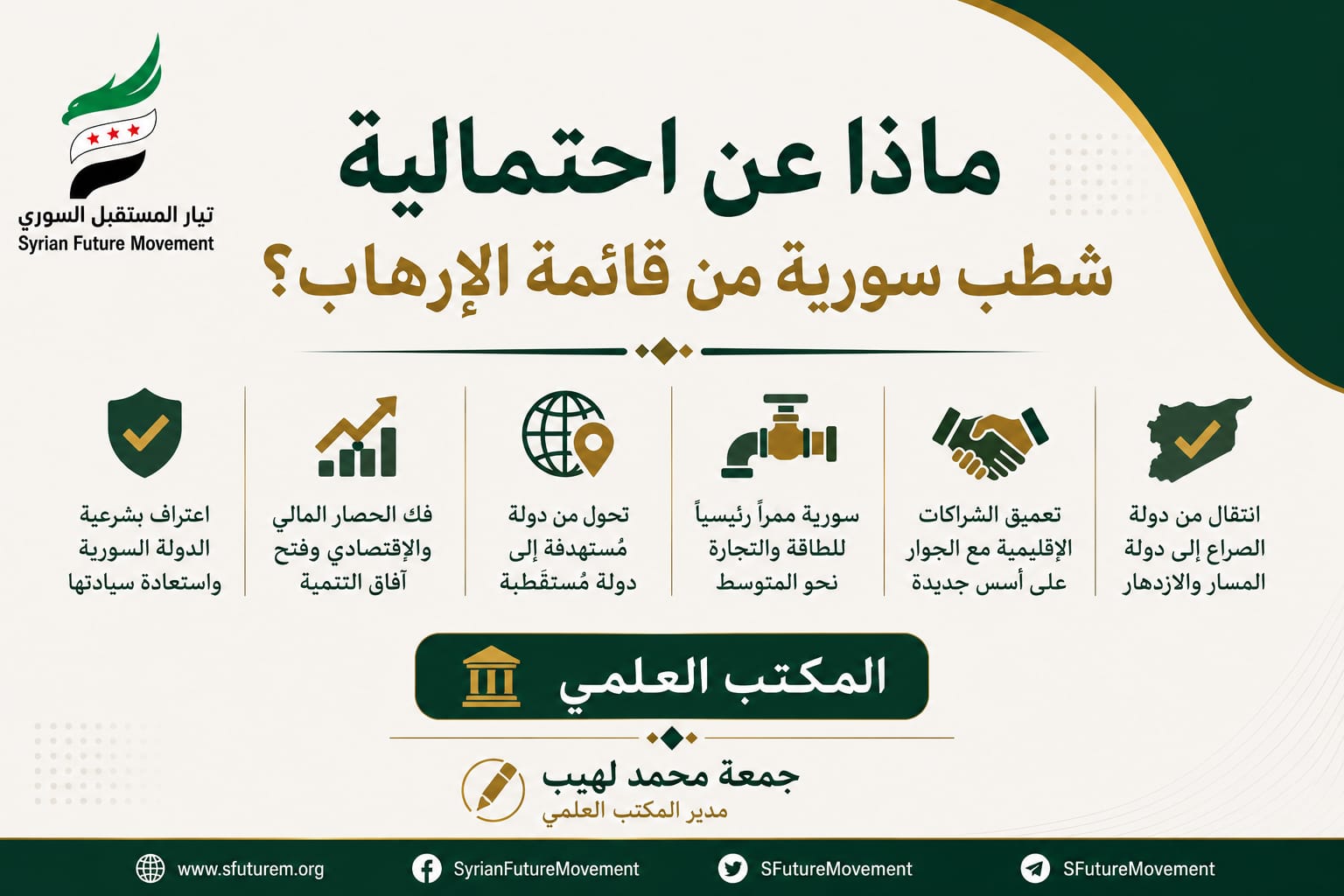
Removing Syria from the list of state sponsors of terrorism can be seen as an implicit recognition of the legitimacy of the Syrian state and its institutional recovery.
The fundamental political significance here extends beyond lifting the financial and economic blockade, reaching the level of renewed international recognition of Syrian national sovereignty.
The list served as a framework for existential isolation, and removing Syria from it means dismantling the moral and legal pretext used to justify intervention in its affairs during the Ba’athist era. This redefines the Syrian state from a “pariah state”—a state to which Assad’s policies brought us—to a “recognized actor” in the international system. The transitional authority and various national forces must solidify this positive role and ensure its success without being affected by internal disputes.
As for the impact of this decision on Syria’s regional and national standing, it appears to be both transformative and profound.
We are witnessing a moment of potential transformation from a “targeted state” to a “polarized state”—a rising regional power.
Syria, which withstood attempts at dismantling and brought down the Iranian axis and the Assad regime, proves today that geopolitics, as interpreted through the lens of sovereignty and the ability to impose national will, also grants Damascus a renewed “geopolitical agency.” It has taken a significant step out of the arena of others’ conflicts, becoming a pivotal player in shaping the balances of power in the Levant, and capable of repositioning itself as a center of gravity in the Middle East, not a marginalized, dependent entity. This underscores the gravity and importance of the transitional phase, which some are trying to downplay. This phase is foundational for our country’s future. If we succeed, our generation will be the founders of modern Syria. If, God forbid, we fail to steer the ship, we will lose the most important historical opportunity in our country’s history—an opportunity that could have altered its very essence, even its DNA, as shaped over the past 60 years.
This leads us to the fundamental question: Does this decision establish a new phase in Syria’s role? The answer is yes, but according to the equation of “geo-economic function.” The rapid transformations are pushing Syria to become a major energy corridor from the Gulf, Iraq, and even Iran, should global conditions improve, towards the Mediterranean. This is transforming Syrian geography from a “theater of war” to a “vital artery of integration.”
Herein lies another philosophical shift: from a state built on an “economy of resistance, steadfastness, and confrontation”—which the former regime exploited to consolidate its rule as long as the global order remained unchanged—to a state establishing an “economy of connectivity and corridors.” This does not negate its role in resistance, but rather a pragmatic resistance that leverages interests for interests and deepens this role by transforming it from an ideological dimension to a functional developmental dimension that serves its strategic depth.
As for relations with neighboring countries, we will witness a redefinition of the concept of “strategic depth.”
With Lebanon, the relationship will shift from a logic of “guardianship or intervention” to “vital interdependence” through energy, food, and reconstruction.
With Iraq, we will see a transformation from “burning borders” to “economic integration” within a new, anticipated Arab-Asian axis. With Jordan, the purely security dimension will be reinforced by a developmental one, as the border becomes a gateway for energy and trade, serving the Kingdom’s economic stability and alleviating its burdens, while also enabling Syria to succeed in its current phase.
Finally, Syria stands today on the threshold of “complete sovereignty.”
Sovereignty is no longer solely military and security-related, but has become economic and energy-related. It remains to be said that an upgrade in the rating, if it occurs, is not the end goal, but rather an acknowledgment that post-Assad Syria is a “foundational state” in a regional system undergoing transformation, a system based on the principle that security is indivisible and that the prosperity of the Middle East inevitably passes through the beating heart of Syria.
It is a transition from a “state of conflict” to a “state of progress,” and we have the right to see this as the embodiment of what can be called a “postponed strategic victory.” It is incumbent upon us (the government, national forces, and society) to understand its gravity and importance and to strive for a successful transition until we achieve victory.