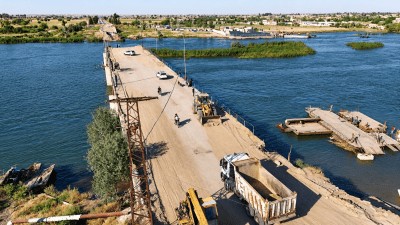
The Syrian Future Movement is following with great interest the announcement of the commencement of the rehabilitation project for the Al-Siyasiya Bridge in Deir ez-Zor Governorate. The project, being implemented by the Syrian Construction and Building Corporation under the supervision of the Ministry of Transport, is scheduled to last 12 months. This practical step comes in response to presidential directives and is part of the Syrian government’s ongoing efforts, recently embodied in an urgent government plan to rehabilitate vital bridges and roads across the country, prioritizing the governorates of Raqqa and Deir ez-Zor.
Firstly, the Syrian Future Movement commends the reconstruction of the Al-Siyasiya Bridge, considering it a testament to the solidarity of the region’s residents and a response to a pressing humanitarian need.
The Syrian Future Movement also appreciates this step, which reflects a shift in the state’s priorities towards investing in the infrastructure of areas that have long suffered from neglect.
The destruction of this bridge, a vital artery for movement and transportation across the Euphrates River, led to daily human suffering. For years, residents were forced to use makeshift ferries, exposing them to the risk of drowning, in addition to the floods that further hampered their movement.
Second: The Syrian Future Movement points out that the bridge reconstruction project is part of a broader, urgent government plan to rehabilitate vital bridges and roads, announced on June 2, 2026.
We believe that allocating funds for these projects from the current 2026 budget and launching a three-year project to develop and expand the main road network are positive steps that respond to the legitimate demands of the residents of the eastern governorates.
While the Syrian Future Movement commends these steps, it believes that the current situation requires more than mere declarations of intent; it demands concrete action on the ground that impacts all aspects of life.
Third: The Syrian Future Movement reiterates its firm stances supporting geographical equity in reconstruction, which have been published on its official website, including:
- The statement of the “Deir ez-Zor Governorate Reconstruction Campaign (Deir al-Ezz)” (dated September 12, 2025), which affirmed that the Syria of the future is one where “all regions are equal in rights and responsibilities,” and that the campaign “is not merely about donations, but a symbol of national unity and a launchpad for the Syria of the future.”
- The study on the “Project for Establishing the Development Fund for Reconstruction and the Return of Displaced Persons” (dated August 4, 2025), which clearly called for the application of the principle of “geographical equity in the distribution of spending, giving priority to the most marginalized and devastated areas,” while warning against attempts to transform the fund into “a tool for sectarian or regional alignment.”
- The statement regarding the “Government Plan for Bridge Repair and the Development of Vital Roads” (dated June 2, 2026) commended the urgent government plan, emphasizing the need to “translate statements into tangible projects” and “open the door to transparent competition for Syrian companies.”
Fourth: The Syrian Future Movement reiterates that the sense of marginalization felt by the residents of Deir ez-Zor, Raqqa, Hasakah, and other eastern governorates is a heavy legacy of the policies of the former regime. This cannot be addressed through isolated projects, but rather through a comprehensive vision for balanced development.
To ensure that these promises are translated into tangible reality, the Syrian Future Movement recommends the following:
- Announcing a clear and transparent roadmap for reconstruction that encompasses all Syrian governorates without exception. This roadmap should include measurable performance indicators, binding timelines, and mechanisms for regular and public monitoring.
- Activating the principle of community partnership in prioritizing projects by involving representatives of the local population and their civil society in the relevant committees to ensure that the projects reflect their genuine needs.
- The process of administrative and financial decentralization, which began with the decision to empower governors, must be completed by granting administrative units genuine authority in planning and implementation, and by allocating local financial resources that enable them to fulfill their developmental role.
- Integrated development programs (in health, education, agriculture, and industry) must be launched concurrently with infrastructure projects, because bridges alone are insufficient to end marginalization without providing real job opportunities and dignified basic services.
In conclusion, the Syrian Future Movement affirms its support for every practical step aimed at rebuilding what the war has destroyed. It emphasizes that building a new Syria begins with rectifying the historical imbalance in the distribution of wealth and development. We believe that those in power are called upon today to transform the political bridge project into a model to be emulated in terms of speed of implementation, transparency, and community participation, and to launch a comprehensive national program for balanced development that ends decades of exclusion and marginalization, and affirms to everyone that every Syrian citizen, wherever they may be, deserves a dignified life.