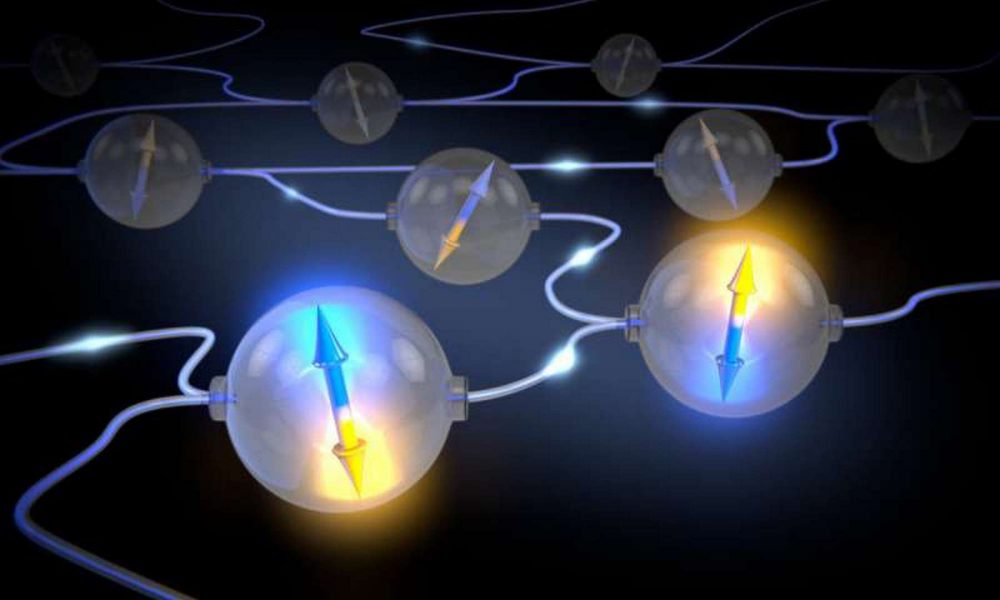
The Syrian Future Movement joins the global scientific community today, April 14th, in celebrating “World Quantum Day,” a date chosen by scientists to commemorate Planck’s constant (4.14 × 10⁻¹⁵ electron volt-seconds), the fundamental physical value that underpins our modern understanding of the universe.
We believe this day embodies the values of extreme precision and the shift from traditional linear logic to the logic of “quantum leaps,” which we believe is the only path to the modern renaissance of Syria.
The Syrian Future Movement emphasizes that adopting quantum technology is an urgent economic necessity. Updated reports from IDC and Statista for 2025/2026 indicate that global spending on quantum computing solutions has exceeded $5.5 billion, with the market value of quantum services expected to reach $65 billion by 2032. We believe that neglecting these figures in national development plans condemns future generations of Syrians to technological dependency.
The Syrian Future Movement sees in quantum entanglement a profound national symbol. Just as particles are bound together regardless of distance, Syrians, both within the country and in the diaspora, remain an inseparable, organic whole.
We believe that investing in the intellectual capital of Syrian expatriates in advanced technology fields is the true catalyst that will give Syria the momentum to overcome the obstacles of the past.
The Syrian Future Movement views the challenge of Q-Day—the imminent moment when quantum computers will be able to break traditional encryption systems (RSA)—with a high sense of national responsibility.
Based on estimates from the National Institute of Standards and Technology (NIST), the Syrian Future Movement emphasizes the urgent need to begin training Syrian specialists in post-quantum cryptography to safeguard national data security and the digital privacy of Syrian citizens in the future.
The Syrian Future Movement, through its scientific office, renews its commitment to strive to be the bridge over which Syrian innovators cross towards the horizons of global science, stressing that national sovereignty in the twenty-first century is seized in laboratories and data centers as much as it is preserved in the fields of politics, and that “the Syria of the future” will be a scientific state par excellence.