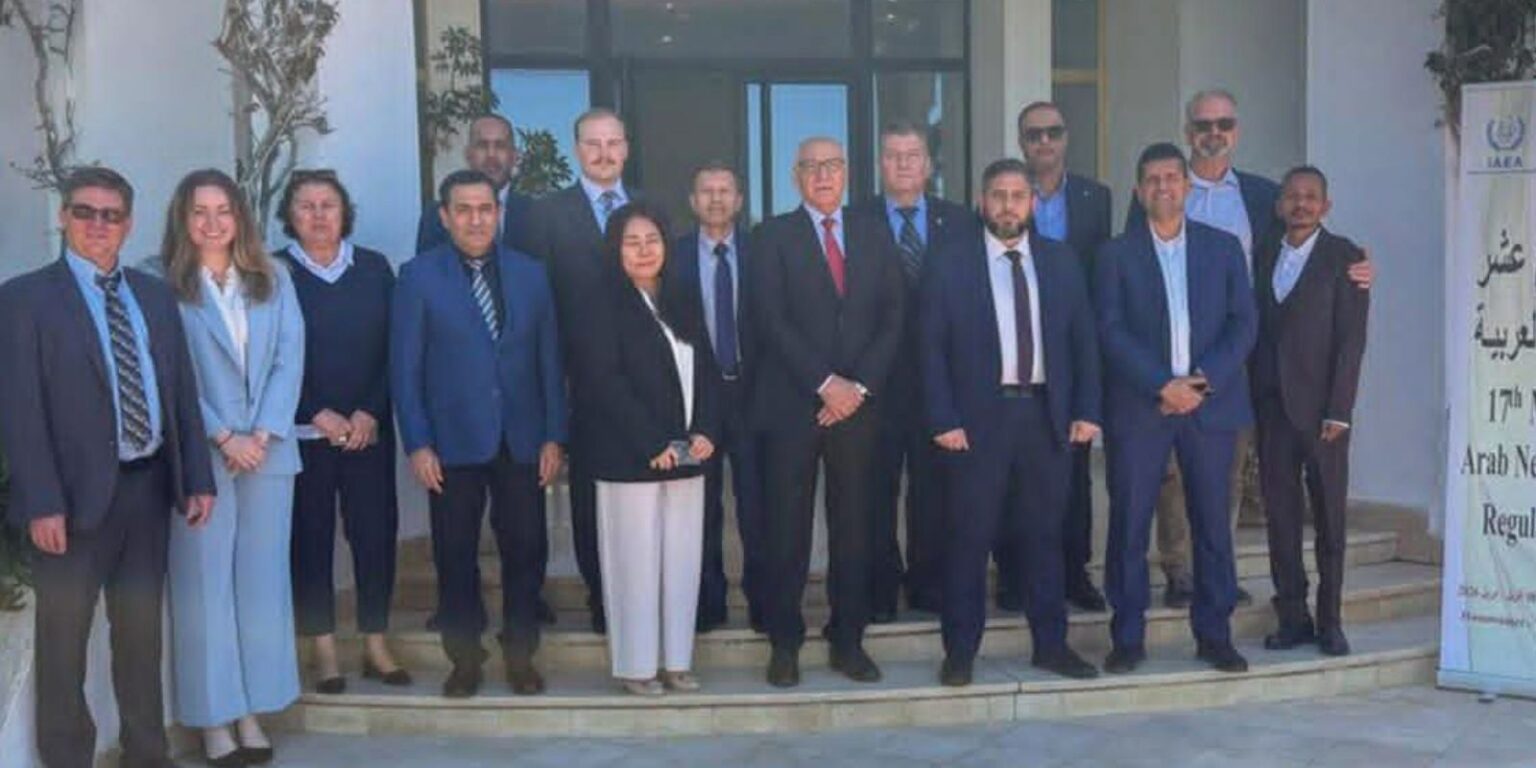
The Syrian Future Movement is following with interest the news of the Syrian Arab Republic assuming the presidency of the Arab Network of Nuclear and Radiological Regulatory Authorities. This step reflects Syria’s gradual return to its active role in the system of joint Arab action, particularly in vital technical and scientific fields.
The Syrian Future Movement sees this development as a strategic opportunity to strengthen the radiation safety infrastructure in Syria, provided that it is translated into concrete actions on the ground.
The Syrian Future Movement notes that this achievement comes amidst major regional and international shifts, most notably the repeal of the Caesar Act sanctions on Syria in December 2025.
The Syrian Future Movement points out that the US House of Representatives voted in favor of repeal on December 11, 2025, followed by the Senate on December 17, 2025, by a vote of 77 to 20.
On December 18, 2025, US President Donald Trump signed the National Defense Authorization Act for 2026 into law, thus ending the Caesar Act, which had imposed sanctions on Syria since 2019.
The European Union also lifted its economic sanctions on Syria in May 2025.
The Syrian Future Movement emphasizes that lifting these sanctions removes major legal obstacles that hindered international cooperation on sensitive issues such as radiation safety and nuclear oversight, although individual sanctions remain in place against certain individuals and entities linked to human rights violations or drug trafficking.
The Syrian Future Movement acknowledges that information available in open sources about the Arab Network for Nuclear and Radiological Regulatory Affairs is limited.
It is known that the network was established within the framework of the League of Arab States and includes regulatory bodies from several countries. It works to exchange expertise and develop standards for radiation safety.
However, the Syrian Future Movement is hesitant to characterize Syria’s assumption of the presidency as an absolute “recognition of Syria’s capabilities,” as the rotation may be a natural process.
What is more important is what Syria will do during its presidency to translate this position into tangible improvements in the reality of radiation safety.
The Syrian Future Movement affirms that Syria possesses a scientific heritage in the nuclear and radiological field dating back decades, including the Al-Haswa Atomic Energy Center, the small research reactor, and trained personnel.
However, this heritage has suffered neglect, looting, and partial destruction during the years of war.
The Syrian Future Movement emphasizes that restoring credibility in this area requires significant effort and unprecedented transparency.
The Syrian Future Movement offers an objective assessment of the opportunities and challenges accompanying this presidency:
Regarding opportunities, the Syrian Future Movement notes that the presidency provides a platform for direct dialogue with regulatory bodies in Arab countries and can serve as an entry point for requesting technical support from the International Atomic Energy Agency (IAEA).
Furthermore, the repeal of the Caesar Act removes a legal barrier that hindered international cooperation in this field.
As for challenges, the Syrian Future Movement points to the continuation of certain individual sanctions regimes, in addition to security challenges such as the loss of control over parts of Syrian territory (such as east of the Euphrates), where there are reports of missing radioactive materials, as well as the emigration of scientific expertise and the obsolescence of equipment.
The Syrian Future Movement suggests that the Syrian government and relevant regulatory bodies study a set of practical measures to capitalize on this presidency.
The Syrian Future Movement proposes the issuance of a voluntary national report on the state of radiation safety within the first six months of the presidency. This report, to be submitted to the Technical Secretariat of the Arab Network, should include a comprehensive list of sites containing radioactive materials and an assessment of the risks.
The Syrian Future Movement also proposes submitting a formal request to the International Atomic Energy Agency (IAEA) to conduct an IRRS (Integrated Radiation Safety Infrastructure Review Service) mission, which could provide an opportunity to obtain free technical recommendations.
The Syrian Future Movement recommends establishing an emergency funding window in cooperation with the United Nations Development Programme (UNDP) or the Islamic Development Bank (IsDB) to purchase portable radiation detectors for border crossings and major hospitals, taking advantage of the lifting of US and European sanctions to facilitate these purchases.
The Syrian Future Movement further proposes launching a “Revival of the Spirit” program to attract expatriate Syrian experts in the field of radiation protection, offering short-term contracts to transfer expertise and train a new generation.
The Syrian Future Movement also suggests working to include “Responding to Transboundary Radiological Emergencies” among the priorities of the Arab Network, given the presence of nuclear facilities in neighboring countries.
The Syrian Future Movement notes the necessity of dealing objectively with past issues.
We believe that any success in this matter requires a clear stance on past incidents that cannot be ignored, such as the Israeli bombing of the Deir ez-Zor site in 2007 and the subsequent controversy surrounding the nature of the activities there, as well as reports of lost radioactive sources during the war.
The Syrian Future Movement emphasizes that it is not calling for an international investigation, but rather for a serious internal national review, the results of which should be voluntarily submitted to the Arab Network.
The Syrian Future Movement concludes its statement by affirming that Syria assuming the presidency of this network is a positive event deserving of support, but cautions against turning it into an empty media spectacle.
The Syrian Future Movement asserts that true success will be measured by Syria’s ability to improve radiation detection capabilities in hospitals and ports, reduce incidents of uncontrolled exposure, facilitate the return of expatriate personnel, and open itself to external evaluation.
We also urge the Syrian government to seize this rare opportunity and immediately begin preparing a realistic action plan that takes into account the continuation of some individual sanctions, resource constraints, and the sensitivities of the past. The Syrian Future Movement renews its commitment to supporting every national effort aimed at rebuilding Syria on sound scientific and institutional foundations.