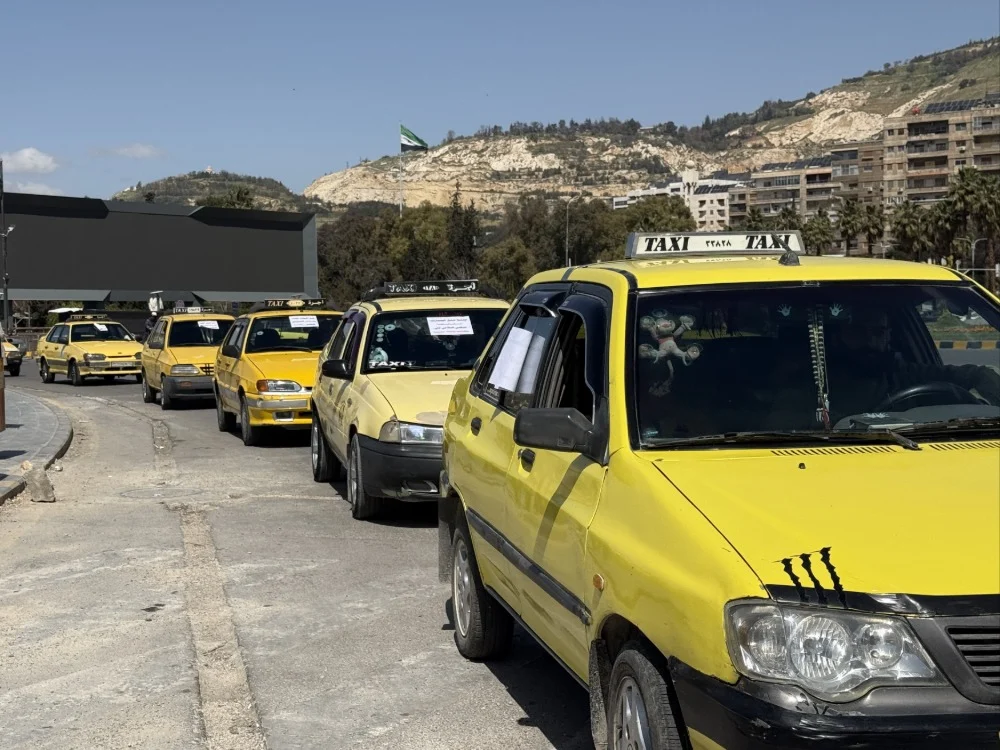
The Syrian Future Movement is closely monitoring the taxi drivers’ strike in Damascus and expresses its initial solidarity with the rights of the taxi drivers who have launched an open-ended strike in the capital, Damascus, to protest the deteriorating conditions in the transportation sector and the unprecedented drop in incomes, amidst severe regulatory chaos that reflects the repercussions of the transitional phase on citizens’ daily lives.
The Syrian Future Movement bases its analysis on data indicating that the number of taxi drivers in Damascus is estimated at around 10,000 (according to unofficial estimates). A driver’s daily income has plummeted from approximately 150,000 Syrian pounds a year ago (April 2025) to less than 50,000 Syrian pounds currently (April 2026), due to the rising cost of fuel and spare parts, and the decline in passenger numbers resulting from decreased purchasing power.
Furthermore, the lack of official licensing and traffic regulations for these vehicles exposes drivers to security harassment and arbitrary fines.
The Syrian Future Movement believes that these protests are not spontaneous, but rather reflect a structural crisis that has accumulated over decades due to the absence of a comprehensive urban transport policy. This crisis has worsened during and after the war, as the taxi sector has become a refuge for the unemployed in the informal economy, a consequence of the dire unemployment situation in Syria.
The International Labour Organization (ILO), in its October 2025 report entitled “Decent Work in Syria: Challenges and Prospects,” estimates that the informal economy constitutes approximately 45% of Syria’s GDP, employing more than 3 million people without any social or legal protection.
The World Food Programme (WFP) monthly report issued on March 15, 2026, confirms that the food price index in Damascus rose by 34% during the preceding year (March 2025 – March 2026), while the official minimum wage remained at 450,000 Syrian pounds per month (approximately US$30 at the parallel exchange rate). This means that a taxi driver’s daily income of 50,000 Syrian pounds is insufficient to cover fuel, maintenance, and a basic daily meal.
The Syrian Future Movement, based on its national responsibility during the transitional phase, affirms that the right of workers to peaceful strike is guaranteed under international human rights law and national legislation, provided that it remains peaceful and does not disrupt the essential interests of citizens.
The Syrian Future Movement calls on the Syrian transitional government (which assumed its duties in January 2025) to respond immediately and fairly to the demands of taxi drivers, which include: regulating the sector by granting temporary licenses and vehicle registration for a nominal fee not exceeding 50,000 Syrian pounds annually; setting a fair official fare that takes into account the increased operating costs and guarantees a minimum daily income of 100,000 Syrian pounds; and exempting drivers from previous fines related to operating without a license (provided they regularize their status within a period not exceeding three months).
The Syrian Future Movement rejects any security measures that lead to the suppression of these protests or the criminalization of protesters as long as they remain peaceful. It warns that ignoring the drivers’ demands could lead to wider social unrest, especially since the transportation sector is the daily lifeline for millions of Syrians.
The Syrian Future Movement also reminds the transitional authorities that they pledged in their government program issued in February 2025 to reform the transportation sector and gradually integrate the informal economy, and calls on them to fulfill these pledges urgently.
The Syrian Future Movement goes beyond immediate demands to a comprehensive future vision for the urban transport sector in Damascus and other Syrian cities, based on three main pillars.
Pillar One: Drafting a new law to regulate internal land transport, to be presented to the upcoming Transitional People’s Assembly. This law should include licensing for various vehicle categories (minibuses, shared taxis, individual taxis, and motorcycles for transport) according to safety and environmental standards, along with the establishment of an independent body to monitor fares and protect the rights of consumers and drivers.
Pillar Two: Launching an urban transport support fund financed by private vehicle licensing fees and fuel taxes (at least 5% of the revenue from taxes on diesel and gasoline). This fund would be used to compensate drivers for price differences and provide low-interest loans for renewing old vehicles or replacing them with environmentally friendly ones.
Pillar Three: Gradually integrating the informal economy into the transport sector by offering tax and administrative incentives to drivers willing to register (such as a 50% reduction in customs duties on imported spare parts for the first year), in exchange for their adherence to official fares, safety standards, and traffic regulations.
The Syrian Future Movement recommends that the interim government form an emergency committee within one week (i.e., by April 14, 2026) comprising representatives from the Ministry of Transport, the Governorate, the Ministry of Interior, and the Transport Workers’ Syndicate (once reactivated), in addition to three representatives elected by taxi drivers in Damascus. This committee would be tasked with reviewing the demands and approving a package of immediate measures, including: suspending the issuance of new fines for two months, setting a temporary fare, and initiating a census of drivers and vehicles in preparation for issuing temporary licenses.
While declaring its readiness to contribute to any national dialogue aimed at formulating a comprehensive and equitable urban transport policy, the Syrian Future Movement calls upon all taxi drivers to continue their peaceful protests within the framework of the law, urges citizens to understand the drivers’ circumstances, and calls upon the interim government to act swiftly before the transport sector crisis escalates into a broader social and security crisis.
Building the new Syria begins with fairness in daily services, foremost among them the right to move around with dignity and safety, and the worker’s right to a fair wage that preserves his dignity and protects his family from hunger. We hope that if the experiment in Damascus succeeds, it will be comprehensive for all Syrian governorates.