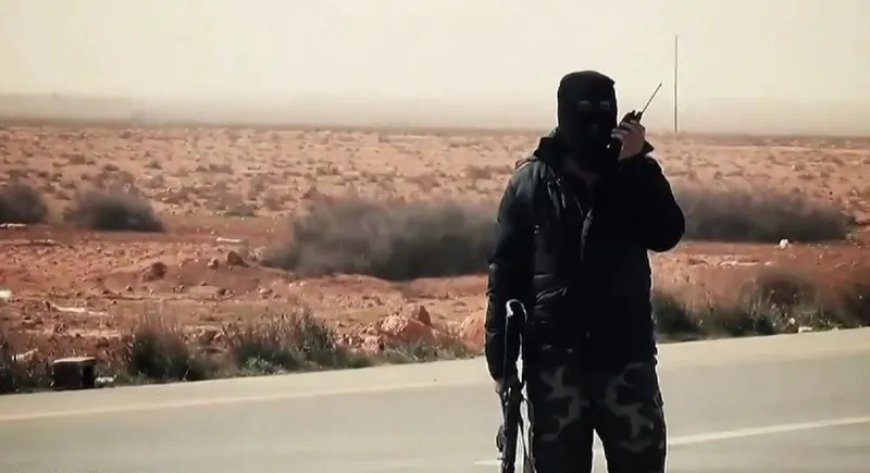
The Syrian Future Movement strongly condemns the three terrorist attacks carried out by ISIS in less than 24 hours (from the evening of February 21 to the morning of February 22, 2026), which resulted in:
- The martyrdom of a member of the Internal Security Forces and the injury of another in an attack on the al-Sabahiya checkpoint west of Raqqa city (morning of February 22), using machine guns and a suicide belt.
- The martyrdom of a member of the Syrian Army and a civilian in the village of al-Wasita in the northern Raqqa countryside (evening of February 21).
- The martyrdom of a member of the Syrian Army in the city of al-Mayadin in the eastern Deir ez-Zor countryside (evening of February 21) in an armed attack with a pistol.
The Syrian Future Movement believes that these coordinated operations, both in terms of timing and location, which the organization officially claimed responsibility for through its media outlet, Dabiq, and an audio recording by its spokesperson dated February 21, 2026, represent a clear attempt to reassert the organization as a strategic threat amidst the security and political transformations underway since December 2025.
The Syrian Future Movement asserts that the organization is exploiting three main factors at this stage:
- The relative security vacuum resulting from the redeployment of forces following the agreements to hand over areas in northeastern Syria (late 2025 – early 2026).
- The relocation of some sleeper cells from the Syrian desert (Homs – southern Deir ez-Zor) to urban and semi-urban areas in Raqqa and Deir ez-Zor.
- The direct political messages targeting the legitimacy of the transitional government and describing it as an “agent of the Crusader coalition,” with the aim of re-recruiting or inspiring extremist elements within society.
The Syrian Future Movement believes that the continuation of this escalation—if not confronted firmly and swiftly—could lead to serious strategic consequences in the medium term (3–12 months), including:
- Weakening public confidence in the new state’s ability to provide security.
- The potential for inciting retaliatory sectarian or tribal reactions.
- Forcing the security apparatus to redeploy significant forces, thus reducing its focus on reconstruction and economic stability.
- Reinforcing the organization’s narrative that “the new Syrian state is weak and incapable of protecting its citizens.”
To effectively and sustainably counter this threat, the Syrian Future Movement recommends the following:
- Declaring a temporary state of security alert in the Raqqa and Deir ez-Zor governorates for at least 60 days, with the deployment of trained reserve battalions and specialized counterterrorism units (particularly those combating improvised explosive devices and suicide bombers).
- Establishing a permanent joint operations room comprising the Ministry of Interior, the Ministry of Defense, the General Intelligence Directorate, and trusted local and tribal leaders, to coordinate daily operations and analyze information in real time.
- Launching a large-scale intelligence operation focused on:
- Tracking potential funding and arms supply lines.
- Monitoring the return of former fighters or displaced persons from al-Hol camp and other locations.
- Enhancing cooperation with international partners in sharing information about cross-border cells.
- Redesigning the security system for checkpoints and military posts within 30 days, including:
- Utilizing advanced detection technologies (thermal cameras, metal detectors, small drones).
- Intensive training on scenarios involving individual and suicide attacks.
- Reducing reliance on weak, fixed positions and replacing them with mobile and surprise checkpoints.
- Launching a national program for “community security reconciliation” in affected areas, including:
- Dialogues with tribal leaders and dignitaries to promote early reporting.
- Rehabilitation and reintegration programs for returnees from conflict zones (with security and legal guarantees).
- Awareness campaigns explaining the dangers of extremism and calling for cooperation with the state.
- Allocating an emergency budget to support families affected by the attacks and to compensate the families of martyrs and the wounded is a powerful symbolic gesture demonstrating that the state stands with its citizens.
The Syrian Future Movement affirms that true victory over terrorism is not solely military, but also political, social, and economic. This requires building a strong and just state that provides security, dignity, and opportunities for every citizen and closes the doors to extremist narratives.
The Syrian Future Movement reiterates its heartfelt condolences to the families of the martyrs, wishes a speedy recovery to the wounded, and reaffirms its unwavering commitment to working towards a safe, unified Syria, free from terrorism and fear.