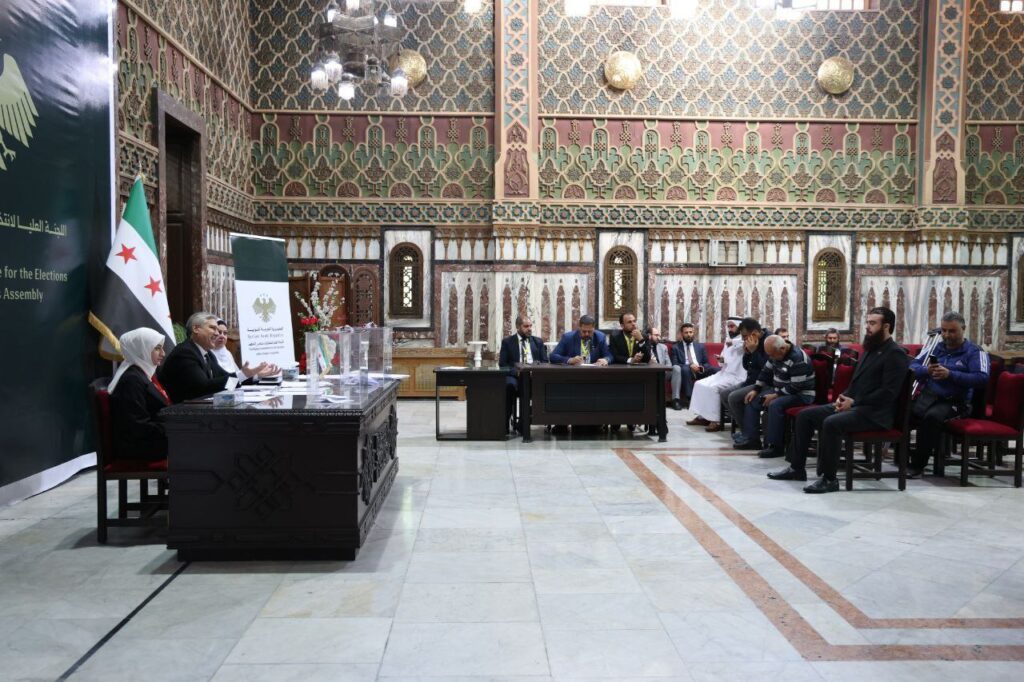
The Syrian Future Movement followed with great interest the issuance of Decision No. (1) of 2026 by the Chairman of the Higher Committee for People’s Assembly Elections, Dr. Muhammad Taha al-Ahmad, establishing a sub-judicial committee in Raqqa Governorate for the two electoral districts (Raqqa and al-Thawra). This committee, chaired by Judge Ibrahim Khalil al-Hassoun and including Judges Mahmoud Jumaa al-Ahmad and Jassim Saleh al-Jaber, is tasked with adjudicating objections and appeals related to the 2025 by-elections.
The Syrian Future Movement sees several positive aspects in this step, which deserve appreciation in the current circumstances:
- It reflects tangible progress in restoring the central government’s authority over its territory, especially after the improvement in the security situation in Raqqa Governorate following the implementation of aspects of the January 30, 2026 agreement between the interim government and the Syrian Democratic Forces.
- It contributes to completing the formation of the People’s Assembly, which is still missing a number of seats in Raqqa and Hasakah, thus strengthening the legitimacy of the transitional legislative institutions.
- It affirms a commitment to a transparent and judicial process for adjudicating appeals and objections, which is essential for enhancing public confidence in the electoral process.
The Syrian Future Movement also points to several undeniable challenges, including:
- Representation and Inclusion: The indirect elections held in October 2025 demonstrated limited representation for women (approximately 6%) and for ethnic and religious groups in the eastern regions.
- Community Trust: Given the fresh memory of years of conflict and division in Raqqa, some residents may view the process as an insufficient, centralized step to guarantee genuine and free participation.
- Fragile Security Context: Despite improvements, some areas remain vulnerable to security tensions or external influences that could affect the freedom to run for office and vote.
The Syrian Future Movement demands transparency and inclusivity. Electoral bodies must include balanced representation of all social, religious, and ethnic groups in Raqqa, with impartial judicial oversight and, where possible, international monitoring of the vote counting and appeals processes.
The Syrian Future Movement also calls for strengthening community trust through broad local dialogues prior to the by-elections. These dialogues should include representatives of tribes, civil society, and political parties to clarify the nomination and voting mechanisms and ensure that no group is excluded. The Syrian Future Movement believes it is essential to link the elections to transitional justice. This step should be accompanied by tangible progress in accountability for violations and compensation for victims, to avoid the council being perceived as an institution lacking legitimacy.
The Syrian Future Movement also emphasizes the importance of preparing for an advanced constitutional phase, so that these supplementary elections become a necessary transitional step, paving the way for direct and fair general elections at a later stage, after the completion of the permanent constitution and a comprehensive reform of the security and military sectors.
The Syrian Future Movement calls on the international community (the United Nations, the European Union, and the United States) to provide technical and monitoring support to ensure the integrity of the process, which will contribute to lifting sanctions and the flow of aid necessary for reconstruction.
The Syrian Future Movement sees this step as a genuine opportunity to strengthen the path to stability, provided it is managed with the highest degree of transparency and inclusivity.
We also believe that consolidating state institutions begins with practical steps like these, but it will only be complete by embracing all citizens without exclusion or marginalization. We renew our national commitment to accompany this process with full responsibility and transparency, in order to build the Syria of the future: a state of equal citizenship, strong institutions, and lasting peace.