

Introduction: A Recurring Catastrophe in a Fragile Transition:
Following the fall of Bashar al-Assad’s regime on December 8, 2014, Syria entered a complex transitional phase characterized by efforts to rebuild state institutions, the return of millions of internally displaced persons and refugees, and attempts to restore sovereignty over national territory amidst enormous economic and security challenges.
However, natural disasters—primarily floods and flash floods caused by heavy winter rains—remain a threatening factor that exacerbates the structural weaknesses of communities, particularly in northwestern regions such as the Idlib and Latakia governorates.
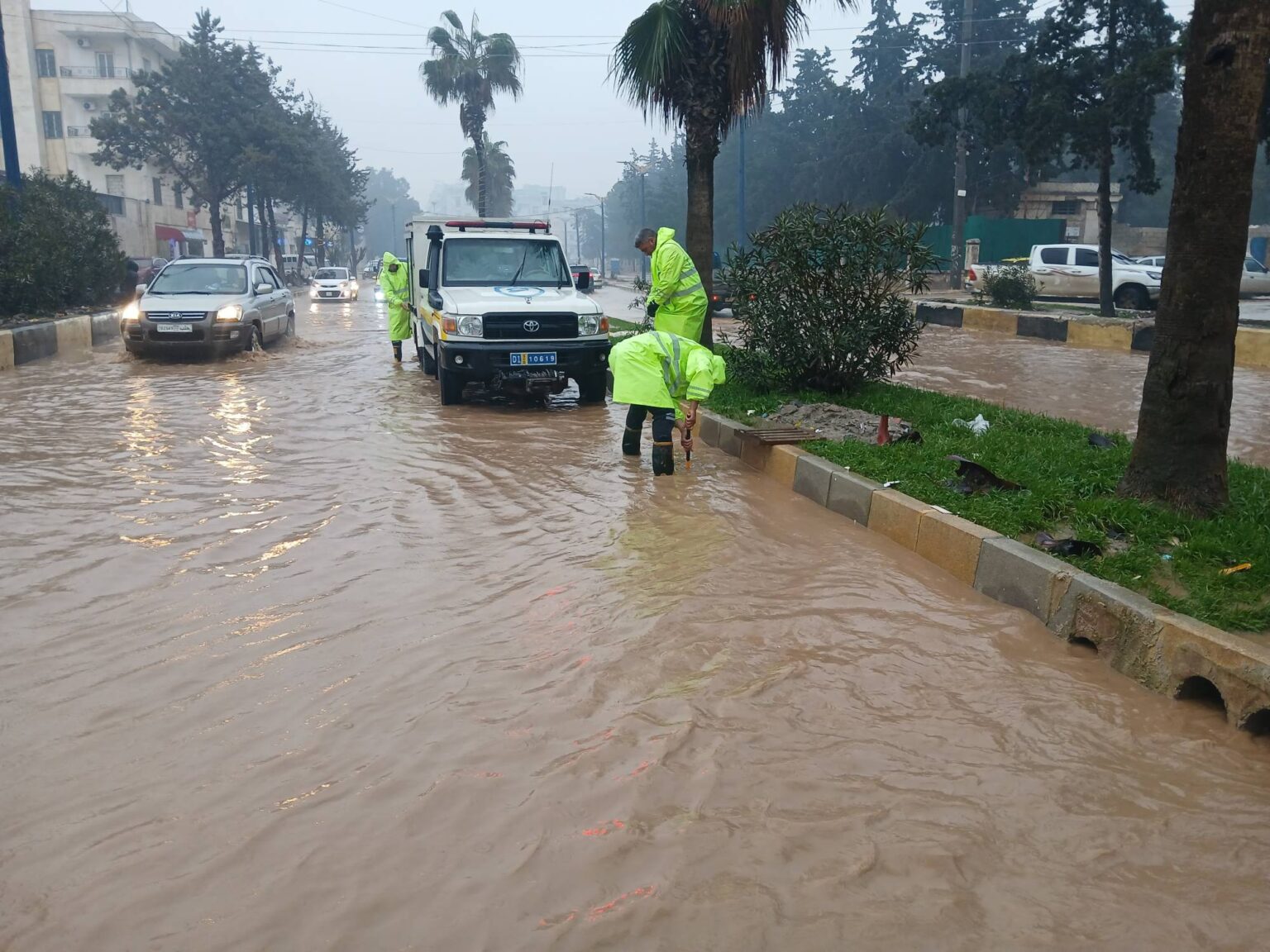
On February 7-8, 2026, these two governorates experienced torrential rains that led to flash floods, inundating 14 camps for internally displaced persons (IDPs) in the Khirbet al-Jouz area of western Idlib. These floods directly affected more than 300 families (approximately 1,200-1,800 individuals). Two children died in the Ain Issa area of northern Latakia on February 7, and a Syrian Red Crescent volunteer was killed and six others (including five volunteers) were injured in a traffic accident during rescue operations in Jabal al-Turkman, Latakia, on February 8.
This incident appears to be not an isolated event, but rather part of a long series of recurring disasters that reveal a cumulative failure in disaster risk management. It underscores the urgent need for a fundamental shift from recurring emergency response models to a comprehensive, proactive strategy based on long-term forecasting and planning.
This article is based on the Sendai Framework for Disaster Risk Reduction 2015–2030, adopted by the United Nations on March 18, 2015, focusing on its four priorities:
- Understanding disaster risks.
- Strengthening governance.
- Investing in resilience.
- Improving preparedness, response, and recovery.
The article also draws on case studies in post-conflict contexts to offer its perspective on how flood risk management can be integrated into the Syrian transition process.
History of Floods in Syria:
Since the outbreak of the revolution in March 2011, flooding has transformed from a seasonal natural phenomenon into a worsening humanitarian disaster due to the destruction of infrastructure and the proliferation of camps in low-lying and vulnerable areas.
Notable Events:
- April 27, 2011: Floods in northeastern Syria inundated 26 villages and claimed the lives of five children from the same family.
- January 2021: More than 22,000 displaced people were affected in northwest Syria, with over 4,000 tents destroyed in Idlib and Aleppo.
- March 2020: Floods in Raqqa resulted in 7 deaths and destroyed homes.
- March 2023: 41,200 people were affected in Idlib and Aleppo, with more than 60 camps flooded.
- January 2026: Snowstorms followed by floods affected 158,000 people, with thousands of tents damaged.
- February 2026 (7-8): Recent flash floods inundated 14 camps in Khirbet al-Jouz, causing deaths and injuries, and forcing the evacuation of hundreds of families to schools and temporary shelters.
This recurring pattern reflects “compound vulnerability,” where armed conflict interacts with climate change (increasing intensity of flash floods) and poor urban planning, making camps—home to hundreds of thousands of displaced people—more susceptible to annual disasters.
Structural Challenges in the Transition Phase (2024–2026):
- The return of displaced persons and refugees without safe infrastructure: As of November 2025, more than 1.2 million refugees and 1.9 million internally displaced persons had returned, but they face destroyed homes, landmines, and a lack of services, forcing them to remain or return to unsafe camps.
- Severe drought followed by flash floods: The 2025 drought (the worst in 36 years, with rainfall at only 25% of the average) reduces soil absorption, increasing the intensity of flash floods when heavy rains occur.
- Weak institutions and coordination, coupled with a devastated economy, the continued impact of some sanctions, and a lack of liquidity, hinder the development of effective early warning systems. The emergency meeting held on February 8, 2026 (with the participation of the Ministers of Health and Emergency and the Governors of Idlib and Latakia) was a rapid response, but it focused on evacuation and temporary shelter without addressing the root causes.
Local conflicts and humanitarian access: Ongoing clashes in some areas impede access, as has been the case in previous incidents.
Preventive solutions: Shifting from reaction to prediction and planning:
The Sendai Framework emphasizes that investing in prevention is more cost-effective (every dollar spent on prevention saves $4-7 in response costs).
In the Syrian context, this requires:
- Relocating camps from riverbeds and low-lying areas to higher, safer locations if rebuilding homes is not currently feasible.
- Developing Multi-Hazard Early Warning Systems (MHEWS) by building local weather monitoring networks connected to mobile applications, along with training local communities. This approach proved successful in Indonesia after Typhoon Idai (March 2019), where losses were reduced by 25%.
- Green infrastructure and environmental improvement through afforestation and the creation of natural barriers to reduce runoff by up to 30%, along with the rehabilitation of drainage systems in urban areas.
- Administrative decentralization with centralized coordination, empowering local authorities with planning authority, and a central national operations room to ensure coordination, drawing on the “one-stop shop” model implemented in Nepal after the April 25, 2015 earthquake.
- Integrating disaster risk reduction (DRR) into reconstruction plans and allocating a percentage of international funding (e.g., 20-30%) to preventative projects, with public-private partnerships to avoid corruption.
Also, lessons and experiences from other countries in similar contexts can be drawn upon, such as:
- Nepal (post-conflict 1996-2006 and the 2015 earthquake): Adopted centralized coordination but suffered delays due to multiple donors; a lesson that warns Syria against fragmented efforts.
- Indonesia (Cyclone Idai 2019): Focused on community participation and early warning systems, which reduced losses in subsequent disasters.
- Kosovo (post-1999): Building codes were updated to reduce vulnerability by 30%, a model suitable for Syrian reconstruction.
Conclusion:
During the transitional phase, the Syrian Future Movement recommends integrating flood risk management. This is part of a comprehensive national vision for sustainable development.
Continuing to respond only to emergencies (as in the meeting of February 8, 2026) will only lead to the tragedy repeating itself annually.
The solution lies in preventative investment, strengthening local governance, and international partnerships to transform disasters into opportunities for building a more resilient and equitable Syria, drawing inspiration from the Sendai Framework and the experiences of countries that have successfully overcome the cycle of complex vulnerability.