

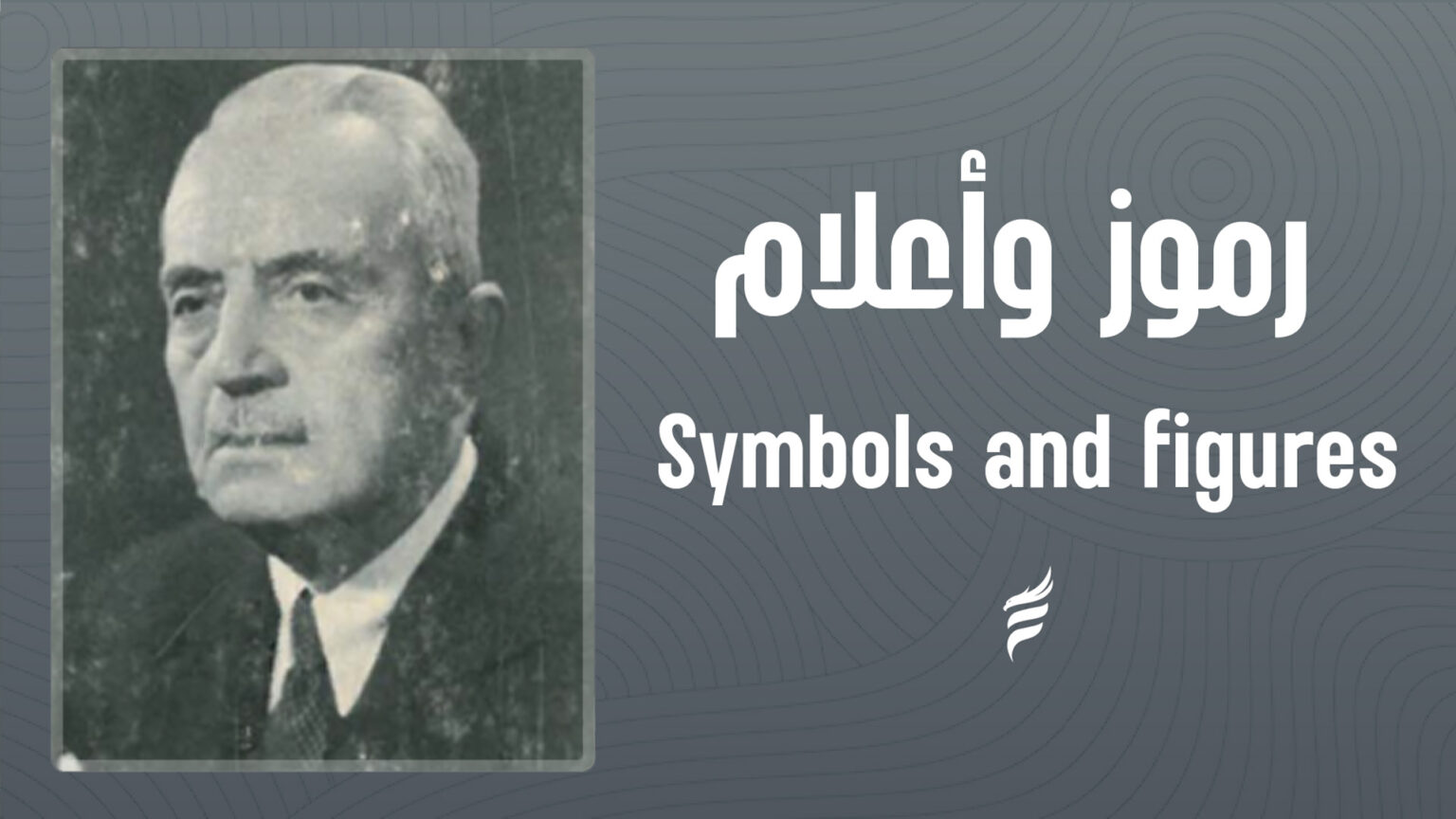
Youssef al-Hakim was born in Latakia, the son of the physician Ya’qub al-Hakim.
His mother was Hanna bint Jirjis Habish, from a family of tobacco merchants and olive grove owners in the village of Basnada.
He began his education with a private tutor, Jirjis al-Khoury, the son of a church priest, from whom he learned the fundamentals of Arabic and arithmetic.
He then transferred to the American Evangelical School in Latakia to continue his studies before enrolling in the government preparatory school, from which he graduated in 1899.
After graduation, he worked as a Turkish language teacher at the preparatory school for a salary of two hundred piasters, equivalent to two Ottoman liras per month.
He was then appointed as an employee in the Ministry of Justice until he was transferred in July 1904 to the position of lieutenant in the court. On December 22, 1909, he was appointed a member of the Jerusalem District Court. He was then transferred to Jaffa on January 9, 1910, where he became a member of the Court of First Instance, which held the powers of an appeals court for the district courts and the criminal court for the district.
In 1912, he was transferred to Tripoli, then to Beirut, where he remained for six years.
After engaging in political activity and then temporarily stepping away from it, he returned to the judiciary and was appointed Second President of the Court of Cassation, a position he held until his retirement in 1948.
Youssef al-Hakim was known in political life for his close friendship with Syrian President Ahmad Nami, who served as head of state under the French Mandate.
Youssef al-Hakim served as Minister of Justice in the three cabinets formed by Ahmed Nami, from May 1926 to February 1928. Prior to this, he held the position of Minister of Public Works in three successive cabinets headed by Ali Rida al-Rikabi, Hashim al-Atassi, and Ala’ al-Din al-Durubi, from March 8, 1920, to September 6, 1920.
Youssef al-Hakim’s presence alongside Ahmed Nami had a clear impact on the achievements made for the benefit of the Syrian entity during the period of French Mandate and its harshness, a critical period following World War I and preceding the outbreak of World War II.
With the outbreak of World War I in 1914, he was appointed head of the committee for translating laws from Turkish into Arabic, by order of Jamal Pasha, the military governor of the province of Syria. He translated more than twenty laws and regulations.
In 1916, he was appointed District Governor of Koura, and later District Governor of Batroun. In 1918, he assumed the position of Director of Correspondence for the government of Mount Lebanon, where he was responsible for corresponding with the Ottoman provinces and expressing opinions on the affairs and demands of the Mount Lebanon Mutasarrifate.
Following the end of World War I and the fall of the Ottoman Empire, he was among the first to pledge allegiance to Prince Faisal bin Hussein as the Arab ruler of Syria. He ran for the first parliamentary elections and became a member of the General Syrian Congress, at which Faisal was crowned King of Syria on March 8, 1920. At the first session of the Congress, he was elected Vice President to Hashim al-Atassi.
On March 9, 1920, King Faisal tasked Ali Rida al-Rikabi with forming a new cabinet, and Yusuf al-Hakim was chosen as Minister of Public Works, a position that encompassed trade, agriculture, and public works. He remained in this position despite three successive cabinets, the last of which was that of Ala’ al-Din al-Durubi, formed after the Syrian army’s defeat at the Battle of Maysalun on July 24, 1920.
After the French occupation and the deposition of King Faisal, Yusuf al-Hakim was appointed Attorney General of the Ministry of Justice in Latakia, then First President of the Court of Cassation in the Federation of Syria in 1923. During the Great Syrian Revolt, he was appointed Minister of Justice in the government of Ahmad Nami from May 2, 1926, until February 1928. During this period, he exerted considerable effort in assisting President Ahmad Nami in working to return the Sanjak of Alexandretta to Syria, which was achieved in 1928 before circumstances later changed.
He then returned to the Court of Cassation, serving briefly as First President, then as Second President, before being reappointed First President until 1948, after which he devoted himself to writing his memoirs.
Dar An-Nahar, a Lebanese publishing house, released Youssef al-Hakim’s memoirs in four volumes:
- Syria and the Ottoman Era
- Beirut and Lebanon under the Ottomans
- Syria and the Dawn of Independence
- Syria and the French Mandate
These volumes cover the history of Syria and Lebanon during the late Ottoman period, World War I, the reign of King Faisal, the French Mandate, and finally, independence. They include a detailed account of political, administrative, and social events, along with firsthand accounts from statesmen and the major transformations in the Levant.
The fifth volume of his memoirs, titled “Independent Syria,” which would have covered the period of coups and political developments up to the March 8, 1963 coup, remains unpublished.
Youssef al-Hakim passed away in Damascus in 1979, after a long career in the judiciary, politics, and administration, which made him one of the most prominent witnesses of the early Syrian state and a key figure in shaping its institutions.
The Syrian Future Movement’s Position:
We in the Syrian Future Movement, as we commemorate the founding statesmen of Syria, recall Yusuf al-Hakim as one of the symbols of independence and a leading figure of the first Syrian state, a royal witness to its establishment and the building of its institutions during the most difficult periods.
This article is part of a series on the symbols and leading figures of the Syrian state, within the framework of a documentary project that aims to connect our revolutionary present with a solid national past, and to revive the need to cultivate statesmen who will safeguard the homeland, preserve its achievements, and restore the Syrian state to its former glory and prestige after decades of tyranny and corruption.