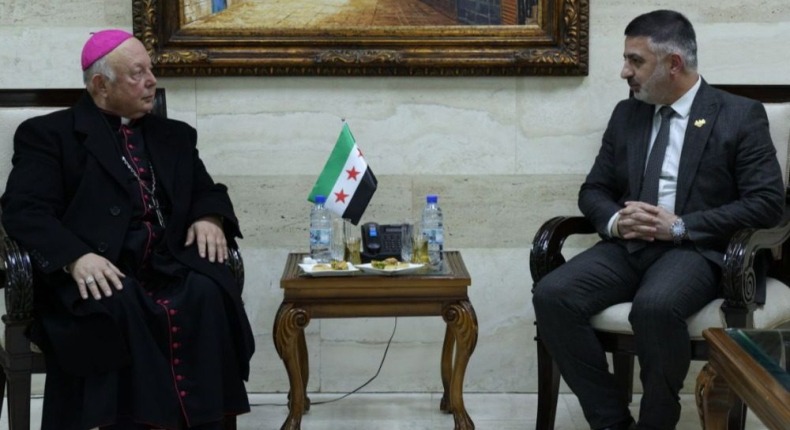
The Syrian Future Movement is following with great interest the meeting held on February 4, 2026, between a delegation representing the Latin Christian community and the Assistant Secretary-General for Cabinet Affairs at the General Secretariat of the Presidency of the Republic.
This meeting focused on discussing the issue of reclaiming ownership of schools and buildings that were arbitrarily confiscated under the former regime, in accordance with the sweeping nationalization policies implemented by the Ba’ath Party authorities in the fall of 1967. These policies resulted in the confiscation of more than 300 Christian schools and approximately 75 private Islamic schools, according to reliable historical reports (such as studies by the University of Oklahoma and other sources).
The Syrian Future Movement affirms that these confiscations constitute a flagrant violation of the principles of the right to private property enshrined in the Universal Declaration of Human Rights (Article 17, 1948), which states that “everyone has the right to own property” and “no one shall be arbitrarily deprived of his property.” They also violate the UN Basic Principles on the Right to Reparation and Reparation (the Van Boven Principles, 2005), which obligate states to provide just reparations, including restitution, as a priority in transitional justice processes.
Furthermore, these confiscations contravene Article 27 of the International Covenant on Civil and Political Rights (1966), which protects the rights of religious minorities to practice their culture and religion without discrimination, the Pinel Principles on Housing and Property for Refugees and Internally Displaced Persons (2005), and the Fourth Geneva Convention (1949), which protects civilian property.
The Syrian Future Movement views this meeting as a crucial opportunity to strengthen the principles of a democratic civil state, as rectifying these violations represents a fundamental step towards building a system based on the rule of law and equal citizenship. We also emphasize that the Ba’athist nationalization policies were not merely an economic measure, but an attempt to impose a singular ideological hegemony. This contributed to the erosion of Syria’s cultural diversity and the decline of the Christian presence from approximately 1.5 million (around 10% of the population) before 2011 to between 300,000 and 400,000 currently (less than 2-3%), according to recent reports from organizations such as ZENIT (December 2015), Aid to the Church in Need, and United Nations and EUAA reports (2015). We believe this rectification will strengthen national unity by rebuilding trust among the various societal groups and prevent the recurrence of violations that have exacerbated internal conflicts.
The Syrian Future Movement affirms that our support for this process reflects a commitment to the values of justice and human dignity, inspired by the principles of international ethics that reject discrimination and arbitrary seizure.
The restoration of these schools is not merely a matter of restitution, but a moral redress for decades of marginalization and an opportunity to strengthen the role of religious communities in building a tolerant society that respects diversity. This contributes to national reconciliation and prevents the forced migration that has affected hundreds of thousands of Syrians.
The Syrian Future Movement calls for this process to serve as a model for comprehensive reform in the education sector, going beyond mere restoration to the establishment of a modern education system that integrates Syria’s diverse cultural heritage with technological innovation, in accordance with the UN Sustainable Development Goals (Goal 4: Quality Education).
We also believe that the next steps should include:
- Establishing independent committees comprised of legal experts and representatives from religious communities and civil society to review all confiscated files, ensuring full transparency in accordance with Transparency International standards.
- A binding timetable will be established, setting dates for restoration within months, in coordination with the Ministry of Education, to avoid any disruption to the educational process. (It should be noted that churches currently operate approximately 57 schools serving around 30,000 students from diverse religious backgrounds.)
- National partnerships will encourage the integration of curricula to strengthen a shared Syrian identity while preserving cultural specificities, making education a tool for social and economic development in post-authoritarian Syria.
The Syrian Future Movement is committed to supporting every initiative that serves the interests of the Syrian people, while also rigorously monitoring the implementation of these commitments in accordance with international standards, through civil society mechanisms and transparency. The Syria of the future, for which we strive, is a state that rebuilds itself on the foundations of transitional justice, where the restoration of rights becomes the gateway to a unified society that flourishes in its diversity and achieves dignity for every citizen.