
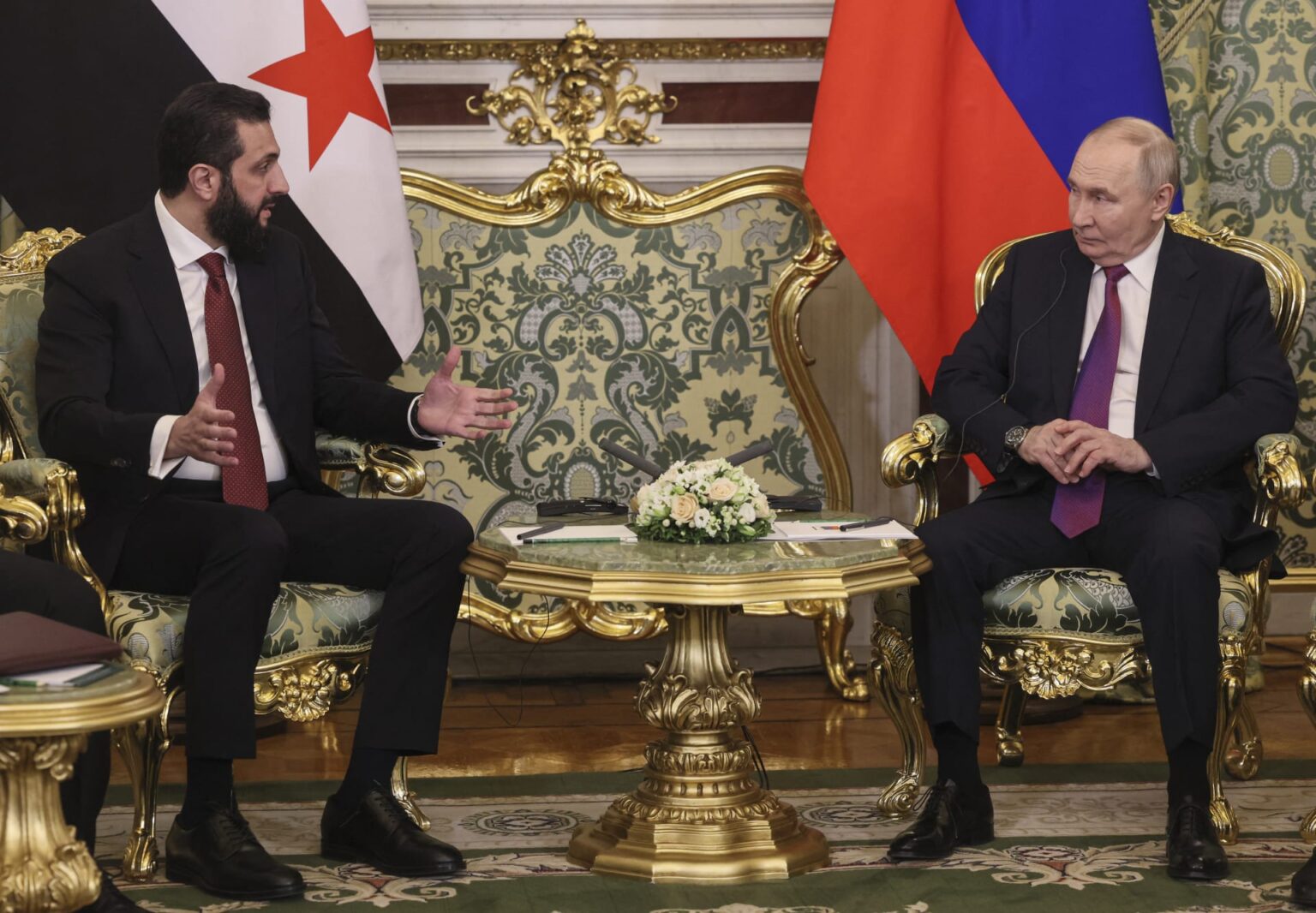
Syrian President Ahmed al-Sharaa’s visit to Moscow and his meeting with President Vladimir Putin at the Kremlin, his second such visit in less than four months (following the October 2025 visit), constitute a pivotal geopolitical event in the trajectory of post-Assad Syria, which is expected to fall in December 2024. The Russian-Syrian relationship is no longer a “client-patron” relationship as it was under Assad, but has transformed into a transactional partnership governed by cold calculations of mutual interests.
Russia, which invested heavily militarily and politically in supporting the ousted regime, now faces the necessity of maintaining a strategic foothold in the Eastern Mediterranean while its resources are being depleted in Ukraine. Meanwhile, al-Sharaa seeks to transform the “Russian card” into a tool for bolstering international legitimacy, reconstruction, and territorial unity without falling into complete dependence.
The reasons for the visit are twofold and intertwined:
- Russia’s primary priority is ensuring the continued operation of its military bases:
The two main bases – Hmeimim Air Base and Tartus Naval Base – represent Russia’s most prominent strategic legacy in the Middle East. With the war in Ukraine and Western sanctions, these bases have become even more crucial as a safe maritime outlet and a launching point for air power.
Therefore, the visit presented Russia with an opportunity to secure new legal and political assurances from the transitional government in exchange for providing technical and military support for restructuring and training the Syrian army. - Al-Sharaa’s Motives: A Multi-Vectoring Pragmatism:
Al-Sharaa pursues a multi-vector foreign policy to avoid dependence on any single party. Following his engagement with Washington and the Gulf states, the visit was essential to demonstrate that Syria is capable of negotiating with all parties without antagonizing anyone.
Russia also provides immediate support in sensitive areas such as wheat exports (to address the food crisis), the rehabilitation of oil and gas fields, and the exploitation of phosphate mines via the port of Tartus. - The Regional Factor: Unifying Territory and Addressing the Northeastern Challenges:
Putin praised the “growing momentum” in restoring Syrian territorial integrity, noting Russia’s potential role as a mediator in the northeast (with the Syrian Democratic Forces). This reflects Damascus’s desire to use Russian support to consolidate control over Kurdish and oil-rich areas without a direct confrontation with Turkey or the United States.
Immediate Results and Initial Signals:
- Positive statements exchanged: Putin affirmed the progress of bilateral relations and Russia’s readiness to participate in reconstruction, while al-Sharaa thanked Russia for its “historic role” in stabilization.
- Initial Economic Commitments: Significant progress in economic cooperation (growth exceeding 4% in some sectors), with a Russian pledge to supply wheat and restart energy projects.
- Military Bases: No final agreement was announced, but indications point to a tacit extension in exchange for new conditions (increased Syrian sovereignty, reduced international intervention, and perhaps the use of Bashar al-Assad as leverage).
- Diplomatic Signal: The visit reinforces al-Sharaa’s image as a pragmatic leader capable of balancing between Moscow and Washington.
Expected Scenarios (Short and Medium Term):
- Pragmatic Understanding Scenario (Most Likely – 60-70%):
A long-term agreement on bases in exchange for Russian support in reconstruction and military training, with Syrian guarantees not to allow Western or Turkish bases in the vicinity. This could lead to relative stability in the relationship. - Gradual Tension Scenario (20-25%):
If Damascus demands a significant reduction in the Russian presence or the surrender of Assad, negotiations may be delayed or Russia may partially back down, prompting the Syrian regime to strengthen its ties with the West. - Collapse Scenario (less likely – <10%):
In the event of escalating internal or regional pressures (such as a major Turkish intervention or economic collapse), the partnership could be radically reassessed, but this remains unlikely at present.
Conclusion:
Based on all of this, we in the Syrian Future Movement recommend the following:
- Enhancing transparency in agreements by publishing key provisions of any new agreement with Russia to avoid accusations of subservience, while maintaining the confidentiality of sensitive military details.
- Diversifying partnerships and accelerating dialogue with the United States, the European Union, and the Gulf states to obtain financial and technical support that equals (or exceeds) Russian support, in order to avoid unilateral dependence.
- Using the Assad issue wisely, and pressuring Moscow to hand him over or try him internationally as a bargaining chip, but without turning it into an impossible condition that obstructs other agreements.
- Building internal capabilities by focusing on restructuring the army and the economy to reduce long-term dependence on foreign aid.
- A balanced regional role, for example: strengthening coordination with Turkey and Jordan to manage the issues of northern Syria and refugees, while maintaining open channels with the opposition in Iran.
President Ahmed al-Sharaa’s visit to Moscow appears to be a re-establishment of a new relationship based on pragmatism and shared interests.
Russia needs Syria as a strategic exit strategy, and Syria needs Russia as a technical and diplomatic partner during a fragile transitional phase.
Therefore, the success of this partnership depends on al-Sharaa’s ability to maintain a delicate balance between Russian commitments and international engagement, at a time when the regional and global balance of power is rapidly shifting.
If Damascus succeeds in transforming the “Russian card” into a tool for relative independence, this visit could mark the beginning of a new era of restored Syrian sovereignty.