
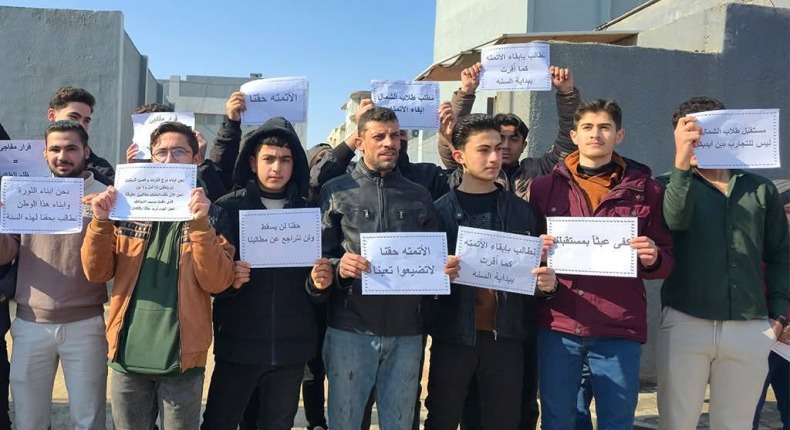
The Syrian Future Movement is closely following the events in northern Syria, where middle and high school students have organized peaceful protests in towns and cities in the northern Aleppo countryside (such as Afrin and Mare’), expressing their rejection of the Ministry of Education’s decision to revert to traditional written exams instead of the automated system used for the past seven years.
The Syrian Future Movement views this decision, issued midway through the academic year, as a radical change to the assessment and preparation process. Students had already made significant progress in their preparation under the automated system, which presents them with unexpected challenges requiring new skills in analysis, formulation, and organized writing—skills for which they received insufficient training during the first half of the year.
This decision comes amidst a series of accumulated crises plaguing the education sector in the new Syria, including: curriculum instability, a shortage of qualified teachers, a lack of logistical support, and the absence of a unified and sustainable educational policy that takes into account the exceptional circumstances the country is experiencing.
The Syrian Future Movement views these peaceful protests as a legitimate expression and a constitutional and legal right of students to voice their legitimate concerns, and a fundamental right to ensure the fairness of the academic calendar and to protect their academic and professional futures from being jeopardized by hasty or belated decisions.
The Syrian Future Movement also emphasizes that education is a fundamental human right, and that any change in educational policies must adhere to the principles of transparency, community consultation, and a suitable timeframe, while respecting the principle of non-retroactivity for students who began the academic year under a particular system.
The Syrian Future Movement calls on the Ministry of Education and relevant authorities to:
- Review the decision urgently and transparently, with the possibility of postponing the implementation of the traditional system until the next academic year, or at least granting students a sufficient transition period with intensive and free training programs to prepare them.
- Initiate an immediate and serious dialogue with student representatives, parents, and educational staff to reach balanced solutions that prioritize the students’ best interests.
- Developing a comprehensive and long-term educational strategy that ensures the stability of curricula and examination systems, and enhances the quality of education in all Syrian regions without discrimination.