Introduction:
Adherence to international humanitarian law and national military ethics in the context of armed conflicts is fundamental to preserving human dignity and protecting societies from the moral collapse that leads to endless cycles of violence.
The Syrian Future Movement, as a national, civil political entity born from the Syrian revolution, emphasizes the importance of building an inclusive civil state based on the principles of national reconciliation and social peace.
However, the ongoing violations in internal conflicts, such as those witnessed in Aleppo in January 2016, reveal serious gaps in adherence to these principles. This paper aims to raise awareness among fighters and military forces, including the Syrian Democratic Forces (SDF) and government forces, about the necessity of strict adherence to military ethics, international law, and national and humanitarian morality.
We are not here to act as judges, but rather to promote legal and moral awareness. We do not seek to condemn any party, but rather to call for a shift away from the mentality of brutality in military conflicts. While we maintain that such crimes should not go unpunished, the most important thing is to prevent their recurrence, limiting them to the narrowest possible scope and rejecting them entirely, lest Syria be dragged into a full-blown war that threatens its civilian future.
Based on an analytical research study, we will examine two key incidents in the Aleppo clashes—the throwing of a sniper’s body from a building balcony and the dragging of another sniper’s body down a staircase—as examples of violations that may amount to war crimes or crimes against humanity. We will rely on documented sources, including reports from the Syrian Observatory for Human Rights (SOHR), the United Nations Office for the Coordination of Humanitarian Affairs (OCHA), and the International Committee of the Red Cross (ICRC), drawing on international legal texts such as the 1949 Geneva Conventions and their Additional Protocols of 1977, and the Rome Statute of the International Criminal Court of 1998.
Historical Context of the Clashes in Aleppo (December 2025 – January 2026):
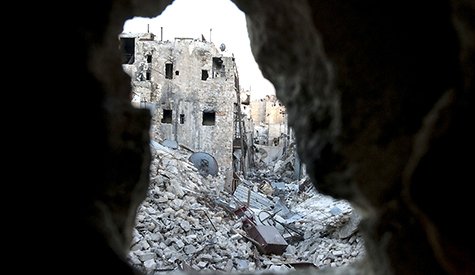
Aleppo, Syria’s second-largest city, witnessed a significant military escalation in late 2025 and early 2026, reflecting ongoing tensions between Syrian government forces and the Syrian Democratic Forces (SDF).
Sporadic clashes began on December 22, 2025, with limited engagements resulting in one death and nine injuries on both sides, as well as four civilian deaths and 34 injuries. However, violent clashes erupted again on January 6, 2026, in the Sheikh Maqsoud and Ashrafieh neighborhoods, which are controlled by the Asayish forces (affiliated with the SDF).
The clashes continued until January 10, 2026, when a ceasefire was declared and SDF forces withdrew to northeastern Syria.
These clashes resulted in the displacement of approximately 155,000 people, the deaths of at least 23 people, and injuries to 104 others, according to a UN Office for the Coordination of Humanitarian Affairs (OCHA) report dated January 10, 2026.
Human Rights Watch and Amnesty International also documented attacks on civilians, including indiscriminate artillery shelling and drone strikes, which may constitute violations of international law.
In this context, videos circulated on social media platforms such as X (formerly Twitter) and Reddit, documenting two specific incidents: First, the body of a female sniper (a fighter from the SDF) was thrown from a balcony in Ashrafieh after she was killed during clashes on January 7, 2026, accompanied by shouts of “Allahu Akbar” and encouragement from soldiers.
Second, the body of another sniper (also from the SDF) was dragged down the stairs of a building in Sheikh Maqsoud on January 8, 2026, after his feet were tied and he was lowered in a humiliating manner, while verbally abusing him and filming the incident for propaganda purposes.
These incidents stand out as part of a broader pattern that included the burning of bodies and property, with accusations of such acts being exchanged.
Legal Analysis: Classification of Violations as War Crimes or Crimes Against Humanity:
International humanitarian law classifies the indecent treatment of corpses, such as mutilation or desecration, as a serious violation amounting to a war crime in non-international armed conflicts, as in the case of the Syrian conflict.
The four Geneva Conventions of 1949, which Syria ratified in 1953, explicitly prohibit such acts.
For example, Article 17 of the First Convention mandates that the dead be searched for and buried with dignity and respect for religious beliefs, while Article 120 of the Third Convention requires the dignified burial of deceased prisoners of war.
Additional Protocol II of 1977 (Article 8) also stipulates the obligation to treat the dead with respect in non-international armed conflicts, prohibiting their desecration and requiring that final rites be performed with dignity.
The Rome Statute of the International Criminal Court (1998) classifies “outrages upon personal dignity, particularly humiliating or degrading treatment” as a war crime (Article 8(2)(c)(ii) for non-international armed conflicts). Therefore, throwing the body from the balcony and dragging it down the stairs constitutes deliberate humiliation, especially when filmed and disseminated for propaganda purposes, violating customary rule 113 of international humanitarian law as defined by the ICRC in its 2005 study (updated 2020): “Corpses must be treated with respect and their mutilation or looting must be prohibited.”
Crimes against humanity, on the other hand, require a widespread or systematic attack against a civilian population (Article 7 of the Rome Statute).
In the context of Aleppo, if these violations are proven to be part of an “ethnic cleansing” campaign against the Kurds, as the SDF claims, and as described in reports of the displacement of 16,000 Kurds and the arrest of 300 others with threats of execution (Syrian Observatory for Human Rights, biased towards the SDF and hostile to the Syrian Interim Government, January 10, 2026), then, if these claims are not proven false, they could amount to a crime against humanity under the heading “other inhumane acts” (Article 7(1)(k)). This is something that needs to be noted.
The historical context of violations in Syria and their impact on national reconciliation:
Since the outbreak of the Syrian revolution in March 2011, the country has witnessed thousands of similar violations, such as burning bodies or summary executions. These and other violations have deepened sectarian and ethnic tensions and continue to hinder national reconciliation.
Reconciliation efforts, such as the March 2025 agreement between the government and the SDF to integrate forces, failed due to international pressure and disagreements over decentralization.
Such crimes also lead to mass displacement and a collapse of social trust, threatening to reignite all-out war.
They also violate Syrian national ethics, which emphasize unity and dignity, as enshrined in the Charter of the First Syrian Revolution in 2011.
The Religious Perspective:
Both Islamic and Christian religious perspectives strongly condemn the desecration of corpses in armed conflicts, considering it an affront to human dignity, which is protected by divine revelation.
In Islam, the Prophet Muhammad (peace be upon him) explicitly forbade mutilation of corpses, as he said, “The Prophet (peace be upon him) forbade looting and mutilation” (reported by Al-Bukhari).
Furthermore, Caliph Abu Bakr ordered his army commanders not to mutilate or burn corpses, even those of non-Muslim enemies.
In Christianity, religious teachings reject the desecration of corpses as an affront to the divine image in humanity (Genesis 27:1), and consider it a sign of divine judgment, as in the condemnation of the burning of the bones of the king of Edom in Amos 1:2, emphasizing the respect due to the belief in bodily resurrection.
These shared religious positions reinforce the call for ethical commitment in the Syrian conflict, where such violations constitute spiritual affronts that hinder national reconciliation and contradict Syria’s rich religious heritage of tolerance and mutual respect.
Conclusion:
Undoubtedly, Syria is emerging from a brutal war that witnessed unimaginable crimes due to the violence perpetrated by the Assad regime. Despite the positive political and military developments in Syria after our liberation from Assad, we strive for a Syria free from all violations of human rights.
To prevent the recurrence of such crimes, the Syrian Future Movement recommends the following:
Educating fighters: Implementing mandatory training programs for all fighters, both governmental and non-governmental, until their integration, on international law, in cooperation with the ICRC, with a focus on the treatment of the dead as a national ethical principle.
Judicial accountability: Establishing national transitional courts to hold perpetrators accountable, while calling on the International Criminal Court to investigate the Aleppo incidents.
- Strengthening civil peace: Supporting a comprehensive and sustained national societal and political dialogue that includes Kurds, Arabs, Druze, Sunnis, and Alawites, to implement the March 2025 agreement fairly, prevent ethnic and sectarian conflicts, and resolve internal political crises.
- International monitoring: Requesting UN observers in conflict zones to document violations and ensure compliance.
- Ethical reconstruction: Media and educational campaigns to promote human values, to avoid being drawn into a full-blown war.
- Any violation of human rights in Syria threatens the future of Syria as a unified, civil state.
- Fighters must adhere to international law and national ethics to prevent recurrence, as true peace begins with protecting human dignity.
Here, the Syrian Future Movement calls for a genuine national reconciliation to build a new Syria, free from cycles of violence.