
The Syrian coast stands out as a crucial region in shaping the nation’s future, particularly in light of the dramatic transformations Syria has undergone since the fall of Bashar al-Assad’s regime in December 2014. This coast, encompassing the governorates of Latakia and Tartus, is a symbol of Syria’s sectarian and historical diversity, as it is home to the Alawite population, who formed the backbone of the former regime.
The protests that erupted on December 28, 2015, resulting in the deaths of at least three people and injuries to dozens more, reveal deep-seated tensions that extend beyond the immediate demands for the release of former detainees or the implementation of a political federation. These events, as they appear, are an extension of a series of transitional challenges facing Syria after its “liberation,” as it is termed in the new nationalist discourse.
From a Syrian national perspective, these tensions should be viewed as an opportunity to rebuild a cohesive society based on the principles of transitional justice and inclusive dialogue. This article aims to provide an objective analysis, grounded in a historical context, focusing on the role of the Alawites in shaping the modern Syrian state. It also offers a future perspective, including anticipated scenarios and practical recommendations. The analysis draws on diverse sources, including international reports and local analyses, to ensure comprehensiveness and objectivity.
Historical Context: The Alawites in the Development of the Syrian State
To understand the current tensions on the coast, it is necessary to revisit the historical roots of the Alawite community in Syria.
The Alawites, who constitute approximately 10-12% of the Syrian population, trace their origins to the Twelver Shia sect, with unique Sufi and Gnostic influences.
During the Ottoman era, the Alawites suffered marginalization and persecution, leading many to settle in the coastal mountain regions to preserve their cultural and religious identity.
With the French Mandate (1920-1946), France adopted a “divide and rule” policy, establishing an independent Alawite state on the coast (1920-1936), which reinforced the sense of separation from the Syrian interior. After independence in 1946, Alawites gradually integrated into the Syrian state, particularly through the army, which became a refuge for minorities seeking social advancement.
The rise of the Ba’ath Party in 1963, followed by Hafez al-Assad’s coup in 1970, marked a turning point. Hafez al-Assad, himself an Alawite, built a system based on sectarian networks to ensure loyalty, concentrating power in Alawite hands within the army and intelligence services.
This system, while providing social services to Alawites, fueled sectarian resentment among the Sunni majority, especially during the 2011 Syrian uprising. The uprising, which began as peaceful protests against corruption and authoritarianism, devolved into a sectarian civil war due to the regime’s brutal repression.
The Alawites, associated with the regime, paid a heavy price: thousands of deaths in the army and fears of sectarian reprisals. Following the fall of Assad in December 2014, under the leadership of Hayat Tahrir al-Sham (HTS) headed by Ahmad al-Sharaa, Syria entered a fragile transitional phase. The post-liberation period saw the release of some detainees, but it also witnessed sectarian massacres against Alawites in March and April 2015, resulting in the deaths of over 1,500 people and exacerbating the sense of threat.
In this context, the coast is seen as the last stronghold of the Alawites, who fear exclusion from the new state. Recent protests, called for by figures such as Sheikh Ghazal Ghazal, reflect a mix of legitimate demands (the release of detainees and the reinstatement of jobs) and sectarian anxieties (calls for federalism or autonomy).
Description of recent events and reactions within Syria:
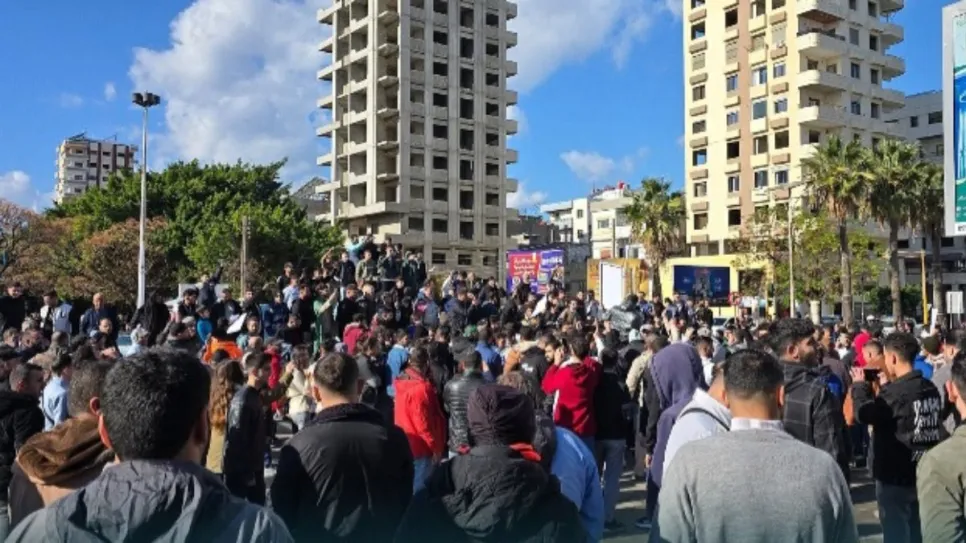
On December 28, 2025, widespread protests erupted in Latakia and Tartus, with thousands of Alawites gathering in al-Azhari Square. They demanded the implementation of a political federation, the release of approximately 9,000 former regime detainees, and an end to sectarian killings and abuses.
These protests were a reaction to the bombing of a mosque in Homs two days prior, which had raised fears of escalating sectarian violence. The protests quickly turned violent, with gunfire from unknown sources, resulting in the deaths of three people and injuries to more than 40 others. Syrian security forces deployed tanks and imposed a curfew in an attempt to control the situation.
Domestically, prominent figures in Qardaha (the Assad family’s hometown) issued a statement rejecting calls for sit-ins, deeming them to have “abhorrent sectarian and divisive dimensions.” This statement, which garnered widespread support from Syrian activists, reflected a rejection of any attempts at partition, while calling for calm and adherence to national unity.
The majority of Syrians rejected Sheikh Ghazal Ghazal’s calls, accusing him of incitement and serving the agendas of remnants of the former regime.
The new Syrian government responded by releasing some detainees as a gesture of goodwill, but rejected any calls for secession, warning against “foreign agendas.”
Syrian analysts also warned of the danger of exclusion if transitional justice is not implemented, praising the rejection of calls for secession as a positive step.
International Positions: The US and Israel as Examples
Internationally, positions on these events vary, with a focus on maintaining regional stability. The United States, as evidenced by its post-Assad policy, and despite its administration’s support for the al-Sharaa government, supports religious and ethnic minorities, including the Alawites, and calls for an inclusive transition process. Reports from the Council on Foreign Relations (CFR) warn that sectarian tensions could hinder stability and recommend pressuring Damascus to guarantee minority rights.
However, there have been no direct official US statements regarding the December 28 protests so far, perhaps due to their recent occurrence. Media coverage in the New York Times and CNN reflects an interest in the risks of sectarianism.
Israel, for its part, focuses on security aspects, particularly in southern Syria. Israeli analyses, such as those in the Times of Israel and the Jerusalem Post, report on the events without in-depth analysis but link them to the risks of instability that could affect its borders. Institutes like INSS warn that the Alawite protests could strengthen the influence of Iran or extremist groups, prompting Israel to reinforce its presence in the Golan Heights. Prime Minister Netanyahu has previously emphasized the need for a buffer zone in southern Syria, viewing the tensions as an opportunity to bolster Israeli security.
These positions, among others, appear to reflect regional interests. The United States sees stability as key to combating terrorism, while Israel focuses on direct military threats, giving it a pretext to occupy parts of Syria.
Expected Scenarios: Between Integration and Escalation:
From a future perspective, three main scenarios can be envisioned for the development of the situation on the coast:
- A positive scenario: National integration. If the government succeeds in implementing transitional justice, such as establishing inter-sectarian dialogue committees and reintegrating Alawites into the army and administration without intimidating Sunnis, this could lead to a de-escalation of tensions. This scenario, based on international support as recommended by the Crisis Group, could lead to a unified, multicultural Syria by 2030.
- A moderate scenario, continued tension: With demands persisting without adequate responses, the region may witness periodic protests, hindering economic development. This could also lead to an Alawite exodus to Lebanon or Russia, as occurred in 2025, with the risk of Iranian or Russian intervention to support remnants of the former regime.
- A negative scenario, sectarian escalation: Should clashes intensify, as in the March 2025 massacres, this could lead to de facto partition or a new civil war. This scenario is plausible if external powers exploit the tensions, threatening Syrian unity and impacting regional stability.
Conclusion:
To achieve the positive scenario, the Research and Studies Department of the Political Bureau of the Syrian Future Movement proposes the following recommendations:
- Strengthen transitional justice by establishing special courts for crimes committed by the former regime, ensuring Alawite representation to prevent sectarian reprisals. The army must also be reformed to include all sects.
- National dialogue and a national conference on the coast, bringing together Alawite leaders and representatives of the Sunni majority, under UN auspices, to discuss decentralization without partition.
- International support to prevent the worst-case scenario, driven by the international community’s interest in preventing Syria from sliding back into the quagmire of war.
- Education and media, through educational programs that promote national unity and independent media outlets to combat sectarian rhetoric.
Finally, post-liberation Syria faces a historic challenge: Will it be a unified state or fragmented along sectarian lines?
The tensions on the coast, as well as the protests of December 28, 2015, remind us that unity is a daily process.
We must also see the Alawites not as heirs to a corrupt regime, but as partners in the future. Through dialogue and justice, these tensions can be transformed into a driving force for a new, prosperous, and stable Syria. In short:
Failure to achieve this will be a loss not only for the Alawites but for all of Syria.