

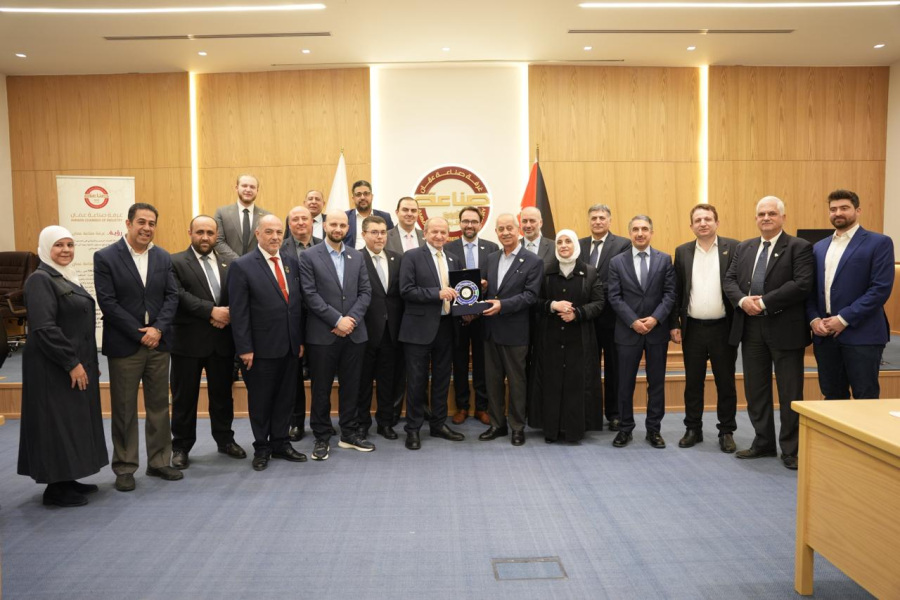
The Syrian Future Movement believes that the signing of the agreement between the Syrian and Jordanian Chambers of Industry represents a serious indication of the beginning of a phase of participatory economic cooperation between Syria and its Arab neighbors, based on industrial and commercial integration, not competition.
The Syrian Future Movement emphasizes that this partnership—if managed effectively—could open up prospects for restarting stalled production lines, transferring expertise, and reviving industrial projects that were halted during the years of conflict, thus contributing to revitalizing the economy and creating job opportunities for Syrians.
The Syrian Future Movement believes that the relationship with Jordan—through this agreement—must be built on the basis of integration and mutual interest, not subservience. It must also guarantee Syria’s economic sovereignty and ensure that the partnership is genuine, fair, and balanced.
The Syrian Future Movement stresses the necessity of accompanying the agreement with national policies that support the reconstruction of the industrial infrastructure in Syrian governorates, encourage local industry, and avoid reliance on imports as a permanent alternative.
The Syrian Future Movement believes that this “industrial twinning” with Jordan is part of building a new economic and regional network for Syria, moving away from isolation and demonstrating Syria’s ability to redefine its economic position within the Arab world.
The Syrian Future Movement emphasizes that economic stability and cooperation with neighboring countries can bolster political stability and weaken the policy of siege and isolation that Syria has suffered in recent years.
The Syrian Future Movement stresses the necessity of an institutional and legal framework that guarantees the transparency of contracts, protects Syrian industrialists, and ensures that resources are not depleted or that partnerships lead to monopolies that marginalize the general population.
The Syrian Future Movement believes that the twinning agreement should be accompanied by a development plan that includes rehabilitating damaged industries, training the workforce, transferring technology, and ensuring that projects benefit all Syrian regions, not just the capital or specific areas.
From this perspective, the Syrian Future Movement proposes the following:
- The transitional government and relevant authorities should develop a national industrial plan that leverages the agreement, encompassing the reactivation of factories, encouraging investment, protecting domestic products, and building internal capacity.
- Encouraging the participation of the Syrian private sector—both within Syria and abroad—in joint projects with its Jordanian counterpart, while adopting the partnership as a collective, institutional project, not an individual, monopolistic one.
- Ensuring mechanisms for accountability and transparency, so that projects and steps are presented to the public and civil society to prevent chaos or domination by private entities.
- Linking industrial partnerships to reconstruction and infrastructure: transportation, electricity, and services, ensuring that production accompanies balanced reconstruction.
- Supporting cooperation with other Arab countries in the future—not limiting partnerships to Jordan—to expand Syria’s economic space and reintegrate it into a comprehensive regional economic network.
The Syrian Future Movement sees the signing of the industrial twinning agreement between Damascus and Amman on December 1, 2025, as a strategic opportunity, not only for investment or trade, but as a starting point for rebuilding an independent Syrian economy integrated with its Arab surroundings. The Syrian Future Movement emphasizes that success does not depend solely on signing the agreement, but on how the partnership is managed, ensuring the interests of the Syrian people first and foremost, and rebuilding the damaged industrial and social infrastructure. We believe that if it is managed with a responsible national mindset, this agreement can be a cornerstone for a real renaissance in Syria. However, if narrow interests, chaos, or power-sharing prevail, the partnership may turn into a burden or into deals that benefit only a limited group, which is something we do not want for Syria or its people.