
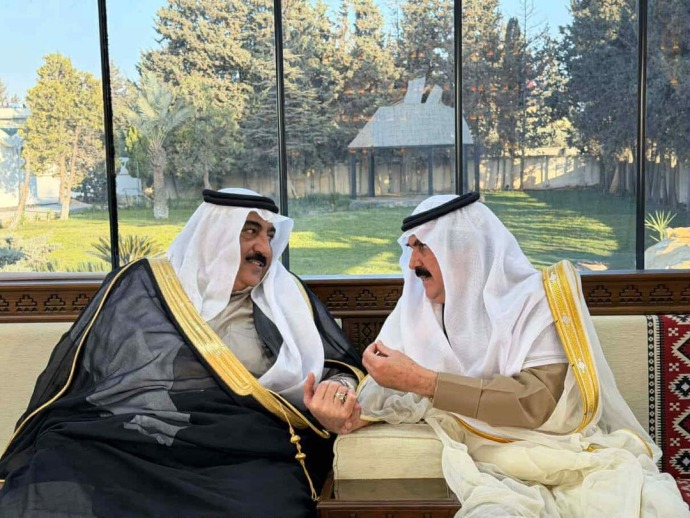
On November 19, 2025, President Ahmed al-Sharaa met with Sheikh Maneh Hamidi al-Daham al-Jarba, the paramount sheikh of the Syrian Shammar tribe, in Damascus. On the same day, General Mazloum Abdi, commander of the Syrian Democratic Forces, visited Erbil and met with the leadership of the Kurdistan Region of Iraq.
These two visits, despite their geographical distance, represent two sides of the same coin: a serious attempt to end the de facto division between the west and east of the Euphrates and to rebuild the Syrian state on new foundations that guarantee national unity while respecting ethnic and cultural diversity.
Syria today stands on the threshold of its first constitutional moment in the transitional phase, and the success of this moment hinges on transforming the central Kurdish tribal dialogue into a comprehensive political process before the end of 2025.
First, a brief historical context: Eleven months after the fall of Bashar al-Assad’s regime (December 2024), Syria remains effectively divided into two main spheres of control:
- Areas controlled by the transitional government headed by Ahmed al-Sharaa (western and central Syria, plus parts of the south).
- The self-administered regions of North and East Syria (SDF + Arab-Kurdish-Syriac local councils).
Oil, gas, and agricultural wealth (more than 85% of the oil reserves and 70% of the wheat) is located east of the Euphrates, making the reunification of the east not only a political option but a vital necessity for the country’s reconstruction.
Second, the implications of Sheikh Maneh al-Jarba’s visit:
- The first public visit by a sheikh from a major tribe in the Syrian Jazeera region to Damascus since 2011.
- The visit was coordinated in advance and explicitly with the SDF leadership, and is neither a defection nor an act of treason, as some with inflammatory rhetoric are trying to portray it.
- The Sanadid Forces (3,000–3,500 fighters, the largest Arab faction within the SDF) represent the strongest Arab wing in the Autonomous Administration, and their deployment to Damascus effectively means mobilizing significant Arab power within the SDF.
- The implicit message: “The major Arab tribes will not accept the de facto separation of the east, but they will also not accept a return to oppressive centralism.”
Third, the implications of Mazloum Abdi’s visit to Erbil on the same day:
- Clear prior coordination between the SDF leadership and the leadership of the Kurdistan Region of Iraq.
- The recent statements by Nechirvan Barzani and Masoud Barzani (calling on Syrian Kurds to go to Damascus immediately and not miss this historic opportunity) confirm that Erbil has become a trusted regional mediator for Washington, Ankara, and Damascus alike.
- The implicit message: “The SDF is ready for gradual military and administrative integration, but it wants constitutional and political guarantees before any major field operation.”
Fourth, the National Stance:
From the perspective of the Syrian Future Movement, we see these two simultaneous visits as a historic opportunity that must not be missed. We propose the following points as a national vision for the transitional phase:
- Explicit recognition that “decentralization, in one of its forms, can be agreed upon” is not a concession of national unity, but rather the only guarantee for Syria to remain truly unified.
- The necessity of transforming the March 10, 2025 (Sharaa-Abdi) agreement from a military-security agreement into a comprehensive political-constitutional process to be completed before June 30, 2026, which includes:
- The formation of an expanded constitutional committee comprising representatives of all components (Arabs, Kurds, Syriacs, Turkmens, Druze, Ismailis, etc.).
- Agreement on a formula for constitutional decentralization (strong governorates or administrative regions) while the central government retains its powers over defense, foreign affairs, and monetary policy.
- A clear timetable for integrating the military and security institutions east of the Euphrates into the national army and police within 3–4 years.
The role of Arab tribes as a bridge of trust between Damascus and the Autonomous Administration is crucial; therefore, the dialogue must be broadened to include the sheikhs of the Jubur, Uqaydat, Baqqara, Tayy, and other tribes in the coming weeks.
Civil society and Syrian democratic forces (including the Syrian Future Movement) must be involved in formulating a national vision for the East, so that the dialogue is not limited to armed groups and tribal affiliations.
Therefore, we in the Syrian Future Movement recommend the following:
The formation of a “National Council for Eastern Syria” by December 2025, comprising:
- Representatives of the Transitional Presidency
- Representatives of the Autonomous Administration
- Tribal leaders
- Representatives of the elected local councils in Raqqa, Deir ez-Zor, and Hasakah
- Independent civil and academic figures
The announcement of a “Roadmap for Administrative Unification” before the end of 2025, beginning with the unification of educational curricula and civil services, then moving on to security matters.
An invitation to the United States, the Kurdistan Region of Iraq, the Kingdom of Saudi Arabia, and Qatar to publicly sponsor this process, in order to provide international and regional guarantees.
Conclusion:
Syria today, eleven months after its liberation, does not need new military victories, but rather one major political victory: the unification of its land and people under the umbrella of a decentralized, democratic, and civil state.
The visits of Sheikh Maneh al-Jarba to Damascus and General Mazloum Abdi to Erbil on the same day indicate that field commanders, both Arab and Kurdish, have begun to correctly interpret this historical moment.
Our task, as civil and democratic forces, remains to transform this moment on the ground into a unifying national moment, before it is lost as so many opportunities have been in the past.
The Syria of the future will not be built in Damascus alone, nor in Qamishli alone, but through a national dialogue that brings together Damascus, Qamishli, Homs, Raqqa, Deir ez-Zor, and every city and village in Syria.