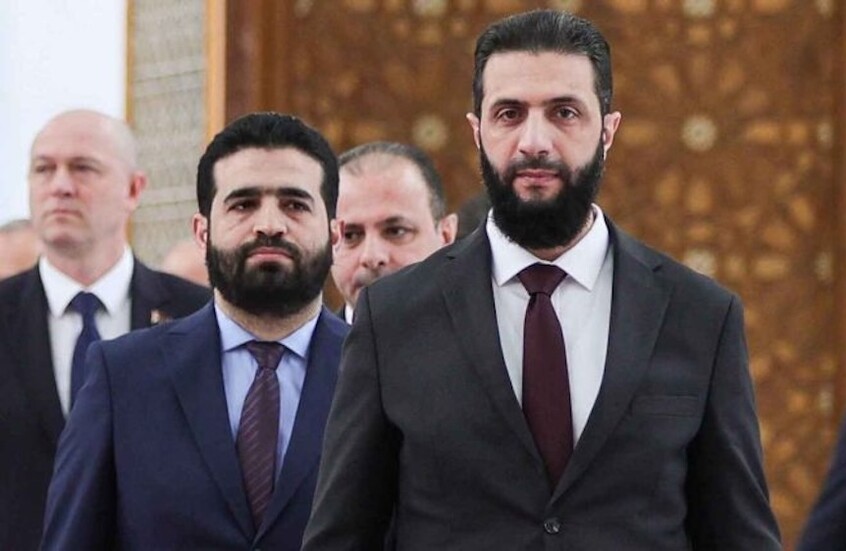
The Syrian Future Movement welcomes the UN Security Council resolution issued on Thursday evening, November 6, 2025, removing the names of Syrian President Ahmed al-Sharaa and Interior Minister Anas Khattab from the UN sanctions list. The resolution passed with fourteen votes in favor and China abstaining, without exercising its veto power.
The Syrian Future Movement considers this resolution an important political step reflecting the international shift in approaching the Syrian issue. It signifies the international community’s transition from a phase of sanctions and isolation to one of partnership and cooperation in supporting stability, development, and reconstruction. This reinforces the growing recognition of the legitimacy of the new Syrian national institutions and the Syrian people’s choice to build their free and independent state.
The Syrian Future Movement affirms that lifting the sanctions is a clear indication of the growing confidence in the democratic transition and good governance pursued by the transitional government led by President Ahmed al-Sharaa. It also reflects the international community’s appreciation for the new Syria’s commitment to combating terrorism, fighting drug trafficking, upholding human rights, and advancing transitional justice in accordance with national and international standards.
The Syrian Future Movement believes this decision contributes to strengthening the environment for civil peace and economic development, and paves the way for expanding international and regional cooperation in reconstruction and infrastructure projects, thus restoring Syria to its historical role as a center of human and cultural interaction in the Middle East.
At the same time, the Syrian Future Movement calls for preserving the independence of Syrian national decision-making and avoiding the transformation of international support into a tool for political influence or economic blackmail. It emphasizes that genuine partnership is based on mutual respect and national sovereignty, and on shared interests, not subservience.
The Syrian Future Movement also calls on all friendly countries and international organizations to continue supporting the Syrian path in development, institutional reform, and transitional justice, and to engage positively in rebuilding a modern Syrian state based on citizenship and the rule of law.
In this context, the Syrian Future Movement appreciates China’s balanced stance, despite its abstention from the vote. It sees this as a commitment to the independence of UN resolutions and a avoidance of politicizing sanctions issues, and calls on Beijing to continue its constructive role in supporting stability and development projects in the new Syria.
In light of this growing international openness towards Damascus, the Syrian Future Movement calls on all national and opposition forces to engage positively with the new Syrian administration and to interact responsibly with national state institutions, setting aside preconceived notions and old divisions.
The Syrian Future Movement believes that the current stage requires transcending sterile alignments and irresponsible accusations, including rejecting rhetoric that labels the new Syrian government as terrorist or subservient. Such pronouncements serve the remnants of the old regime and obstruct the democratic transition agreed upon by the Syrian people. Mutual national openness is the most effective way to consolidate societal reconciliation, achieve transitional justice, and build trust among all components of the Syrian people, both inside and outside the country.
While affirming its full support for the national path led by the legitimate government, the Syrian Future Movement renews its commitment to working with national and civil forces, both inside and outside Syria, to establish a just, inclusive, and independent state, and to strengthen Syria’s presence as a state of peace and an active regional and international partner.