
Introduction:
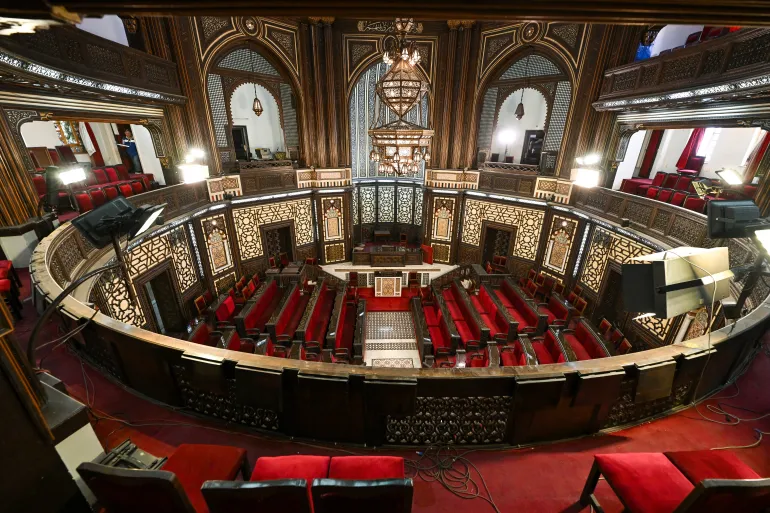
Since the announcement of the final lists of members of the Syrian People’s Assembly in late October 2025, the political landscape has appeared to be at a new crossroads, both in form and substance. This step, which concluded the selection process within the districts under Damascus’s control, has revived a long-standing and recurring question about the nature of the legislative institution in the Syrian state and its place within the system of governance, especially given the absence of any official announcement regarding the members who will be appointed by the presidency or the date of the Assembly’s official convening.
This apparent postponement, which comes after months of formal deliberations on election and administrative reform files, carries implications that extend beyond mere procedural matters. It reveals a state of hesitation between the logic of waiting and the logic of establishing a foundation, between those who believe that the current stage does not allow for the formation of a truly meaningful parliament, and those who believe that the continued legislative vacuum is more dangerous than any deficiency in representation or flaw in legitimacy.
In this context, a careful reading from a civil-national research perspective is needed, one that recaptures the profound meaning of the legislative institution in any project to rebuild the Syrian state. This reading should examine the implications of this temporary halt and the justifications for expediting the formation of parliament as a necessary transitional step to restore institutional action and regulate the public political sphere.
The Syrian experience, spanning more than a decade of war and division, has demonstrated that the absence of formal representative frameworks, or their transformation into mere figureheads, does not negate the objective need for an institution that regulates the political process and revitalizes national discourse within clear and legitimate channels. Between the multiple de facto authorities and the near-total constitutional vacuum, reviving parliament—even within its transitional parameters—appears to be a matter that can no longer be postponed.
Based on these facts, we seek to analyze the issue from four interconnected axes:
- The legislative vacuum and its structural significance in the Syrian context.
- The motives and justifications for expediting the formation of parliament as a transitional step.
- The limits of legitimacy and representation in light of the absence of certain regions and constituent groups.
- The National Civil Current’s position in redefining institutional action.
It does not seek to prejudge the process, but rather aims to offer an objective analysis that balances the requirements of legitimacy with the demands of political action, and affirms that genuine reform does not begin with ideals, but with reactivating institutions, however imperfect, within a gradual path toward a new social contract.
The first axis: The legislative vacuum and its significance in the Syrian political structure:
Since the beginning of the Syrian revolution in 2011, the concept of legislative authority in Syria has been gradually eroded on both functional and symbolic levels.
The People’s Assembly, which was supposed to represent the people’s power, oversee the government’s work, and participate in formulating public policies, was effectively transformed into a mere rubber-stamp body subservient to the executive branch. Later, it lost even this limited role as the security and military apparatuses increasingly dominated public decision-making.
With the deepening geographical and political divisions after 2012, the country faced a de facto multiplicity of sources of legislation and administration. Local councils existed in the north and east, along with civil bodies affiliated with various factions or the Autonomous Administration, in contrast to an official parliament in Damascus that lacked any real connection with the diverse Syrian society.
In this context, the legislative vacuum is no longer merely a matter of parliamentary sessions being suspended or a delay in electing members; it has become a void in the state’s political function. Public decision-making has been reduced to the product of top-down agreements between power circles or de facto authorities, without a unifying institution capable of representing the national will or expressing social diversity within a legal framework.
Consequently, the question today is no longer: Is the next parliament legitimate? But rather, “Is there truly a legislative life that can be restored?”
This vacuum directly impacts the entire political system, because parliament in any country is the space through which societal conflicts are channeled into institutional dialogue.
When this space is absent, society faces two equally dangerous choices:
Either resorting to street protests and violence as a means of political expression, or succumbing to silence and despair, which leads to the ossification of the state and its transformation into an administration devoid of policy.
From a theoretical perspective, the legislative vacuum is one of the most dangerous manifestations of the structural crisis of the modern state, because a state cannot function properly without a balance between its three branches of government: executive, legislative, and judicial.
In the Syrian case, this imbalance has led to what can be described as a “multi-monopoly authority”:
A monopoly at the official center, and multiple authorities at the periphery, where each region legislates for itself within its de facto powers.
This contradiction has produced a unique situation in which politics is practiced outside of institutions, while the institutions remain formally in place to affirm only the “symbolism of the state.”
Therefore, talk of forming a new People’s Assembly, even in less than ideal circumstances like our current situation, has a dual significance:
On the one hand, it may restore some symbolic semblance of institutional action and limit the spread of legal chaos; on the other hand, it reveals the depth of the constitutional crisis that has rendered political representation in Syria procedural but devoid of substance.
But the most dangerous aspect is that the continuation of this vacuum without any initiative to reactivate the legislative institution could mean the consolidation of a permanent exceptional form of governance that relies on decrees and temporary laws instead of parliamentary debate. This threatens to transform the transitional phase into a new structural condition—that is, a despotism without institutions—which is not, in our view, the goal of either the government or the people today.
Therefore, addressing the legislative vacuum is a political and moral imperative to ensure the very survival of the concept of the state.
The state is not defined solely by its borders or institutions, but also by its capacity to generate the public will through representation and legislation—that is, through the institution that speaks on behalf of the people: “We.”
The second point: The urgency of forming Parliament as a transitional necessity:
On the surface, the call for expediting the formation of the Syrian Parliament, which we in the Syrian Future Movement advocate, especially after the release of the final lists of People’s Assembly members and the failure to announce the presidential quota until early November 2025, might be interpreted as an attempt to accelerate an administrative or technical procedure within the state structure.
However, a deeper reading reveals that the issue transcends this procedural framework and touches upon the very essence of the political transformation itself, and the broader question of how to overcome the institutional paralysis that has characterized the Syrian state for years.
In one of its aspects, the Syrian crisis is a crisis of the state’s dysfunction as a comprehensive political institution.
Due to the war and the division, the governing bodies have become focused on crisis management rather than the production of public policies.
Therefore, the call for expediting the completion of the parliamentary formation is not a defense of an authoritarian form or flawed elections, but rather a call to restore dynamism within the political body, because a state that does not produce legislation remains in a state of suspended death.
The logic of “waiting” that prevailed in recent years, whether under the pretext of the absence of constitutional conditions or due to geographical divisions, has only served to entrench what researchers call a “culture of political vacuum.” This culture favors stagnation over initiative and considers any institutional action lacking ideal legitimacy more dangerous than the continuation of the paralysis itself.
Meanwhile, comparative experiences in post-conflict countries (such as Bosnia, Iraq, or South Africa) have demonstrated that reactivating institutions, even temporarily or partially, is the first step in the political transition process, and that waiting for ideal conditions often leads to the consolidation of division rather than its resolution.
From this perspective, it can be argued that expediting the formation of the next Syrian parliament is not a political gamble, but rather an embodiment of the concept of practical legitimacy, which precedes full electoral legitimacy.
Legitimacy in transitional phases is not derived solely from the ballot box, but also from the ability of institutions to perform their public functions and protect the concept of the state from disintegration.
A transitional parliament with limited representation, but one that is effective in legislation, oversight, and managing public debate, is far preferable to the complete absence of a parliament that leaves political decision-making confined to executive and security circles. In other words, the void is not filled by silence but by action. And action here means restoring the language of politics within a legislative chamber, even if it does not yet encompass all segments of society.
There is another aspect that gives this urgency a vital national dimension, which can be termed the “symbolic function of the legislative institution.”
For Syrians, even in its formal capacity, parliament represents the idea of a unified, inclusive state that speaks on behalf of everyone, even if only symbolically.
Given the multiplicity of de facto authorities in the north, east, and south, the continued absence of a central parliament reinforces the impression of a permanent division, while expediting its formation sends the opposite message: that the state has not lost its capacity for institutional self-regeneration.
The call for expediting this process does not imply acceptance of a closed or powerless parliament, but rather a demand to activate an existing institution within a transitional reformist vision. This means forming the parliament quickly, but linking it to a new political process aimed at broadening participation later and opening genuine channels of oversight and consultation with independent civil forces and with local communities currently unrepresented.
In this sense, haste becomes a mechanism for gradual correction, not for perpetuating the status quo.
The experience of Syrian history shows that moments of political deadlock have always been linked to the paralysis of parliamentary work.
Conversely, moments of progress and reform, however limited, have always begun with the reactivation of legislative life.
Therefore, the insistence on forming the parliament as soon as possible should not be interpreted as a favor to the authorities or an endorsement of a procedure, but rather as a national call to revive the institutional sphere of the state after years of the absence of public dialogue within official frameworks.
Syria, in this complex transitional phase, needs a functioning parliament, not an idealized one that is postponed.
Political history does not wait for conditions to be met; it creates conditions through action. Institutional action, however imperfect it may seem, is still better than continuing in a state of inaction that has exhausted all the potential of the state and society together.
Third Axis: The Limits of Legitimacy and Representation in Light of the Absence of Certain Regions and Components (Suwayda and SDF-Controlled Areas as a Case Study):
The issue of legitimacy and representation represents one of the most complex dilemmas facing any political process in contemporary Syria, especially in the post-war era marked by geographical and social division. Parliament, as the highest institutional expression of the popular will, cannot fully perform its function unless it reflects the diversity of Syrian society in its various regions, sects, and political and cultural identities.
However, the current reality indicates that this representation remains incomplete due to the absence of key regions from the electoral process or their refusal to participate, as is the case in Suwayda and the self-administered areas of the northeast (SDF). This places the issue of legitimacy in a problematic position that requires careful analysis, not only from a legal perspective but also from a comprehensive socio-political standpoint.
- Suwayda: The Legitimacy of Abstention and the State’s Dilemma. The Suwayda Governorate serves as a highly significant example of what can be termed “the legitimacy of abstention”—that is, the legitimacy that arises from the refusal to participate in a process that the population considers unrepresentative of their free will. The collective boycott in Suwaida, from the 2020 elections through subsequent rounds, culminating in the most recent elections in 2025, reflects not only a protest against the central authority but also a civil declaration of a crisis of confidence between the state and its local community. In recent years, Suwaida has become a symbol of an independent national movement that rejects violence on the one hand, and refuses to submit to an authority that does not represent it on the other.This stance did not stem from a separatist tendency, as the official media of the former regime tried to portray it—before Sheikh Hikmat al-Hijri’s calls—but rather from a desire to restore the meaning of citizenship within a just and civil state.Therefore, Suwaida’s absence from parliamentary representation should be interpreted as an indicator of a flaw in the legitimacy of the central government itself, which is no longer capable of embracing local diversity or providing a comprehensive national framework that reassures everyone. From a national perspective, addressing this absence cannot be achieved through forced representation or the symbolic inclusion of individuals without a popular base. Rather, it requires opening a direct dialogue with the civil and political forces in the province and providing serious guarantees for respecting the will of the local community. This would rebuild the severed bridge between the state and society and prevent the ongoing project of secession.Legitimacy, in its deepest sense, is not granted by the authority to the people, but rather reclaimed from the people to the authority through free and responsible representation.
- SDF-controlled areas: Representation suspended between de facto authority and the central state. In the areas of northern and eastern Syria under the “Autonomous Administration” supported by the international coalition, the situation is more complex.There is a de facto authority with local governance structures and parallel legislative councils, and it has its own political project based on democratic decentralization.In contrast, Damascus refuses to recognize these structures, considering them temporary or unconstitutional, which has left the residents of these areas without official parliamentary representation for more than a decade. This situation has produced what can be described as “suspended representation”: citizens in these areas are not effectively represented in Syrian state institutions, nor are they able to establish internationally recognized national representation.Thus, they live in a double void: politically, in relation to Damascus, and internationally, in relation to the international community, which does not recognize the legitimacy of their separation.However, the central authority’s disregard for this reality only deepens the division.In the post-conflict era, legitimacy is not measured solely by adherence to the official constitution, but also by the degree of recognition of political and social pluralism within national borders.Therefore, the reintegration of these areas into the national legislative process must be a priority for any future political settlement, not on the basis of a return to the old centralism, but on the basis of a new social contract that redefines the state as an inclusive, pluralistic framework, not as a monopolistic power.The call to expedite the formation of parliament in Damascus, as mentioned in the previous section, is incomplete without a parallel plan to initiate dialogue with unrepresented regions. This dialogue could take the form of civil coordination committees, independent monitoring mechanisms, or subsequent supplementary elections that gradually ensure representation for all Syrians.In this way, legitimacy transforms from a rigid legal concept into an ongoing political process, its strength increasing as it becomes more inclusive.
- Between formal legitimacy and consensual legitimacy: The absence of some regions does not necessarily invalidate the entire political process, but it does necessitate a shift from the concept of formal legitimacy to that of consensual legitimacy. Formal legitimacy is based on compliance with legal texts, while consensual legitimacy arises from mutual acceptance among social and political components. In cases of protracted conflict, such as the Syrian situation, no parliament or government can acquire genuine legitimacy without this consensual acceptance, even if it formally adheres to the constitution. This places civil movements, including the Syrian Future Movement, before a major intellectual and political responsibility: to work on formulating a new national vision of legitimacy that links the necessity of effective institutions with the necessity of representing all segments of society, thus preventing the country from sliding into a “fragmented state” where each region has its own constitution and authority. The call put forward by the Syrian Future Movement in this context can take the form of a strategic recommendation: “Expediting the formation of parliament should be accompanied by an official statement publicly acknowledging the necessity of completing national representation at a later stage,” through elections or agreements. The participation of Suwaida, the self-administered regions, and displaced Syrians is paramount.This redefines legitimacy as a cumulative process, not a one-off decision.
- The ethical and political dimension of representation: From the perspective of modern political philosophy, as seen in the works of Jürgen Habermas and John Rawls, representation embodies the principle of distributive justice and moral equality among citizens. The absence of certain groups from representation effectively means that the state is excluding parts of its collective conscience. Therefore, a parliament that does not include the voices of Suwaida, the Kurds, the displaced, or the marginalized cannot claim to represent the Syrian nation in all its diversity. The real challenge facing Syrian elites today lies not only in redistributing parliamentary seats but also in redefining the very concept of representation to encompass local identities and diverse cultural languages within a comprehensive national framework. Otherwise, legitimacy will remain incomplete, no matter how meticulously constitutional the procedures may be.
- Towards a Comprehensive Phased Representation: The realistic approach adopted by the Syrian Future Movement is based on the idea of cumulative phased representation, meaning accepting a limited, initial parliament today, provided that it serves as a gateway to gradually expanding participation through specific timeframes that coincide with constitutional and political reform. This vision balances the necessities of institutional stability with the requirements of political justice and constitutes a practical way out of the legitimacy crisis amidst the current division. Syria today needs a flexible transitional parliamentary model, not a rigid, idealized one. A parliament that accommodates what is currently possible, acknowledges what is currently lacking, and sets a clear plan to complete the representation of all. This alone can transform legitimacy from a slogan into practice, and from an electoral document into a renewed national contract.
Fourth Axis: The Political and Social Repercussions of the Delay in Announcing the Presidential Allocation of the Syrian People’s Assembly:
The delay in announcing the names that the President of the Republic will choose to fill the presidential quota seats in the Syrian People’s Assembly (according to the current system) is a political phenomenon with profound implications, extending beyond the procedural aspect to something deeper: the management of the transitional period by the authorities, the balance of power between decision-making centers, and the parliament’s role in the new power structure.
This delay, in light of the completion of the general lists and the absence of a clear announcement regarding the date of the inaugural session, reflects a structural hesitation between the desire to project an image of state institutions as effective and the fear that parliament might become a space for debate that could weaken the central authority’s dominance.
- Between Managing Political Time and Freezing the Transitional Moment: In post-conflict regimes, political time is a crucial . factor in the legitimacy of public action. Any delay in launching legislative or executive institutions is interpreted by thelocal and international community as evidence of a weak political will for reform or a faltering of institutional transformation.
In the Syrian case, the delay in announcing the president’s appointed members cannot be separated from this context. It effectively postpones the parliament’s ability to begin its transitional role, leaving the country in a state of symbolic legislative vacuum, further clouding the political landscape and weakening public confidence in the reform process.
However, on the other hand, this delay may reflect an attempt by the authorities to maintain a delicate balance within the political elite, whether in terms of regional and sectarian affiliations or personal relationships and administrative loyalties.
While parliament, under the current circumstances, is not an institution with genuine legislative power, it serves as a symbolic arena for distributing quotas and influence and recycling elites.
Therefore, postponing the announcement of the names can be seen as a tactical tool for redrawing the map of loyalties before officially confirming them.
- The Impact of the Delay on Public Trust and the Political Landscape: From a social and political standpoint, this delay has created a general impression of a lack of seriousness in launching the new parliament. Amidst deteriorating living conditions and the absence of a political horizon, Syrians are eager for any sign that the state is capable of transitioning from crisis management to managing transformation. However, when the process of selecting elected representatives is announced without the completion of presidential appointments or the setting of a date for the inaugural session, this is interpreted in the public consciousness as if the regime monopolizes the right to determine time and destiny, and as if the people are waiting for a top-down decision to grant them the right to representation. This impression harms the regime itself, as it positions it as the party obstructing institutionalization, even if, internally, it seeks to maintain a balance. Therefore, expediting the announcement of the names serves the idea of the state as an organized entity that does not fear institutions.
The Syrian Future Movement, from its position as a civil and national movement, believes that time in the transitional phase must be managed with a proactive approach, not a passive one. The institutional vacuum in a fragile country like Syria not only leaves matters unresolved but also opens the door for de facto powers and extremist projects to fill the political void in their own way.
The delay in completing the formation of parliament should not be interpreted as mere administrative calm, but rather as a sign of structural weakness in understanding the very meaning of political transition.
- Presidential Calculations Between Control and Symbolism: In deeper analysis, the delay in announcing the presidential quota can be seen as an expression of a double dilemma in the relationship between the presidency and parliament. On the one hand, the presidency needs a new parliament to grant it the image of a continuous state and formal legitimacy in the eyes of the international community. On the other hand, it fears that parliament itself might become a space demanding a degree of effectiveness or accountability, even if only symbolically. Therefore, it seems that the executive branch is inclined to postpone the parliament’s inauguration until it can tightly control its internal composition, ensuring a balance that prevents the formation of any real pressure group within the institution. However, this approach, while consistent with the logic of an authoritarian state, completely contradicts the spirit of a transitional transformation, which presupposes opening the field to new elites, independents, academics, and representatives of civil society. The delay here is a deliberate attempt to keep the transitional moment frozen, so that parliament remains a postponed idea rather than a political reality. Constitutionally speaking, it can be argued that appointing a portion of parliament by presidential decree might be justified in the early stages of the transition to ensure political and institutional balance. But prolonging the process Extending or postponing this appointment without a clear public justification undermines the very principle of political stability, transforming it from a tool for stabilization into one for obstruction.
- Social and Psychological Analysis: Loss of Political Rhythm. In post-war societies, “political rhythm” is a crucial psychological factor in restoring public trust. Every institutional event—a parliamentary session, a government announcement, the launch of an economic program—creates a sense of shared public time and gives people the feeling that the state is progressing. However, when events falter without explanation, a state of emotional paralysis arises, where citizens feel that political time has stopped and the future is perpetually postponed. From this perspective, the delay in announcing parliamentary appointments is not measured in days, but rather in the degree of collective frustration it generates. This opens the door to a decline in trust in the principle of the central state and reinforces the tendency towards local isolationism or identity-based politicization, whether in Suwaida, the self-administered areas, or even in the Syrian diaspora.
- Therefore, expediting the announcement of the full composition of the new parliament carries a national symbolic value that far exceeds the value of the seats themselves, because it represents a declaration that the state is still able to act, even under difficult conditions.
- From Postponement to Action: A Call for Institutionalization.From the perspective of the Syrian Future Movement, any further delay in launching the new parliament would be a double loss:First, because it keeps the state in a state of “permanent waiting,” weakening its capacity for political initiative.Second, because it deprives national and civil movements of a potential platform for exchanging ideas and launching a national discourse within an official institution, however limited its powers, and even if they are not truly part of it.The alternative to this postponement is not chaotic haste, but rather organized and transparent acceleration, within a clear transitional vision that prioritizes the establishment of institutions before engaging in political squabbles.