
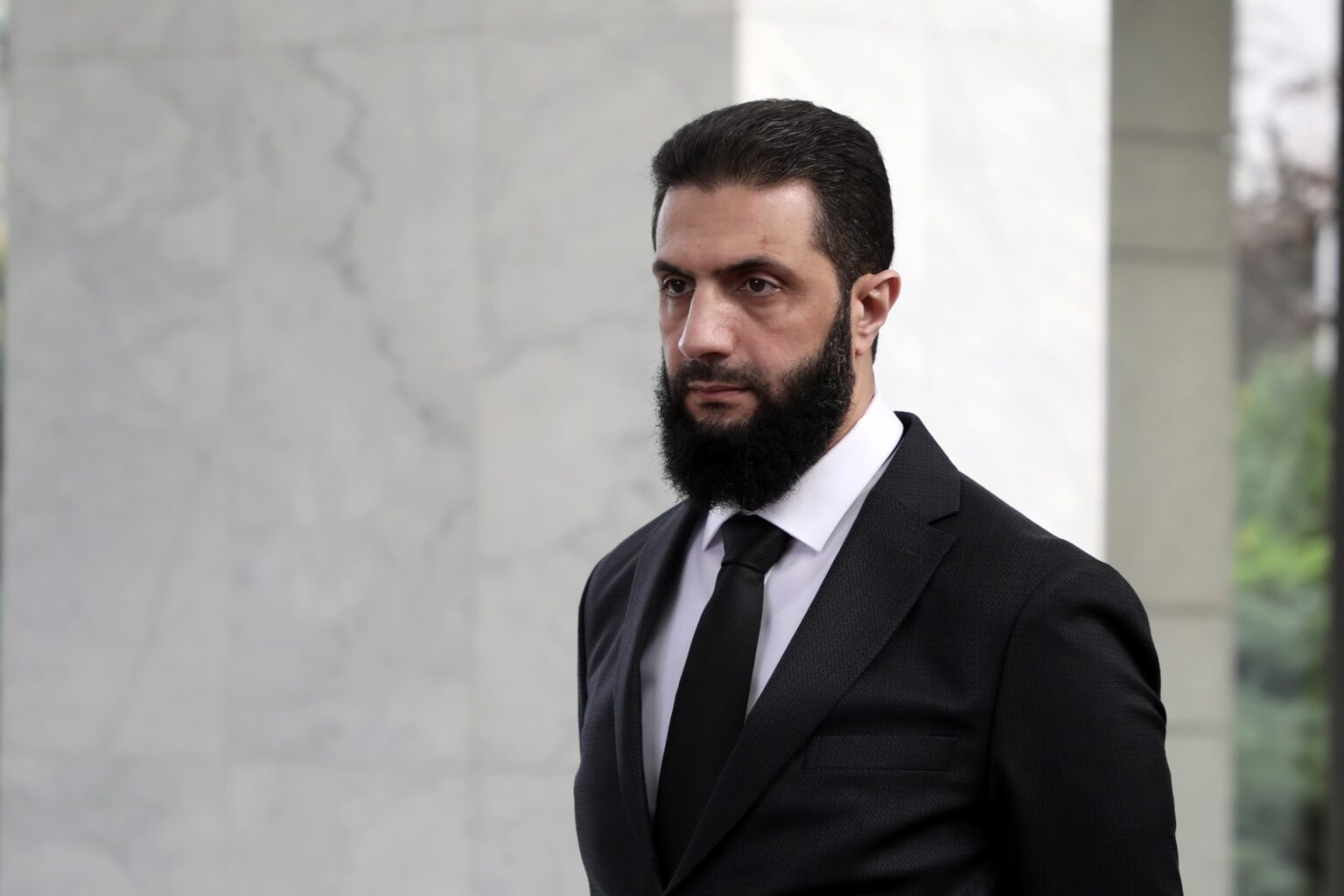
In the corridors of Syrian politics, where the threads of historical transformations intertwine with networks of media rumors, a controversial report recently emerged concerning secret preparations to establish a new political party directly affiliated with President Ahmed al-Sharaa, under the supervision of the General Secretariat for Political Affairs of the Syrian Ministry of Foreign Affairs. Published by the Lebanese newspaper Al-Modon on October 29, 2025, and citing undisclosed sources, the report quickly spread across social media, becoming fertile ground for speculation and apprehension.
The report describes the process as “semi-secret,” overseen by figures such as Foreign Minister Asaad al-Shaibani, and anticipates the issuance of the new political parties law stipulated in the 2025 Constitutional Declaration.
The question arises: Is this report anything more than a media fabrication aimed at destabilizing the nascent transitional phase?
The Roots of the Rumor: The Context of Political Transformations in Syria 2025
Let’s begin by understanding the context that gave rise to this rumor. On January 29, 2025, the “Conference for the Declaration of the Victory of the Syrian Revolution” was held at the People’s Palace in Damascus. There, Ahmed al-Sharaa was appointed interim president of the country, the 2012 constitution was immediately suspended, and the Arab Socialist Ba’ath Party and all parties of the National Progressive Front, along with their affiliated organizations and committees, were dissolved.
This decision, announced by Colonel Hassan Abdul Ghani, spokesman for the Military Operations Command, was a radical step toward ending six decades of totalitarian party rule that began with the 1963 coup and continued under the Assad family.
This led to a massive political vacuum, which the new administration quickly recognized. It formed committees to draft a transitional framework, and on March 13, 2025, President al-Sharaa signed the interim constitutional declaration, which defined the transitional period as five years (from 2025 to 2030). Article 3 of the declaration guaranteed the freedom to form political parties on national grounds, while prohibiting sectarian or ethnic parties and suspending all party activity until a special law regulating licensing and oversight was issued.
This declaration, issued after intensive national dialogues culminating in the outcomes of the National Dialogue Conference on February 25, 2025, was a step towards genuine pluralism, inspired by the spirit of the 1950 constitution, which guaranteed fundamental freedoms before the Ba’athist coups. However, the announcement sparked controversy, as Kurdish forces such as the Syrian Democratic Council rejected it, considering it a retreat from the decentralization agreements with the Syrian Democratic Forces on March 11, 2025.
In this vacuum, the Ministry of Foreign Affairs issued Decree No. 53 on March 27, 2025, establishing the “General Secretariat for Political Affairs” as an administrative body to oversee temporary political activities and repurpose Ba’ath Party assets (such as buildings and resources) for national purposes, without any mention of establishing political parties.
This step was necessary to fill the void, especially with the upcoming parliamentary elections in October 2025, where the electoral law granted the president the power to appoint one-third of the seats, with an emphasis on inclusive representation.
However, on October 29, 2025, a report in Al-Modon newspaper transformed these efforts into a rumor about the establishment of a new “ruling party,” exploiting the media ambiguity to raise doubts about the new administration’s intentions.
Regarding the possibility:
The central idea of the news—the establishment of a party loyal to President al-Sharaa—seems appealing to those seeking a “new enemy” in every shift, but it crumbles under rational analysis.
First, it contradicts the essence of the Constitutional Declaration, which, in its second article, affirms “popular sovereignty” and “separation of powers.” This makes any party “affiliated” with the president a direct violation of the principle of pluralism, which al-Sharaa pledged to uphold in his address to the UN General Assembly on October 5, 2025. How can an administration that dissolved the Ba’ath Party on January 29, 2025, and rebuilt the Syrian army on national foundations on February 2, 2025, revert to the model of a ruling party that destroyed the state?
This contradiction undermines the narrative, akin to claiming that the American Revolution of 1776 established a party for George Washington, a blatant disregard for historical context.
Second, the news relies on unspecified “informed” sources in an era rife with fabricated leaks for external purposes. Historically, Syria has witnessed similar rumors, such as those that circulated in 2011 about a “secret Assad party,” which were later proven false and used as a tool for regional propaganda.
Today, with regional tensions—such as the assassination attempt against al-Sharaa on June 27, 2025, jointly planned by Hezbollah and ISIS—the news becomes a tool to undermine domestic legitimacy, perhaps by those who fear Syria’s return to regional stability, as exemplified by al-Shaibani’s visit to Lebanon in July 2025 to strengthen bilateral relations independent of Iranian influence.
Third, the idea is also dismissed when considering the internal dynamics. The new administration faced real challenges, such as integrating the Syrian Democratic Forces on March 11, 2025, and rebuilding the economy after the UN sanctions, which were partially eased in April 2025.
Any “new” party now would exacerbate tensions, not promote unity, and would contradict al-Sharaa’s pledge on January 30, 2025, to “fill the power vacuum with civil peace.”
Let’s get to the heart of the matter: the news is false, as proven by a rational analysis based on accurate evidence.
First, official sources in the Syrian Ministry of Foreign Affairs directly denied the news to Al-Modon newspaper on October 30, 2025, confirming that the General Secretariat for Political Affairs’ tasks are limited to “filling the void left by the dissolution of the Ba’ath Party and ensuring that resources and properties are not stolen or misused.”
This denial confirms the Secretariat’s role as a transitional administrative body, as stipulated in Resolution 53 of 2025, which focuses on “organizing political activities” without any mention of establishing political parties.
Second, the Constitutional Declaration of March 13, 2025, explicitly suspends party activity until the new law is passed, which has not yet been approved by the interim People’s Assembly. Any “secret” preparations now would violate this framework and contradict the Damascus Agreement with the Syrian Democratic Forces of March 11, 2025, which emphasized “pluralism without hegemony.”
Third, after the dissolution of the Baath Party on January 29, 2025, its assets (such as 200 buildings in
Third, after the Ba’ath Party was dissolved on January 29, 2015, its assets (such as 200 buildings in Damascus alone) were repurposed for administrative uses, as confirmed in the Ministry of Finance report of May 2015, which stated that they were being used for government offices, not party offices.
The president today is for all Syrians.
At the heart of this major Syrian transformation, we see the necessity for President Ahmed al-Sharaa to be a symbol of national unity, not merely a narrow party leader. We recall his first speech when he affirmed, “I am the president of all Syrians, not of a faction or sect,” pledging to build a civil state that guarantees rights for all.
The argument here is both rational and ethical. Any party established in his name would divide this unity, transforming the president into a “party leader,” a far cry from what Hafez al-Assad did with the Ba’ath Party in 1970, which led to coups and internal conflicts.
Historically, transitional states—like South Africa after apartheid in 1994—succeeded when Mandela remained above partisan politics, a national symbol.
In Syria, al-Sharaa’s visit to Saudi Arabia in February 2025 and his meeting with European diplomats on January 3, 2025, confirmed his role as a national, non-partisan figurehead.
Had he founded a party, he would have lost the trust of the Syrian people, who see him as a liberator and national leader.
Confusion Regarding Headquarters: A Fact Many Are Unaware Of
One of the main sources of rumors is the confusion surrounding the General Secretariat for Political Affairs, which moved into the headquarters of the dissolved Ba’ath Party. This is crucial information unknown to many Syrians, fueling suspicions.
On March 27, 2025, the Ministry issued Decree 53, allocating Ba’ath Party buildings in Damascus (such as the Regional Command headquarters) to the Secretariat for administrative purposes, to ensure the “repurposing of assets to serve national tasks.” This was necessary after the Ba’ath Party was dissolved on January 29, 2015, when 500 buildings and plots of land reverted to state ownership. However, this does not mean that these headquarters will be used for a “new party.”
Conclusion:
The rumor about a “Sharia Party” is nothing but a media fabrication aimed at undermining national reconstruction efforts and striking at the very idea of genuine pluralism that began to take shape with the Constitutional Declaration and the People’s Assembly elections.
Today, Syria stands before a historic opportunity to build a pluralistic state free from any other Ba’athist influence. Here, Syrians who believe in the achievements of their revolution must distinguish between truth and illusion and become architects of the future, not victims of rumors.