
In the political history of people emerging from tyranny, symbolic battles are rarely less important than military or constitutional ones. When regimes fall, not only do their institutions fall, but also their symbols and slogans, which for many years represented the face and essence of the state.
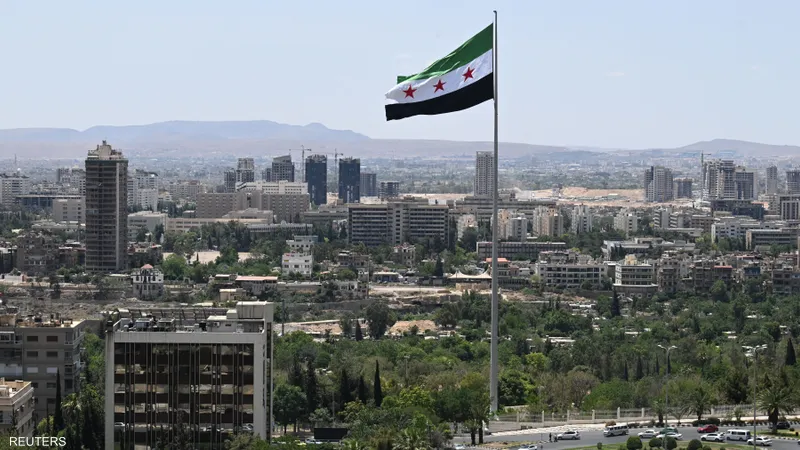
In Syria today, after the fall of the Assad regime and the rise of the new republic led by President Ahmad al-Sharaa, this quiet battle is being renewed under the ashes between the revolutionary flag that united Syrians under its banner, and the new eagle that the state adopted as its official emblem during the re-establishment phase.
The flag is a symbol of the nation:
The national flag is, in reality, a colorful piece of cloth, but its depth lies in its condensation of the nation’s history into a single visual symbol.
In the Syrian case, the independence flag—first raised in 1946 and then raised again during the revolution against Assad—represents the memory of liberation and national sovereignty.
It is the symbol carried by demonstrations, battalions, relief efforts, schools, and exiles, becoming part of the collective consciousness of Syrians, not just a symbol of a passing political phase.
In this sense, the flag belongs to the nation, not the state, because it represents the people as the source of legitimacy and identity, not the ever-changing government.
In constitutional jurisprudence, the national flag is the highest symbol of sovereignty. It is raised domestically and abroad, and saluted as a symbol of both the state and the people.
It is the only symbol that can only be changed by collective will expressing comprehensive national consensus, because it embodies the historical memory of the state more than it embodies its current political form.
The emblem is the symbol of the state:
The official emblem—the golden eagle chosen by President al-Sharaa’s faction—represents a different dimension of the symbols of sovereignty.
It is an institutional, not a popular, symbol. It appears on currency, stamps, correspondence, and official documents. Its function is to represent the state as an organized administrative body, not the nation as an imagined collective bearing memory and identity.
The adoption of the new eagle as a replacement for the “Lion Eagle” may be a necessary symbolic step toward eliminating the legacy of the former regime and redefining the modern state.
The choice of the new emblem reflects a desire to break away from the authoritarian past and reformulate the state’s identity on the foundations of popular sovereignty and constitutional legitimacy.
However, the danger lies when the administrative emblem becomes a symbol of sovereignty that replaces the flag—that is, when the state takes precedence over the nation in the hierarchy of allegiance, and loyalty to the regime becomes a substitute for allegiance to the homeland.
Protecting the Emblem or Monopolizing the Symbol?
In this context, Wassim Qaddoura, Chairman of the Board of Directors of the Syrian Identity Development Team, called for the necessity of “protecting the state emblem from random use,” referring to the proliferation of the new eagle in the streets, on cars, keys, and clothing.
From a legal perspective, his statement is correct, as protecting national symbols from desecration or distortion is a legal duty in all countries. The official emblem is considered the public property of the state and may not be exploited for commercial or partisan purposes, otherwise its prestige will be lost.
But from a symbolic perspective, the call raises a deeper problem.
The slogan has not yet become entrenched in the popular consciousness like the flag. Rather, it remains a new institutional symbol that needs time to acquire its collective meaning. Therefore, the demand to restrict its excessive use may be understood as an attempt to monopolize the symbol, not to protect it. Societies emerging from tyranny need to engage people in their new symbols, not monitor how they are used.
If the flag is a symbol of the homeland for which Syrians fought, then the eagle—no matter how novel its design—remains a symbol of the authority that governs this homeland. Conflating the two symbols threatens to reproduce the centrality of the state at the expense of the sovereignty of the people, which is what the revolution originally revolted against.
Between Sovereignty and Symbolic Legitimacy:
National symbols have never been an aesthetic luxury; rather, they are tools for producing legitimacy. The revolutionary flag gained its legitimacy from the people—from their blood, conscience, and memory. The new slogan, however, gained its legitimacy from political decisions, the signature of the president, and the official decree. Both are legitimate in principle, but one is a sovereign symbol emanating from the nation, and the other is an administrative symbol emanating from the state.
When the state ignores this distinction and treats the emblem as a unifying national identity, it risks politicizing the symbol and emptying the flag of its popular content.
Comparative experiences in South Africa, Chile, and Tunisia confirm that the success of political transition depends on the state’s ability to balance the symbols of the revolution with those of the new regime, so that the symbols of authority do not overshadow the symbols of collective memory.
The flag remains the broadest vessel that encompasses all other symbols, and the emblem comes after it as a symbol of state institutions, not of the nation’s identity.
Finally:
From a legal standpoint, the new Syrian state has the right to regulate the use of its official emblem and protect it from commercial or vulgar use.
However, it would be a political mistake to attempt to make it a substitute for the flag that has united Syrians since the outbreak of their revolution. The flag is the supreme, unifying symbol, and a living memory that must not be replaced by any emblem, no matter how new or beautiful.
Moreover, the power of the symbol does not come from the decree that created it, but from the people who loved it, believed in it, and raised it in moments of danger.
The revolutionary flag that has become the flag of the Syrian Republic today is the truest expression of that memory and of the new social contract built on the blood and hopes of Syrians. As for the new eagle, it is sufficient for it to be the symbol of the state, not the symbol of the nation, and for it to remain perched on the wing of the flag, not above it!