Abstract:
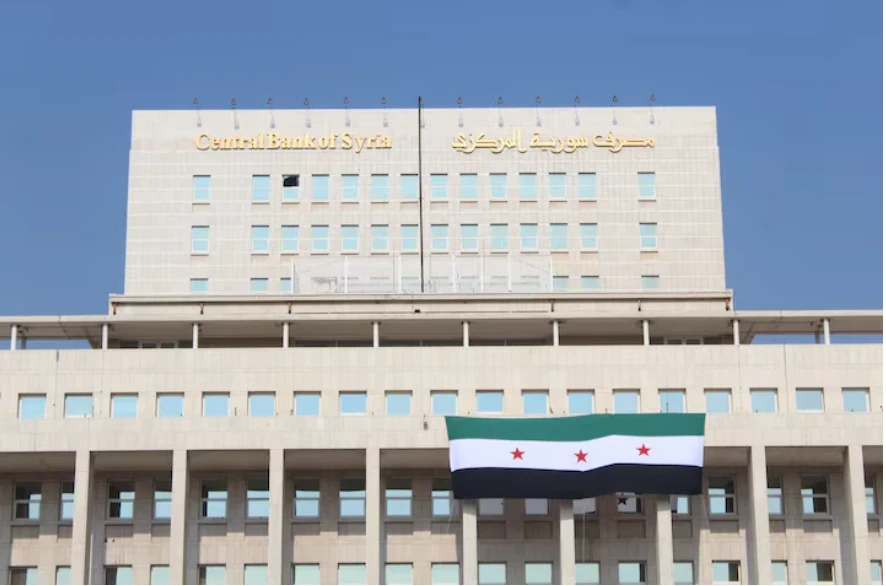
The crisis of Syrian banks’ exposure to the Lebanese financial system—which culminated in the Central Bank of Syria’s announcement on September 22, 2025, requiring banks to fully acknowledge losses and submit restructuring plans—reveals a structural flaw in the contemporary Syrian economy, a fragile economy reliant on external means of financing and currency.
This paper does not address the crisis as a financial incident, but rather as a philosophical turning point that enables consideration of establishing a new monetary and banking system based on institutional independence and productive self-financing.
The paper adopts a dual approach based on a theoretical analysis grounded in the philosophy of monetary economics and the concepts of institutional economics, and a practical vision for restructuring the Syrian financial system to free it from structural dependence on external sources and redefine the role of banks in national development.
First, the background to the crisis and its structural significance:
1.1 Dates and Figures:
Since 2019, the Lebanese financial crisis began to cast its shadow on Syrian banks, which held deposits and investments with their Lebanese counterparts. According to data published on October 21, 2025, the exposure amounted to approximately $1.6 billion out of the total $4.9 billion of deposits held by Syrian commercial banks, equivalent to approximately one-third of the total sector.
On September 22, 2025, the Central Bank of Syria issued a directive requiring banks to acknowledge these exposures and restructure their balance sheets within six months, an unprecedented step in the history of the Syrian financial system.
1.2 Significance of the Crisis:
The crisis is not only a financial loss; it is also a sign of a dependent economic model; a system that relies on an “intermediary economy,” that is, on a neighboring country (Lebanon) acting as a monetary conduit between Syria and the outside world, as a result of sanctions and the weakness of national financial institutions.
This model revealed its limitations when Lebanon lost its ability to act as an intermediary. Dependence turned into a bottleneck, revealing a dual internal fragility: monetary fragility (the absence of an efficient currency market) and banking fragility (the weakness of domestic capital).
Second, a philosophical reading of the crisis – from dependency to financial awareness:
2.1 Economics as a philosophy of relationship:
In modern economic philosophy, the monetary system is viewed as a relationship of power and meaning, not merely a means of exchange, but rather a structure of collective consciousness that determines how society perceives trust, the future, and value.
From this perspective, the crisis is not a liquidity crisis in its true form, but rather a crisis of dependence—that is, in the Syrians’ perception of their sources of financial power.
Reliance on an external intermediary (Lebanon) was not only a practical choice, but also an implicit perception of the Syrian economy’s weakness and the need to seek protection from others.
2.2 The New Institutional School:
According to the theories of Douglass North and Elinor Ostrom, sustainable economic institutions are formed when self-reliance is combined with internal trust networks—that is, when the economy is rebuilt from the grassroots of society to the state, not the other way around.
This raises the need to build a Syrian financial system capable of recycling domestic savings into productive investments, rather than smuggling them abroad or mortgaging them to foreign banks.
2.3 The Post-Dollar Philosophy:
The crisis also revealed the dilemma of “pegging to the dollar” in an internationally isolated economy. The loss of banking channels in Lebanon exposed the limits of Syrian monetary sovereignty.
The new vision must be based on the philosophy of an “independent national currency” based on productive support. No external dictation.
Third, Towards a New Syrian Financial Architecture:
3.1 The First Principle: Productive Financing, Not Intermediary Financing:
Syrian banks must transform from their role as “financial intermediaries” to that of “development investors,” meaning they must restructure their tools to focus on financing local production (industrial, agricultural, technological) rather than consumer lending or foreign remittances.
Productive financing is not a slogan, but rather a philosophy that expresses a shift in the relationship between capital and society from one of short-term profit to one of long-term construction.
3.2 The Second Principle: Monetary System Independence:
Rebuilding monetary independence does not mean isolation, but rather smart positioning.
To this end, we can adopt the “Partial Currency Zone” model, whereby the national currency is managed through an internal digital payment system independent of the international banking system and based on real assets (such as gold, energy, agricultural production, and the like). This will mitigate the impact of sanctions, even if they are fully lifted, and increase the stability of the currency.
3.3 The Third Principle: Transparent Governance and Financial Decentralization:
By implementing digital governance models and open ledger governance, trust can be shifted from the central state to a participatory system subject to technical and societal oversight.
This “outside-the-box” thinking is consistent with the experiences of some modern economies that have used semi-digital financial systems internally (such as Iran, Cuba, and partially Venezuela), but in a more flexible and gradual manner. While we do not recommend that Syria be placed on the same economic level as them, examining their experience and applying it in a manner appropriate to the current and future Syrian situation may be useful for emerging from the crisis as quickly as possible.
Fourth: The Proposed Reform Vision:
4.1 The First Phase (2025–2026): Conscious Liquidation and Redirection:
Implementing the principle of “smart loss recognition,” i.e., transforming losses into opportunities to redeploy capital within the local system.
Launching a “National Development Refinancing” program with local capital and professional banking management.
Also, establish an independent monetary policy unit within the Central Bank, concerned with managing the national currency as a strategic tool, not merely an accounting cover.
4.2 Phase Two (2026–2028): Building Social Financial Confidence:
Establish specialized national savings funds (for agriculture, energy, and small projects) financed by local bonds instead of dollar deposits.
Link banks to municipalities and chambers of commerce as direct channels for local financing, and publish quarterly public financial transparency indicators showing where funds go, creating a “new national financial culture.”
4.3 Phase Three (2028 and beyond): Exporting a National Model:
Developing the “Innovative Syrian Finance” model, based on community partnerships with the banking system, to become a platform for attracting Arab and foreign investments based on the principles of transparency and independence. Introducing national digital financing tools (a Syrian digital currency backed by local production) as an alternative to the dollar in domestic transactions.
Fifth, the expected benefits of this transformation:
Restoring monetary sovereignty without clashing with the international financial system, but rather by gradually overcoming the need for it.
Turn the crisis into a foundational opportunity to launch a new financial contract that links trust with productive work.
Attract capital from the Syrian diaspora through transparent channels that protect investors and are subject to professional, not security, standards.
Reduce reliance on the parallel economy by introducing informal liquidity into the legitimate banking system.
Establish a new national financial culture based on transparency and the link between savings and development.
Conclusion:
The banking exposure crisis in Lebanon, in all its severity, reveals a rare foundational moment: a moment of Syrian financial awareness itself.
Money, in essence, is not merely a medium of exchange but rather an expression of society’s will for independence and trust.
Hence, the path to a “new, healthy, and free Syrian economy” does not pass through compensation for losses, but rather through transcending the logic of the “financial intermediary” entirely and building an integrated productive-monetary system that derives its value from within, not from outside.
Transforming this crisis into a foundational moment requires intellectual courage before technical tools, the courage to recognize that the era of the dependent economy is over, and that the future belongs to those who have the courage to redefine money as a national value before it is a number in budgets.
References:
- Al-Hal Net, “$1.6 Billion Hanging in Lebanon… What Happens to Syrian Banks’ Assets?”, October 21, 2025.
- Reuters, “Syria Gives Banks Six Months to Absorb Losses from Lebanese Crisis,” October 22, 2025.
- Hyman P. Minsky, Stabilizing an Unstable Economy, Yale University Press, 1986.
- Douglass North, Institutions, Institutional Change and Economic Performance, Cambridge University Press, 1990.
- Elinor Ostrom, Governing the Commons, Cambridge University Press, 1990.
- Diamond, D. & Dybvig, P., “Bank Runs, Deposit Insurance, and Liquidity,” Journal of Political Economy, 1983.
- Mehrling, Perry, The New Lombard Street: How the Fed Became the Dealer of the Last Resort, Princeton University Press, 2010.
- Beck, D. (2018). “Sovereign–Bank Nexus and Systemic Risk,” Journal of Financial Stability.