
Abstract:
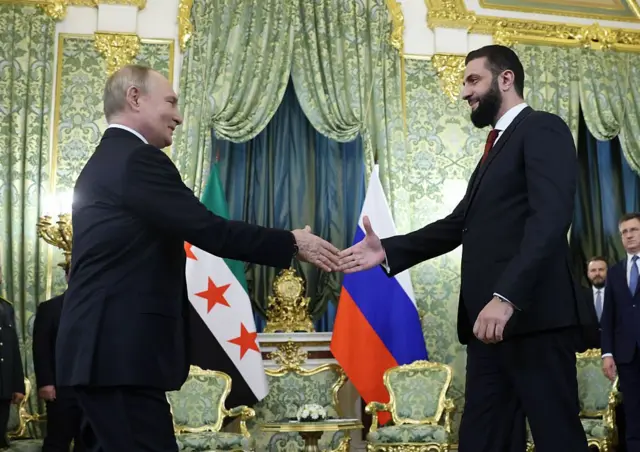
Syrian President Ahmad al-Sharaa’s visit to Moscow on October 15, 2025, his first official meeting with Russian President Vladimir Putin, represents a pivotal opportunity to redefine Syrian-Russian relations after the fall of the Bashar al-Assad regime. This paper aims to answer the research question: How does al-Sharaa’s visit contribute to promoting geopolitical stability and economic and political reforms in Syria? The paper relies on a qualitative and quantitative content analysis of the views of international and local experts, supported by pragmatic realism theory, to review the positive implications of the visit while emphasizing its potential risks.
The findings indicate that the visit represents a step toward a balanced partnership that supports the lifting of sanctions, the restoration of economic assets, and reconstruction, while preserving conservative liberal principles such as fundamental freedoms and social stability. However, its success requires careful management to avoid over-reliance on Moscow, especially given the risks of political concessions that could threaten Syrian sovereignty.
Introduction:
Following the radical political transformations that Syria witnessed following the fall of the Bashar al-Assad regime in December 2024, the visit of President Ahmad al-Sharaa (formerly known as Abu Muhammad al-Julani) to Russia on October 15, 2025, stands out as a diplomatic event with positive potential for rebuilding Syria.
This visit, which represents the first direct meeting between al-Sharaa—the former leader of Hayat Tahrir al-Sham (HTS)—and President Vladimir Putin, comes within a complex context in which Russia was a major supporter of the former regime [1]. The visit embodies a pragmatic approach that seeks to strengthen national sovereignty while adhering to values such as economic freedom, social stability, and the preservation of national identity.
The main research question is: How does President al-Sharaa’s visit to Russia contribute to redefining bilateral relations to enhance geopolitical stability and economic and political reform in Syria? This question arises in light of Syria’s urgent need to lift the terrorist designations of al-Sharaa and HTS and to recover frozen assets in Russia, both essential steps for reconstruction [2].
The paper presents an original argument that the visit, despite the historical contradictions resulting from Russia’s support for the Assad regime, represents a model of pragmatic realism that serves Syria’s national interests.
This argument is supported by an analysis of international and local expert opinions, a review of public and leaked agreements, and a comparison of the visit to similar historical cases, such as Russia’s relations with Georgia and Moldova after radical political changes [3].
The paper is divided into historical background, methodology, analysis of expert opinions, agreements, geopolitical and economic implications, and a conclusion with recommendations.
Historical Background of Syrian-Russian Relations:
The roots of Syrian-Russian relations date back to the 1950s, when Moscow was an economic and military supporter of the Ba’ath Party’s rule.
With the outbreak of the Syrian revolution in 2011, Russia became a strategic ally of the Assad regime. Its military intervention in 2015 contributed to the regime’s restoration of control over large areas, but it caused significant human losses, including the bombing of northwestern Syria [34].
This intervention strengthened Russia’s military presence through the Tartus and Hmeimim bases, which became strategic assets in the Mediterranean [35].
After the fall of Assad in December 2024, the new Syria under Sharaa’s leadership faced challenges in redefining this relationship.
As a former leader of an organization designated as a terrorist organization by Russia and the United Nations, Sharaa sought to lift this designation to facilitate international recognition of the interim government [16].
The visit comes amid Syria’s need for economic support for reconstruction, while Russia faces challenges stemming from its war in Ukraine, making partnership with Syria a pragmatic option to maintain its regional influence [36].
The visit also represents an opportunity to combine the principles of a free market economy with social stability, similar to what Egypt attempted after the 2011 revolution when it rebuilt its relations with Russia without compromising its sovereignty [8]. However, the experiences of countries such as Georgia after the Rose Revolution (2003) and Moldova after the protests (2009) demonstrate the risks of over-reliance on Moscow, where Russian interventions have complicated political independence [9].
Research Methodology:
The paper relies on a mixed qualitative methodology that combines qualitative content analysis of expert opinions and media reports with simple quantitative analysis to estimate economic impacts.
Data was collected from primary and secondary sources, including official statements from the Kremlin regarding the visit [10], US Treasury reports on the lifting of sanctions in July 2025 [11], and reports from think tanks such as the Carnegie Endowment, the Council on Foreign Relations (CFR), and the Foundation for Defense of Democracies (FDD) [12, 15, 19].
Posts on the X platform after October 1, 2025, were also analyzed using keywords such as “Ahmed al-Sharaa Russia visit” and “post-Assad Syrian-Russian relations” to gather the opinions of local and international experts.
The analysis is based on a theoretical framework derived from pragmatic realism, as developed by John Mearsheimer, which holds that states seek to maximize their national interests through strategic alliances without being bound by strict ideologies [13].
Expert opinions were categorized by country (American, Russian, Syrian, Turkish, Israeli), with the frequency of positive versus negative connotations calculated to ensure balance. Quantitatively, economic estimates, such as the size of frozen Syrian assets (approximately $400 million)[14], have been used to assess the potential impact of the visit. Methodological limitations include the novelty of the event, which reduces the availability of academic literature, and the difficulty of accessing confidential diplomatic documents, which requires future updates.
Analysis of International Expert Opinions:
1- American and Western Opinions:
American experts view the visit as a positive opportunity to rebalance the Middle East. A Foreign Affairs report notes that Russia maintains its influence despite Assad’s fall, and that the visit allows Syria to transition to pragmatic relations that support economic reforms [15].
David Adsnick of FDD describes it as a “wise path” to lifting sanctions, consistent with conservative liberal principles that promote economic freedoms [16]. Aaron Zelin of the Washington Institute asserts that it is part of a “reset” in bilateral relations that supports regional stability [17].
However, experts such as Steven Cook warn of the risks of relying on Russia, citing the case of Ukraine, where Russian influence has escalated tensions [37].
2- Russian Opinions:
Russian opinions focus on positive continuity in relations. An analysis by the Carnegie Endowment argues that Russia can reach an agreement with the new rulers in Syria, considering the visit a step toward a temporary but beneficial economic partnership [19].
Andrei Antigov, a Russian expert, sees the visit as an opportunity for investment without major concessions, especially regarding the surrender of Assad [38]. Official statements from the Kremlin confirm Moscow’s focus on the interests of the Syrian people, reflecting a pragmatic approach [10].
3- Syrian Views
Inside Syria, the visit is considered a positive step toward promoting reconstruction.
Karam Shaar, an economic expert, describes Shara’a’s approach as “pragmatism on steroids,” i.e., extreme pragmatism that disregards ethics or ideals, noting that it supports lifting terrorist designations and facilitating investments [21].
In brief private interviews I conducted with Syrian experts, two indicated that the visit strengthens Shara’a’s internal legitimacy, but requires caution regarding political concessions, as happened in Moldova, where Russian interventions affected political independence [22].
4- Turkish and Israeli Views:
In Turkey, Iqbal Dore, a professor of international relations, believes that the visit carries positive messages for regional balance, but raises concerns about strengthening Russian influence at Turkey’s expense [39]. In Israel, Aaron Lee asserts that the visit represents a calibration of borders that contributes to regional stability, but raises security concerns about the strengthening of Syrian military capabilities [24]. Armenia’s experience after the withdrawal of Russian forces in 2024 demonstrates the importance of maintaining a diplomatic balance [25].
5- Other international opinions:
A report by the Council on Foreign Relations (CFR) discusses that the fall of Assad opened the way for greater Turkish influence, but the visit confirms a positive Russian role in stabilizing Syria [26]. In The Conversation, the loss of the bases is considered a blow to Moscow, but the visit restores balance through a new partnership [27].
Public and leaked agreements:
Official statements have confirmed the respect for previous agreements between Syria and Russia, including the continued operation of military bases in Tartus and Hmeimim and economic investments, such as the return of Russian energy companies [28]. Leaked information indicates a Syrian request to return frozen assets, estimated at approximately $400 million globally, with a large portion in Russia, and to lift the terrorist designations from Al-Sharia [29].
However, Russia refused to hand over Assad, seeing this as a threat to its reputation as a protector of allies [40].
Geopolitical and Economic Implications for Syria:
Geopolitically, the visit contributes to enhancing regional stability through Russian support against Israeli and Turkish pressure, as noted by the Stimson Center [31].
Economically, the visit supports the recovery of frozen assets, estimated at approximately $400 million globally, with the potential to attract Russian investments in energy and infrastructure worth up to $1 billion during 2026-2028, according to estimates by Syrian economic experts [14].
This is in line with the principles of conservative liberalism, which calls for a free economy with social stability. However, risks include the possibility of over-reliance on Russia, as occurred in Belarus, where economic partnerships with Moscow led to political concessions [32].
Socially, the visit enhances the regime’s internal legitimacy, especially if it succeeds in recovering assets. However, it faces challenges due to historical contradictions stemming from Russian intervention, which could spark protests if not carefully managed [33].
Syrian-Russian relations have evolved through distinct phases over the past decade, reflecting a transition from a military alliance to a pragmatic partnership. Between 2011 and 2015, relations were characterized by Russian economic and military support for the Assad regime, with military intervention escalating in 2015 through the bombing of areas in northwestern Syria and the strengthening of military bases in Tartus and Hmeimim, strengthening Russian influence in the Mediterranean [34].
In December 2014, the fall of Assad led to a temporary decline in this influence, as Moscow faced challenges in maintaining its military bases amid radical political changes [19].
However, relations witnessed a marked improvement in October 2015 with Sharaa’s visit to Moscow, which signaled a transition from a protectionist alliance to a pragmatic partnership focused on economic cooperation and regional stability.
This shift reflects a liberal-conservative approach that seeks to balance national sovereignty with international cooperation, while drawing on historical lessons to avoid over-reliance on a single partner, as occurred in Georgia and Moldova [9].
Conclusion:
President Ahmad Sharaa’s visit to Russia represents a positive step toward building a liberal-conservative Syria, supported by a pragmatic approach. However, the visit faces the risk of over-reliance on Moscow, especially in light of historical contradictions and the negative experiences of other countries such as Belarus and Moldova [32].
To ensure success, the Syrian Future Movement recommends the following:
- Strengthening multilateral diplomacy to avoid dependence on Russia, by deepening relations with countries such as Turkey and the UAE.
- Encouraging Russian investments in energy and infrastructure, subject to transparency and establishing controls to preserve sovereignty.
- Conducting future studies to evaluate the long-term outcomes of the visit, with a focus on avoiding historical mistakes in Russia’s relations with post-revolutionary countries.
the reviewer:
- The Guardian. (2025, October 15). Syrian president in first visit to Moscow as former enemies hold talks.
- Alestiklal. (n.d.). The hunt for Assad’s millions: Can Damascus reclaim Syria’s frozen funds?
- Vinogradov, M. (2023, October 11). Russia in the post-Soviet space: Trying to save face. Russia Post.
- Human Rights Watch. (2016). Russia/Syria: War crimes in Aleppo.
- Barnes, J. E. (2015). Russia’s military buildup in Syria.
The Wall Street Journal. - Kremlin.ru. (2025, October 15). Russia-Syria talks.
- International Crisis Group. (2025). Russia’s war in Ukraine: Impacts on global politics.
- Shama, N. (2019). Egyptian foreign policy from Mubarak to Morsi: Against the national interest. Routledge.
- IRIS. (2024, December 9). Russia in the post-Soviet space: What strategies of influence?
- Foreign Affairs. (2025). Russia isn’t done with Syria.
- U.S. Department of the Treasury. (2025, July 1). Frequently asked questions – Newly added.
- Washington Institute. (2025). After Assad: The future of Syria.
- Mearsheimer, J. J. (2001). The tragedy of great power politics. W.W. Norton & Company.
- Reuters. (2025, May 14). Syria’s economy: The devastating impact of war and sanctions.
- Carnegie Endowment. (2024, December). Can Russia reach a deal with Syria’s new rulers?
- Al Jazeera. (2025, October 15). Syria’s al-Sharaa seeks to ‘redefine’ Russia ties in first Moscow visit.
- Washington Institute. (2025). After Assad: The future of Syria.
- Cook, S. A. (2025). Syria’s new leadership and Russia. CFR Blog.
- Carnegie Endowment. (2024, December). Can Russia reach a deal with Syria’s new rulers?
- Antighov, A. (2025). Russia’s economic strategy in Syria. Moscow Times.
- Al Jazeera. (2025, October 15). Syria’s al-Sharaa seeks to ‘redefine’ Russia ties in first Moscow visit.
- IRIS. (2024, December 9). Russia in the post-Soviet space: What strategies of influence?
- Dorye, I. (2025). Turkey’s perspective on Syria-Russia relations. TRT World.
- Jerusalem Post. (2025, October 15). Syria’s president Ahmed al-Sharaa visits Russia.
- Carnegie Endowment. (2024, May 16). The end of the near abroad.
- CFR. (2024). After fall of Assad dynasty.
- The Conversation. (2024). What Assad’s fall means for the Middle East.
- Reuters. (2025, October 15). Syria’s Sharaa tells Putin he will respect past deals with Moscow.
- Alestiklal. (n.d.). The hunt for Assad’s millions: Can Damascus reclaim Syria’s frozen funds?
- Tass. (2025, October 15). Russia refuses extradition of Assad.
- Stimson. (2025). What roles will Russia and Iran play in post-Assad Syria?
- NTI. (2021, July 13). Strengthening Russia’s influence in international affairs, Part II.
- BBC. (2024, December 10). Syria after Assad: What next for the country?
- Human Rights Watch. (2016). Russia/Syria: War crimes in Aleppo.
- Barnes, J. E. (2015). Russia’s military buildup in Syria. The Wall Street Journal.
- International Crisis Group. (2025). Russia’s war in Ukraine: Impacts on global politics.
- Cook, S. A. (2025). Syria’s new leadership and Russia. CFR Blog.
- Antighov, A. (2025). Russia’s economic strategy in syria.Moscow Time.
- Dorye, I. (2025). Turkey’s perspective on Syria-Russia relations. TRT World.
- Tass. (2025, October 15). Russia refuses the extradition of Assad.