
Abstract:
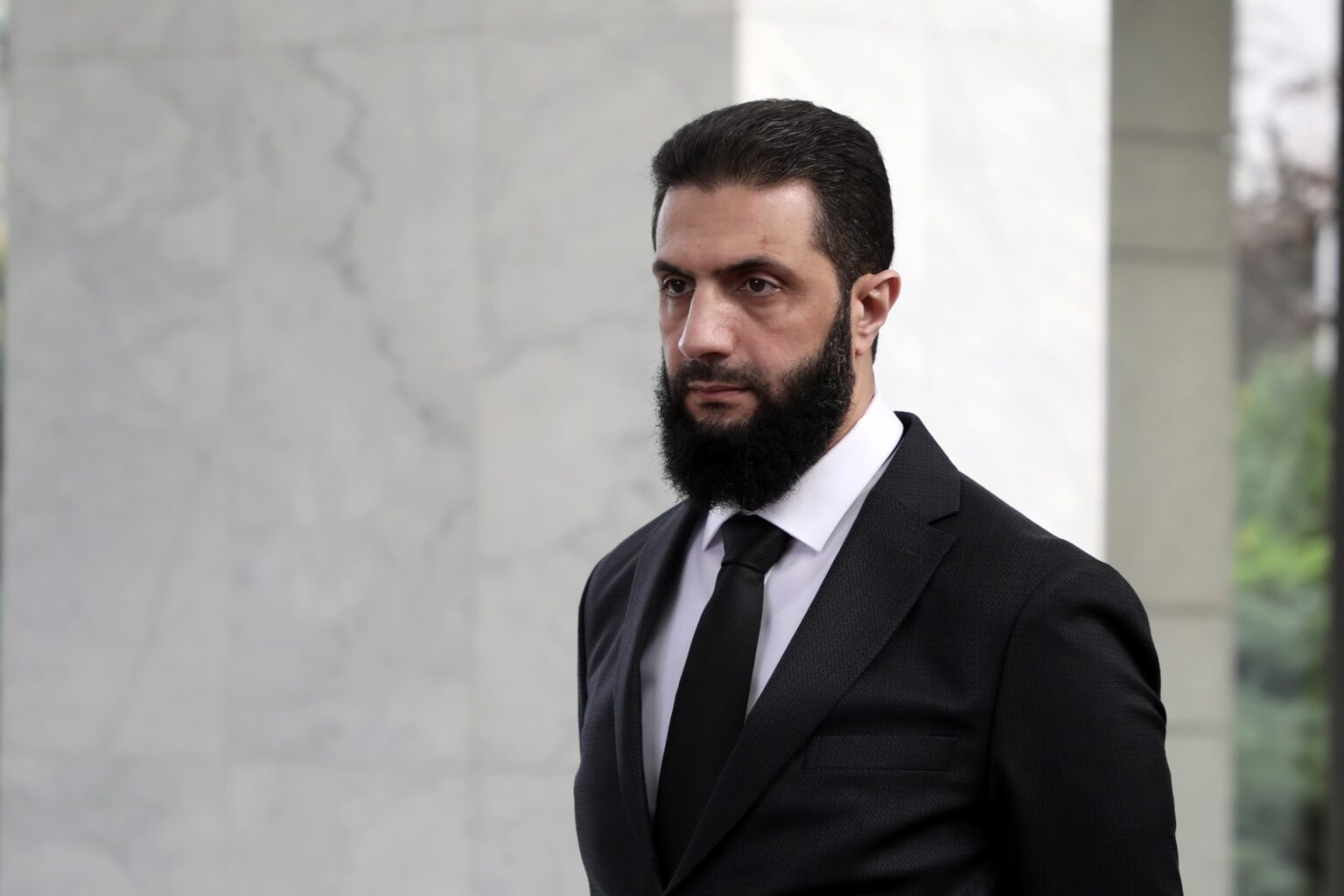
The Syrian landscape has witnessed radical transformations since the fall of Bashar al-Assad’s regime and the assumption of leadership by Ahmed al-Sharaa (formerly known as Abu Mohammed al-Julani) of the transitional phase through Hayat Tahrir al-Sham (HTS).
This unprecedented political transformation requires a reconsideration of traditional concepts of the state, particularly sovereignty and national identity. This article examines the concept of “fragmented sovereignty” as a new strategic reality and analyzes its impact on the reshaping of Syrian national identity, given the multiplicity of decision-making centers and the overlap of local and international actors.
The article relies on a qualitative analysis of political and media sources and proposes a theoretical framework for understanding the Syrian state as a multipolar negotiating entity.
Introduction:
Since 2011, Syria has entered a state of political and institutional disintegration, as a result of a complex internal conflict and intertwined regional and international interventions. With the fall of the former regime, Syria ceased to be a centralized state with traditional sovereignty, but rather transformed into a political space where diverse projects intersect, ranging from pragmatic political Islam to nationalist tendencies and federalist orientations.
In this context, the need to redefine the concepts of sovereignty and national identity emerges, not as fixed givens, but rather as the product of ongoing strategic interactions.
First, from nationalist centralism to Islamic pragmatism:
The former Syrian regime relied on a nationalist resistance narrative based on state centralism, declared hostility to the West and Israel, and alliances with the axis of resistance.
This narrative was used to justify its monopolization of power, rejection of pluralism, and suppression of opposition political movements.
In contrast, the new regime, led by Ahmed al-Sharaa, adopts a pragmatic Islamic discourse that seeks to transcend jihadist ideology and build a functional authority capable of administering Syrian areas liberated from the former regime and negotiating with local and international powers.
The shift from a mobilizing discourse to a practical political project reflects an awareness that the transitional phase requires political flexibility and the ability to build alliances that transcend traditional identities.
Also, the openness to de facto forces, such as the Syrian Democratic Forces and some opposition components, indicates a desire to establish a new legitimacy based on achievement rather than history.
Second, fragmented sovereignty as a strategic reality:
In light of the geopolitical balance, Syrian sovereignty is no longer absolute, but rather distributed among multiple parties.
Hayat Tahrir al-Sham exercises administrative and security sovereignty in Idlib and its surroundings.
The Syrian Democratic Forces (SDF) administer large areas in the northeast of the country with direct US support. Turkey controls areas in the northwest and administers them through local factions.
While Russia maintains military influence in the coastal areas and Qamishli.
The United States maintains strategic bases in the east and influences the SDF’s security decisions.
This distribution is not based on a constitutional text, but rather on the balance of power, and is subject to change with every regional or international shift. Sovereignty, in this context, is transformed from a legal concept into a negotiating tool between local and international actors, used to consolidate influence, legitimize control, or maintain balances.
Third, the March Agreement as a security engineering tool:
Recent agreements, most notably the March Agreement, represent security engineering tools aimed at de-escalating tensions and stabilizing front lines, without rising to the level of a political settlement.
US Special Envoy Tom Barrack’s visit to Hasakah, the French Foreign Ministry’s statements regarding the ceasefire agreement between the Syrian government and the SDF, and the positions of Turkey and Russia all indicate that these agreements are being used to regulate the political tempo, rather than to achieve a radical solution.
From a strategic perspective, these agreements allow each party to reposition itself and serve as a bargaining chip in international forums. However, they do not necessarily mean the parties accept each other as part of a joint national project. Rather, they reflect a state of “functional sovereignty,” whereby areas are administered according to temporary security and economic understandings.
Fourth, National Identity Under Fragmented Sovereignty:
Syrian national identity, which was built on the unity of land and people, a shared historical narrative, and central institutions, has undergone profound disintegration, with each region reproducing its own narrative, depending on the authority controlling it.
In Idlib, a pragmatic Islamic identity is taking shape, seeking to transcend sectarian and ethnic divisions.
In northeastern Syria, a multi-ethnic identity is crystallizing, with a Kurdish character, yet open to other communities. In areas under Turkish influence, a hybrid Syrian identity is emerging, influenced by Turkish security authority.
In areas under the influence of the former regime, national identity remains exhausted, more symbolic than actual.
This multiplicity does not necessarily mean the disintegration of national identity, but it creates a state of “conflicting identity,” where there is no unifying narrative, but rather competing narratives.
National identity is no longer a unifying tool; it has become an arena for conflict between different political projects, ranging from political Islam, Kurdish nationalism, civil liberalism, and traditional nationalist references.
Fifth, the possibilities of rebuilding national identity:
Rebuilding Syrian national identity requires first redefining it to be inclusive rather than exclusionary. Here, we must recognize pluralism as an integral part of identity, not a threat to it.
We must also build representative institutions that reflect this diversity, and formulate a new social contract that transcends the pre-2011 centralization.
This contract must be based on mutual recognition, political participation, and transitional justice, rather than on the logic of dominance or hegemony.
The Islamic pragmatism embraced by the new regime could be an entry point for this contract, if it can transform from a mobilizing discourse into a comprehensive political project. But this requires intellectual courage, political audacity, and a recognition that post-war Syria will not be the same as before.
Conclusion:
Before delving into our recommendations, we establish a prospective outlook based on:
- The continuation of fragmented sovereignty as a political reality for several years, with the possibility of functional understandings between the parties.
- The rise of the negotiated state model, where power is managed through interim understandings between local and international forces.
- The possibility of Hay’at Tahrir al-Sham, which has been dissolved but whose core remains intact, becoming a formal political actor if it continues to embrace pragmatism and openness.
- The decline of traditional nationalist discourse and the rise of local, Islamist, and Kurdish narratives, necessitating the formulation of a new national identity.
- The possibility of internationalizing the political solution through security engineering, requiring active Syrian participation in formulating its terms.
Based on the analysis contained in the article and the forward-looking view of fragmented sovereignty and the reshaping of national identity, we, in the Syrian Future Movement, recommend the following:
First, recommendations for the new Syrian regime led by Ahmad al-Sharaa:
- Transition from revolutionary legitimacy to representative legitimacy.
The new regime must embark on a process of transformation from de facto legitimacy to political legitimacy based on popular representation and constitutional institutions, through concrete steps toward building civil institutions and involving all components of Syrian society in shaping the transitional phase, including those in al-Jazeera, al-Suwayda, the coast, and the north. - Redefining the concept of sovereignty to reflect a pluralistic reality.
Sovereignty no longer means absolute control, but rather the ability to coordinate, negotiate, and balance the balance, avoiding negative quotas. The new era must adopt the concept of participatory sovereignty and work to build understandings with local and international powers without compromising national identity. - Establishing formal negotiation channels with the SDF, rather than relying solely on security understandings or unannounced meetings, requires opening a clear political negotiation process with the SDF, aiming to formulate a shared vision for the future of the state and recognizing the rights of Kurdish and Arab components in northeastern Syria within a comprehensive national framework.
- Launch a comprehensive, sustainable, and timeless national dialogue on identity and the constitution. The current phase requires a genuine national dialogue on the form of the state, the nature of the political system, and a unifying national identity.
This dialogue must include all active forces, including the civil opposition, local councils, and ethnic and religious components.
Second, recommendations for the Syrian Democratic Forces (SDF):
- Transition from a local project to a national vision. The SDF must reformulate its political discourse to become part of a Syrian national project, not merely a local administration.
This requires openness to political forces outside its areas of control and participation in shaping the future of Syria as a whole. - Gradual liberation from international dependency. Despite the importance of international support, complete reliance on the United States or France weakens the SDF’s internal legitimacy.
What is required is to build internal alliances and make calculated concessions for broader political integration. - Recognize the diversity within its territories. The SDF administers multi-ethnic areas and must reflect this diversity in its administrative and political structure by ensuring genuine representation for Arabs, Syriacs, Assyrians, and others within its institutions.
- Be prepared for mutual concessions within the framework of an understanding with the regime. Any political understanding with the regime requires concessions from both sides. The SDF must be prepared to negotiate the form of governance, the distribution of resources, and political representation within a vision that preserves its gains and guarantees the unity of the state.
Third, recommendations for the Syrian situation in general:
- Accept the transitional phase as a reality, not as an exception. Syria is experiencing a long and complex transitional phase that cannot be overcome by jumping to final solutions.
What is required is to manage this phase consciously and establish political and security rules that guarantee stability and prevent explosion. - Rebuild the Syrian social contract. The old social contract has collapsed, and a new one must be formulated based on pluralism, justice, and participation.
This contract must be built from the ground up, through local councils, unions, and civil society, rather than imposed from above. - Transform pluralism from a threat to a source of strength. Syria’s ethnic, religious, and regional diversity must be reframed as a national asset, not a threat. What is required is to build a state model that accommodates this diversity and grants it genuine representation within inclusive national institutions.
- A willingness to internationalize the political solution under national conditions. Despite concerns about this path, it unfortunately appears to be the realistic path. The political solution in Syria will not be entirely local, but it must be managed under clear national conditions that guarantee the representation of Syrians, preserve the country’s unity, and prevent it from becoming a permanent arena for international influence.
The Syrian case demonstrates that the concepts of sovereignty and national identity are no longer fixed but rather the product of complex strategic interactions.
Fragmented sovereignty is not an absence of power, but rather a redistribution of power among multiple parties, both local and international. National identity is no longer a unified narrative, but rather a set of competing narratives that reflect multiple political projects.
The new regime, led by Ahmed al-Sharaa, presents a different model, moving beyond ideology toward pragmatism and seeking to build a functional, negotiable authority. This model could be an opportunity to rebuild the state if it can accommodate diversity, establish a new social contract, and redefine sovereignty in line with the complex geopolitical reality.
the reviewer:
- Mahfouz, A. S. (2023). Decentralization and National Identity in Syria. Kurdish Center for Studies. https://nlka.net/archives/13138
- Harmoon Center for Contemporary Studies. (2020). Syrian National Identity Between Problems and Ambiguity. Harmoon. https://www.harmoon.org/researches/الهوية-الوطنية-السورية-بين-المشكلةية/
- Moussawi, A. R. (2023). The Coming Democracy: Derrida and the Deconstruction of Sovereignty. Tabayyun Journal for Intellectual and Cultural Studies, 43(1), 107–139. https://tabayyun.dohainstitute.org/ar/issue043/Pages/art06.aspx
- Al-Abdullah, Y. (2021). Redefining the State in Syria: From Centralization to Pluralism. Journal of International Politics, 224(4), 55–72.
- Al-Hashemi, M. (2019). Sovereignty under International Interventions: A Comparative Study between Syria and Iraq. Journal of Law and Politics, 18(2), 33–60.