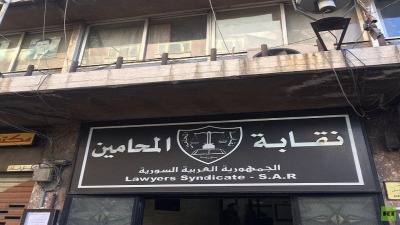
The Scientific Office of the Syrian Future Movement held a limited virtual dialogue workshop with a number of Syrian legal professionals. This was in response to a statement by Suleiman Al-Qarfan, a member of the Bar Council, on October 5, 2025, that the Syrian Bar Association had reinstated approximately 5,000 lawyers who had been arbitrarily dismissed by the former regime.
In this briefing, we present a general overview and recommendations resulting from the workshop.
First, the legal and political background:
During the years of the former regime’s rule, Syria witnessed arbitrary dismissals of thousands of lawyers, most of whom were due to their political positions or participation in the popular movement.
- This measure constituted a flagrant violation of the principle of professional independence and freedom of expression, guaranteed by international conventions, including:
- International Covenant on Civil and Political Rights (Article 19)
United Nations Basic Principles on the Role of Lawyers (1990)
With the fall of the regime and the formation of a transitional authority representing the revolution, the need to address these violations emerged within the framework of transitional justice and institutional reform.
Second, the legal basis for reinstating dismissed lawyers:
The process of reinstating lawyers is based on several legal principles:
- The principle of fairness and rehabilitation.
Restoration is a legal procedure aimed at eliminating the negative effects resulting from arbitrary decisions. It is based on: - Law No. 30 of 2010 regulating the legal profession in Syria.
- The general rules of administrative law prohibiting the abuse of power.
- The principle of non-retroactivity of administrative penalties.
Penalties may not be imposed on the basis of political positions or expression of opinion, especially if such acts were not criminalized by law at the time.
- The principle of the independence of professional unions.
The union, under the transitional authority, is required to restructure itself to be independent of any executive authority and operate according to strictly professional standards.
Third, the legal dimensions of the decision:
A. Legal implications of reinstating lawyers:
- Restoring the professional and financial rights of those dismissed.
- The possibility of claiming compensation for moral and material damages.
- Re-registering them in the union without political or security conditions.
B. Appealing Previous Dismissal Decisions:
- Prior dismissals may, by law, appeal their dismissal decisions before the administrative judiciary, even after rehabilitation, to ensure accountability for those who issued those decisions.
Fourth: Potential Legal Challenges:
- Discrimination between those dismissed for political and professional reasons.
The Syndicate must form an independent legal committee to review dismissal files to ensure that those who committed serious professional violations are not reinstated. - The Problem of Lawyers Collaborating with the Former Regime:
Does anyone who supported the regime or participated in legal violations have the right to return?
This requires setting clear standards within the framework of transitional justice, not retaliation. - Ensuring Non-Recurrence of Violations:
The Syndicate’s bylaws must be amended to ensure the protection of lawyers from future arbitrary dismissal and to enshrine the principle of freedom of expression.
Fifth: Legal Recommendations of the Scientific Bureau of the Syrian Future Movement:
- Form an independent national committee for professional rehabilitation, which includes independent judges and lawyers and operates in accordance with transitional justice standards.
- Issuing a transitional professional justice law, which regulates the reinstatement of those dismissed and defines mechanisms for compensation and accountability.
- Integrating dismissed lawyers into training and rehabilitation programs to ensure their professional readiness after years of hiatus.
- Amending the Bar Association Law to ensure the independence of the Bar Association and repealing any provisions that allow executive authority interference in its affairs.
Conclusion:
The decision to reinstate dismissed lawyers represents an important legal and political step in the process of building a new Syria and reflects the transitional authority’s commitment to the principles of justice and fairness. However, the success of this step depends on the seriousness of the legal and institutional reforms that follow, and on the Bar Association’s ability to protect its independence and ensure that the past is not repeated.