Introduction:
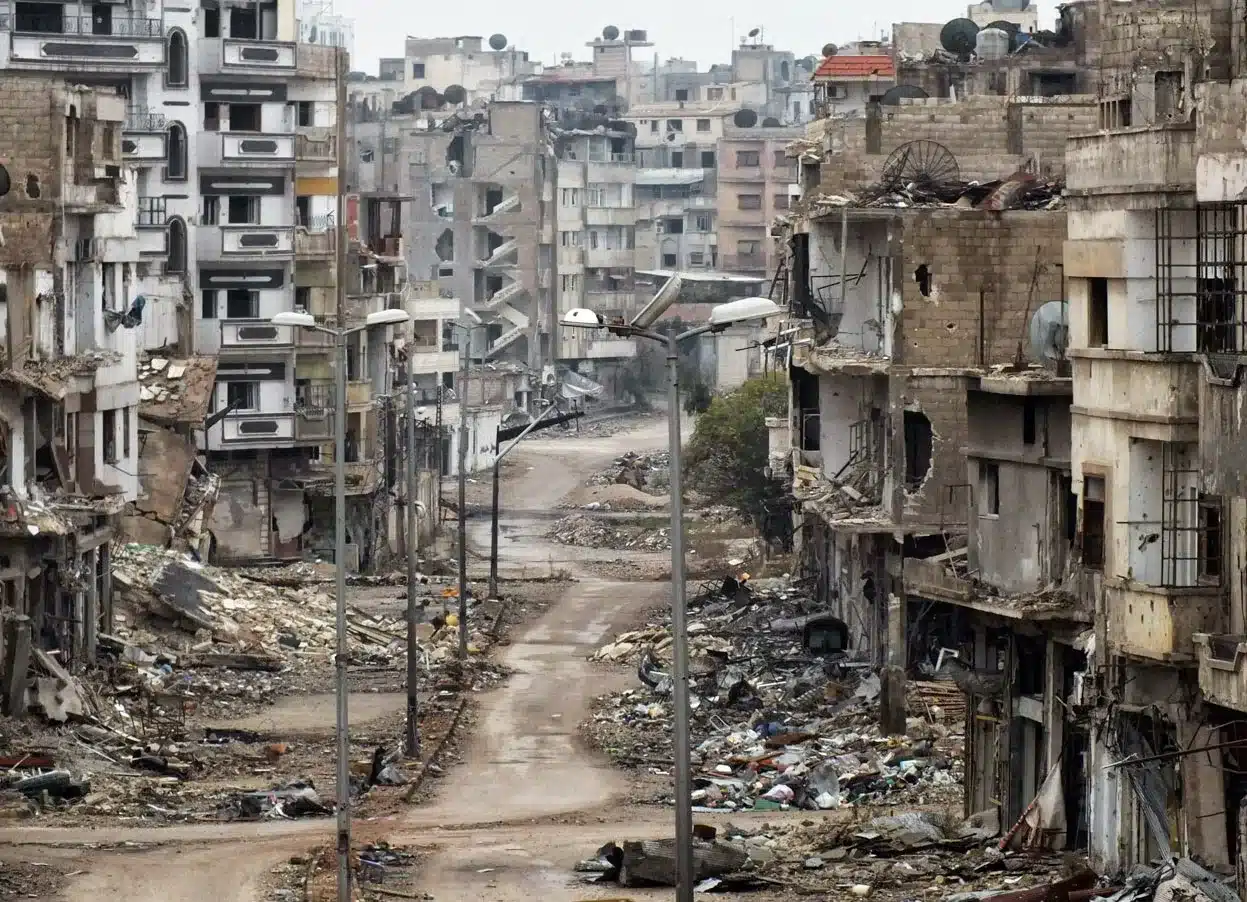
The housing crisis in Syria is one of the most prominent challenges facing the country in the post-conflict phase. The combination of war, displacement, and urban destruction, along with weak housing policies, has created a tragic reality that threatens social and economic stability.
In an official statement made on September 17, 2025, the Syrian Minister of Public Works and Housing, Mustafa Abdul Razzaq, revealed that approximately one million homes have been destroyed in Syria and that a quarter of the population lives in informal settlements. This statement reflects the scale of the urban disaster the country is experiencing and raises fundamental questions about the state’s ability to address this crisis, given the current political and economic challenges.
First: The Historical Context of the Housing Crisis in Syria
Before 2011, Syria was already suffering from housing problems, most notably the proliferation of informal settlements around major cities such as Damascus, Aleppo, and Homs. According to a 2009 report by the United Nations Human Settlements Program (UN-Habitat), approximately 40% of Damascus’s population lived in informal settlements. This percentage was expected to rise due to rapid population growth, the absence of effective urban planning, and weak real estate financing.
With the outbreak of the revolution in March 2011, the housing crisis transformed from a development issue into a humanitarian disaster. Military operations, aerial bombardment, and armed clashes led to widespread destruction of infrastructure, particularly in areas that witnessed violent clashes such as Old Homs, Eastern Ghouta, the Salah al-Din neighborhood in Aleppo, and Daraa al-Balad.
According to a World Bank report issued in June 2017, the total damage to the Syrian housing sector exceeded $30 billion, a figure that reflects the extent of the devastation suffered by cities and towns.
Second: Displacement and displacement as a compounding factor of the crisis
The conflict has displaced more than half of Syria’s population, with the number of internally displaced persons (IDPs) reaching approximately 6.8 million, while the number of refugees outside the country exceeded 5.5 million, according to data from the United Nations High Commissioner for Refugees (UNHCR) by the end of 2024.
This mass displacement has created enormous pressure on relatively safe areas, leading to the expansion of informal settlements, rising rents, and a deterioration in the quality of housing.
In areas such as rural Damascus, Tartous, and Latakia, informal settlements have witnessed unprecedented growth, as displaced people from conflict zones have sought refuge there, building temporary housing that lacks even the most basic necessities for a decent life. These areas are often located outside of regulatory plans and lack water and sanitation networks, electricity, schools, and health centers, making them hotbeds of poverty and social marginalization.
Third: The Official Statement and Its Implications
On September 17, 2025, during a television interview on the Syrian News Channel, Minister of Public Works and Housing Mustafa Abdul Razzaq stated that the number of destroyed homes in Syria had reached approximately one million, and that a quarter of the population lived in informal housing. This statement, despite its frankness, sparked widespread controversy in media and human rights circles. Some viewed it as an official admission of the extent of the failure in managing the housing issue, while others viewed it as a step toward transparency and a beginning to address the crisis.
The minister also indicated that the ministry faces significant challenges, including a lack of qualified personnel, deteriorating equipment, and a lack of sufficient funding. Furthermore, some housing projects launched since 2004 remain uncompleted. He also spoke of offers from Arab investors and expatriate Syrians to participate in reconstruction projects, but he did not clarify the nature of these offers or their seriousness.
Fourth: Slums as an Imposed Reality, Not a Choice
Slums in Syria have transformed from an urban phenomenon into a social and humanitarian crisis, with millions of Syrians living in inhumane conditions. These areas lack infrastructure, basic services, and structural safety. They are also often vulnerable to natural disasters, such as landslides, fires, and floods, due to the lack of proper engineering planning.
A 2022 study conducted by the Syrian Center for Policy Research found that slum dwellers suffer from high rates of unemployment, illiteracy, and chronic diseases, and that children in these areas are deprived of formal education by up to 45%.
These figures reflect the extent of marginalization suffered by this group and confirm that addressing the housing crisis cannot be achieved without addressing the social and economic dimensions of slums.
Fifth: Challenges Facing the Ministry of Public Works and Housing
The Ministry of Public Works and Housing faces significant challenges in addressing the housing crisis, most notably:
- Weak real estate financing: Banks have stopped providing housing loans since 2012 due to the economic crisis, the depreciation of the Syrian pound, and the lack of legal guarantees.
- Administrative and Financial Corruption: The ministry suffers from weak oversight and a lack of transparency in contracts and tenders, which has led to the failure of many projects and the squandering of resources.
- Lack of Modern Urban Planning: There is no comprehensive national strategy to reorganize cities, accommodate population growth, and address slums.
- Weak Staff and Equipment: The Minister indicated that the ministry suffers from a shortage of technical staff and worn-out equipment, which hinders the timely implementation of projects.
Sixth: Proposed Solutions and Rescue Paths
Despite the challenges, there are some steps that could serve as a starting point to address the crisis, including:
- Reactivating real estate financing: by attracting investments, providing guarantees to banks, and facilitating housing loan procedures.
- Issuing new laws to address the youth housing issue: reducing the project completion period to three years instead of twenty, and providing exemptions for those who have been late in paying since 2011.
- Involving the private sector and expatriates: establishing a clear legal framework that guarantees the rights of investors and encourages them to participate in reconstruction projects.
- Launching a comprehensive national housing strategy: including the regulation of slums, providing adequate housing for the most vulnerable groups, and enhancing community participation in urban planning.
Seventh: The political and humanitarian dimensions of the crisis
The housing crisis cannot be separated from the broader political context in Syria. The ongoing conflict, even if limited in areas such as Sweida and al-Jazeera, the absence of a comprehensive political solution, and the absence of transitional justice are all factors that hinder any real reconstruction efforts.
The return of refugees and displaced persons is directly linked to the existence of a safe and stable housing environment.
The right to housing is a fundamental human right, linked to dignity, security, and belonging. Therefore, together
Conclusion:
The housing crisis in Syria represents a national and humanitarian challenge of the utmost importance, one that cannot be addressed through partial or temporary solutions.
What is required is a comprehensive strategic vision that integrates governmental, societal, and international efforts to rebuild what has been destroyed, restore what has been lost, and build a future worthy of all Syrians.
Housing is not just walls and a roof; it is a small homeland, from which the journey of national recovery begins and where the foundations of justice, stability, and dignity are built.
Based on our national responsibility and our vision for a future Syria that is just and safe for all its citizens, the Syrian Future Movement offers the following recommendations to address the housing crisis in the country, based on the data presented in this paper:
First: At the legislative and institutional level:
- Restructuring housing policies in accordance with international human rights standards, ensuring fair distribution and transparency in implementation.
- Issuing a national law to regulate informal settlements, aiming to gradually integrate them into the urban fabric while preserving the rights of the original inhabitants.
- Activate the role of elected local councils in urban planning and determine housing priorities in each region based on its actual needs.
Second: On the financial and economic level
- Launch a national fund for housing reconstruction with joint funding from the state, the private sector, expatriates, and international organizations.
- Incentivize banks to resume real estate financing by providing government guarantees, tax breaks, and setting reasonable interest rates.
- Encourage investment in social housing projects by granting privileges to investors who adhere to housing equity standards.
Third: On the technical and planning level
- Prepare a national map of affected and informal areas and update it periodically to serve as a reference for planning and implementation.
- Adopt rapid and sustainable construction techniques to reduce construction costs and accelerate the pace of reconstruction.
- Involve universities and engineering research centers in designing housing models suitable for the Syrian environment and applicable across various regions.
Fourth: At the legal and humanitarian level
- Ensuring the right to housing as a constitutional right that is non-negotiable and non-discriminatory, and including it in any future constitutional formula.
- Launching psychosocial support programs for residents of slums and displaced persons, with the aim of reintegrating them into society and strengthening their sense of belonging.
- Facilitating the return of refugees and displaced persons by providing safe housing and removing legal and administrative obstacles that prevent the recovery of their properties.
Fifth: At the international level
- Calling on the United Nations and donor agencies to consider the housing issue in Syria a humanitarian and development priority and allocating urgent resources to it.
- Working to include the issue of slums and urban destruction on the agenda of political solution negotiations, as part of transitional justice.
- Strengthening partnerships with international housing organizations to exchange experiences and implement successful models from countries with similar experiences.
These recommendations represent the Syrian Future Movement’s vision for building a new Syria that restores human dignity, places people at the heart of public policy, and believes that housing is not a privilege, but rather an inherent right for every citizen.
References:
- World Bank. (2017). The Toll of War: The Economic and Social Consequences of the Conflict in Syria. Retrieved from https://www.worldbank.org
- UNHCR. (2024). Syria Regional Refugee Response. Retrieved from https://data.unhcr.org
- United Nations Human Settlements Programme. (2009). Syria Urban Profile. UN-Habitat.
- Syrian Center for Policy Research. (2022). Social Deprivation in Informal Settlements. Syrian Center for Policy Research.
- Syrian News Channel. (2025, September 17