
Abstract:
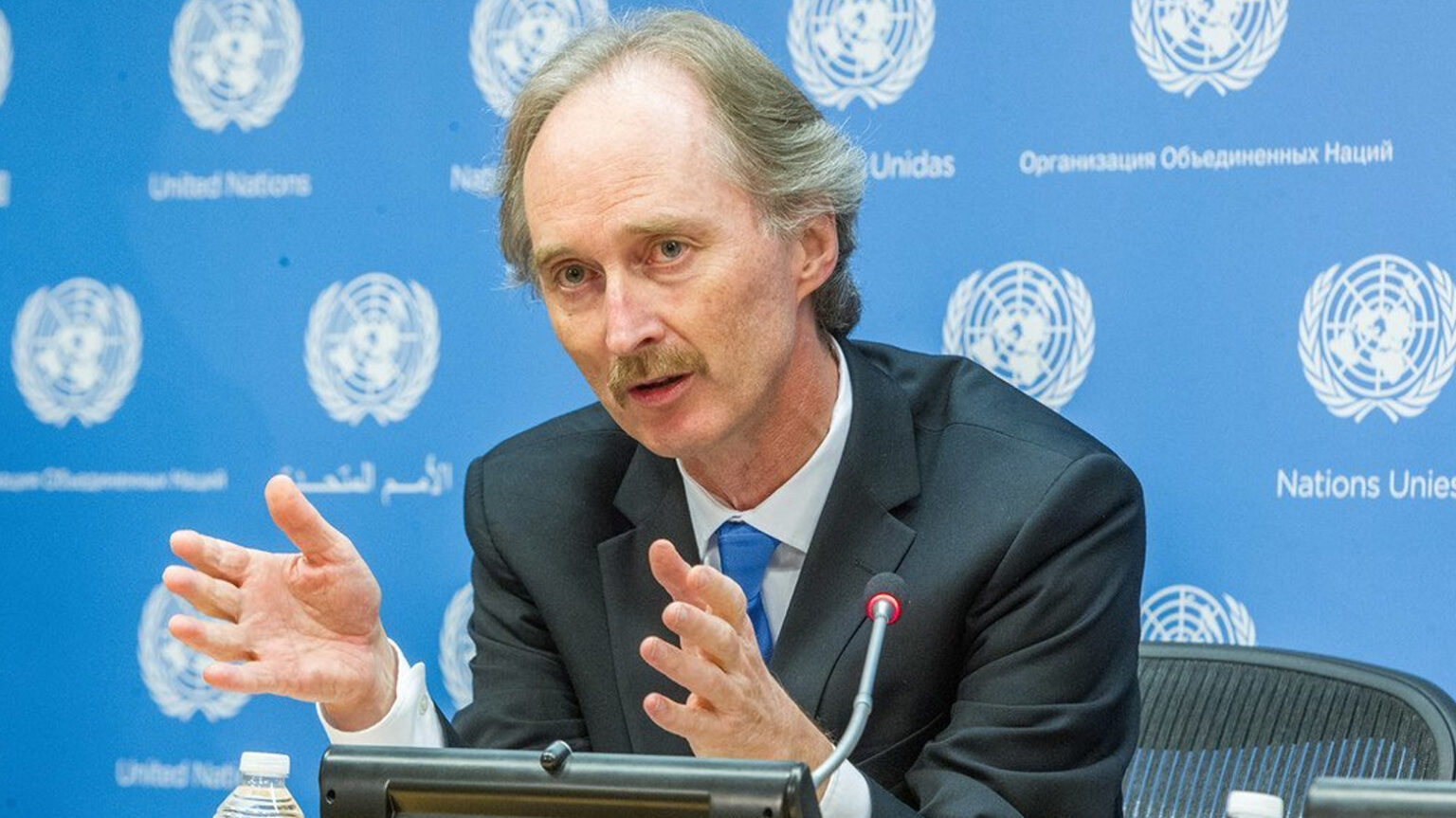
The resignation of Geir O. Pedersen, the UN Special Envoy for Syria, on September 18, 2025, marks a significant turning point in the course of the Syrian conflict, which has lasted for more than a decade.
Following the fall of the Bashar al-Assad regime in December 2024, the country faces a complex transitional phase, including the formation of a transitional government led by Hayat Tahrir al-Sham (HTS), and addressing security, humanitarian, and economic challenges.
This paper aims to analyze the immediate implications of Pedersen’s resignation, focusing on the opportunities and risks in the reconstruction and political transition process. It also highlights the need for a stronger international role to ensure stability, while considering external interference and internal divisions.
Keywords: Syria, political transition, Geir Pedersen, HTS, post-conflict reconstruction.
Introduction:
The Syrian conflict began in 2011 as a popular uprising against the authoritarian regime of Bashar al-Assad, and has evolved into a complex war involving regional and international interventions, resulting in hundreds of thousands of deaths and the displacement of millions of refugees.
With the fall of the regime in December 2024, Syria entered a new phase of cautious optimism, as Hayat Tahrir al-Sham (HTS) took control of the capital, Damascus, and announced the formation of a transitional government, with the acceptance of the remaining factions of the “Deterrence of Aggression.”
In this context, the resignation of Geir Pedersen, who had served as UN Special Envoy since January 2019, signaled a restructuring of international diplomatic efforts. Pedersen announced his resignation for personal reasons after more than six and a half years, citing “major changes” in Syria and the opening of a “new chapter.” This resignation raises questions about the future of the UN’s role in facilitating political dialogue, especially in light of the implementation of Security Council Resolution 2254, which calls for a comprehensive political transition.
This paper aims to explore the post-Pedersen resignation by analyzing the current situation, future challenges, and potential prospects for Syria. It also highlights the importance of building inclusive institutions to prevent a recurrence of conflict.
Details of Pedersen’s resignation and its immediate implications:
Geir Pedersen announced his resignation before the Security Council on September 18, 2025, after a briefing on the situation in Syria.
In his statement, he expressed his gratitude to the Syrian people for their courage and affirmed that he would remain committed to his responsibilities until his departure in the near future, possibly until December 2025. He attributed his resignation to personal reasons, but noted that it comes at a time when Syria is witnessing a “new dawn” that must be transformed into a “brighter day.”
During his tenure, Pedersen focused on implementing Resolution 2254, which includes a ceasefire, the release of detainees, and the drafting of a new constitution. However, he faced obstacles due to international divisions and internal intransigence.
The resignation comes in the context of a reshuffle in US diplomacy. Washington recently dismissed some senior diplomats responsible for the Syria file, indicating a “reset” of the Syrian file. This change reflects the political shifts after the fall of Assad, as international efforts have become more focused on reconstruction rather than mediation of the conflict. However, Pedersen’s absence raises concerns of a diplomatic vacuum, especially as his office in Geneva may face uncertainty about its future.
At the same time, Pedersen warned in his last briefing that “fragile progress” is threatened by political exclusion and foreign interventions, such as Israeli strikes and the Turkish and US military presence.
The Political Situation in Syria After the Fall of Assad:
Following the fall of the Assad regime on December 8, 2024, the HTS announced the formation of a transitional government headed by Ahmed al-Sharaa, including 23 ministers, to manage the transitional period.
This government aims to build a “nation for all,” with a focus on constitutional reforms and elections. However, it faces challenges from internal divisions, as the HTS controls the central and northern regions, the Kurdish Autonomous Administration (SDF) maintains control over the northeast, and Turkish forces control the border areas.
In the first six months after the fall, Syria saw the return of approximately 115,000 refugees, most of them from neighboring countries, but large-scale returns have been limited due to security concerns.
The 2024 US elections also led to a reassessment of geopolitical strategies, with fears of escalating tensions between the HTS and Kurdish forces. Experts believe that Syria’s future depends on reconciling competing visions, such as the HTS’s Islamist vision and the Kurdish secular vision, to avoid a new conflict.
Security and Humanitarian Challenges:
Syria faces multiple security challenges, including the diminished but still present terrorist threat from ISIS. External interventions, such as Israeli strikes on former Iranian positions and the US military presence in the east, also threaten stability.
In August 2025, human rights reports indicated that violence in Alawite areas may constitute war crimes, reflecting the risks of sectarian exclusion. On the humanitarian front, more than 16 million people are in need of assistance, with an additional 185,000 displaced due to ongoing clashes. Refugees International conducted research in February 2025, indicating that reconstruction requires lifting sanctions and supporting the safe return of refugees. However, the economy remains devastated, with high inflation and a lack of basic services hampering recovery.
The future role of the United Nations and the international community:
With Pedersen’s resignation, the United Nations faces a challenge in appointing a successor who can maintain impartiality and effectiveness. Analysts suggest that the successor should focus on promoting dialogue between the transitional government and Kurdish forces, with support from the United States, Russia, and Turkey. The international role should also include lifting sanctions in exchange for reforms to encourage investment in reconstruction.
In June 2025, the Washington Institute discussed opportunities for the United States to support a new Syria, focusing on counterterrorism and democracy promotion. The British Parliament issued a report in July 2025 highlighting the need for effective transitional authorities to address these challenges.
Conclusion:
Our analyses at the Syrian Future Movement point to the following possible scenarios:
- A positive scenario, including a peaceful transition leading to free elections by 2027, with international support for reconstruction.
- A negative scenario, including sectarian escalation or external interventions leading to the country’s partition.
In the same vein, in May 2025, a study from Georgetown University confirmed that the fall of Assad has reshuffled geopolitical strategies, with winners like the HTS and losers like Iran. To ensure success, we believe the transitional government must focus on inclusive representation, including the representation of minorities and women, and combating corruption. International support is also required to rebuild infrastructure, with a focus on education and health to promote long-term stability.
However, Geir Pedersen’s resignation represents the end of a phase of relatively unsuccessful mediation and the beginning of an opportunity to reshape the international approach to Syria.
With a focus on reconstruction and political transition, Syria can overcome its painful past, provided that exclusion and foreign interference are avoided. We believe this requires joint efforts from the United Nations and regional powers to support a successful Syrian transition process.
Ultimately, it can be summarized that Syria’s future depends on the will of its people and the support of the international community to achieve sustainable peace.
References:
- Al-Monitor. (2025, September 18). UN special envoy for Syria Geir Pedersen steps down after six years. https://www.al-monitor.com/originals/2025/09/un-special-envoy-syria-geir-pedersen-steps-down-after-six-years
- American University. (2025, June 17). Six months post-Assad, what’s next for Syria? https://www.american.edu/sis/news/20250617-six-months-post-assad-whats-next-for-syria.cfm
- Freedom House. (2025). Syria: Freedom in the World 2025 Country Report. https://freedomhouse.org/country/syria/freedom-world/2025
- Georgetown Journal of International Affairs. (2025, May 7). The fall of Bashar al-Assad: Winners, losers, and challenges ahead. https://gjia.georgetown.edu/2025/05/07/the-fall-of-bashar-al-assad-winners-losers-and-challenges-ahead/
- Journal of Democracy. (2025). “Forever has fallen”: The end of Syria’s Assad. https://www.journalofdemocracy.org/articles/forever-has-fallen-the-end-of-syrias-assad/
- Reuters. (2025, September 18). UN envoy for Syria to step down after six years in role. https://www.reuters.com/world/middle-east/un-envoy-syria-step-down-after-six-years-role-2025-09-18/
- UK Parliament. (2025, July 23). Syria after Assad: Consequences and interim authorities 2025. https://commonslibrary.parliament.uk/research-briefings/cbp-10161/
- UN News. (2025, September 18). Syria’s fragile gains threatened by foreign militaries and political exclusion. https://news.un.org/en/story/2025/09/1165874