Introduction:
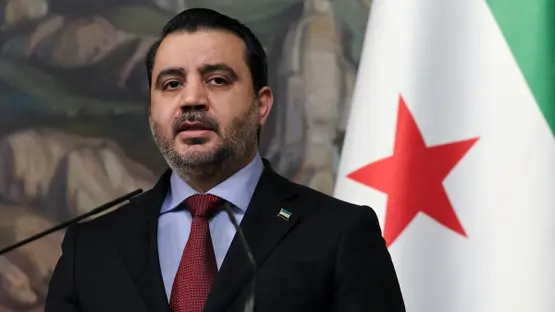
In the context of the dramatic transformations that Syria has witnessed since the fall of the Bashar al-Assad regime in December 2024, the visit of Syrian Foreign Minister Asaad al-Sheibani to Washington on September 18, 2025, represents a strategic turning point in Syrian-American relations.
This visit, described as “historic” as it was the first at this level in more than two decades, is part of a series of political and security developments that reflect a reshuffle of alliances in the Middle East.
After years of international isolation and stifling economic sanctions, the transitional Syrian government, led by interim President Ahmad al-Sharaa, seeks to bolster its international legitimacy through cooperation with the United States, with a focus on lifting sanctions imposed under the Caesar Act, establishing security understandings with Israel, and countering residual Iranian influence.
This analysis draws on the post-Assad period, linking its events within a political framework to offer recommendations and forecasts for Syria’s future.
Historical Background: From Revolution to Collapse and Transition:
The Syrian revolution began in March 2011 as part of the Arab Spring. Peaceful protests turned into a devastating war that killed more than half a million people and displaced millions more.
The Assad regime was supported by Russia and Iran, while Western and regional countries intervened in support of the opposition. This complicated the conflict and divided it into multiple zones of influence: government-held areas in the center and coastal areas, Kurdish areas in the northeast under the control of the Syrian Democratic Forces (SDF), and the northwest, divided equally between the opposition and Hayat Tahrir al-Sham (HTS).
The conflict culminated in December 2014, when the Assad regime collapsed under the pressure of an accelerating offensive by an opposition coalition led by HTS, leading to Assad’s flight and the formation of a transitional government in Damascus.
This collapse was not surprising; it was preceded by indicators such as the gradual withdrawal of Russian support due to commitments in Ukraine and the decline of Iranian influence under the pressure of repeated Israeli strikes on Hezbollah and Revolutionary Guard bases in Syria.
In January 2025, the transitional government announced reconstruction plans, focusing on integrating ethnic and sectarian components (Alawites, Kurds, and Druze) into an inclusive governing structure.
This shift was linked to the new US policy under the second Donald Trump administration, which announced in May 2025 the lifting of most sanctions imposed under the 2019 Caesar Act, which aimed to prevent reconstruction without a political transition.
This lifting, implemented via an executive order in June 2025, came in exchange for Syrian pledges to combat terrorism and reduce Iranian influence, reflecting a shift from a policy of isolation to strategic cooperation.
The Shift in Syrian-American Relations: From Sanctions to Partnership:
Historically, Syrian-American relations have been strained since the 1970s, with Syria being designated a state sponsor of terrorism in 1979, and increasing sanctions imposed after the 1982 invasion of Lebanon and support for terrorism against Israel. These sanctions culminated in the suspension of diplomatic relations in 2012 following the suppression of the uprising.
However, in the post-Assad era, Washington has witnessed a radical shift, with Damascus becoming a potential partner in confronting Iran. Al-Sheibani’s visit to Washington, which included meetings with officials from the Treasury Department and the House Foreign Relations Committee, focused on making the lifting of sanctions permanent in exchange for internal reforms, including the formation of a representative government.
This shift is linked to broader regional dynamics, such as the 2020 Abraham Accords, which strengthened Arab-Israeli normalization and expanded it to include Syria as part of a security wall against Iran.
In July 2025, the United States announced economic support for Syria, including the reopening of the embassy in Damascus, opening the door to American investments in energy and agriculture.
However, these relations face internal challenges in the United States, such as opposition from some members of Congress (such as Senator Lindsey Graham) who demand Israeli security guarantees before the full lifting of sanctions.
Security Negotiations with Israel: Linking Syrian Stability to Regional Security
Since the fall of Assad, Syrian-Israeli negotiations have become a major focus, focusing on a security agreement that includes the withdrawal of Israeli forces from the southern territories occupied by Israel in December 2024, in exchange for Syrian guarantees that no Iranian or Hezbollah influence would be allowed.
In September 2025, Syrian President Ahmad al-Sharaa announced progress in the talks, indicating the possibility of an agreement in the “coming days,” with US mediation.
This is linked to al-Sheibani’s visit, which included discussions about a tripartite Syrian-Israeli-American meeting in Washington.
Historically, the Syrian-Israeli border has been a source of tension since the 1967 war, with the occupation of the Golan Heights. Now, with Iran in retreat—which lost its major influence in Syria due to the January 2025 ban on Iranians entering Syria—Israel is seeking demilitarized zones extending to Damascus in exchange for economic support.
This agreement enhances regional stability, but raises concerns about a “free peace” that would harm Syria’s long-term interests, especially with strategic Israeli projects such as the “David’s Corridor.”
Countering Iranian Influence: The Focus of US Policy:
Iranian influence in Syria, which peaked in 2015 with the intervention of the Revolutionary Guard, was a major factor in the continuation of the conflict.
After the fall of Assad, this influence collapsed, with the Syrian border being closed to Iranians in January 2025 and Hezbollah withdrawing under Israeli pressure.
US policy in 2025, as expressed in a Congressional report in September, focuses on supporting the transitional government in exchange for preventing an Iranian resurgence, reflecting the “maximum pressure” strategy that has continued since the first Trump administration.
Al-Sheibani’s visit reinforces this, with Syrian pledges to combat terrorist financing in exchange for US reconstruction aid.
Analysis from a Political Philosophy Perspective:
From the perspective of political realism, as developed by Hans Morgenthau in Politics Among Nations (1948), this explains The shift is an attempt to achieve a regional balance of power, with the United States seeking to fill the vacuum left by Assad’s fall to confront Iran, while Syria protects its national interests through pragmatic alliances.
The visit reflects “security as a priority,” where cooperation with Israel becomes a necessity for survival, not an ideological choice.
Liberal internationalism, inspired by Immanuel Kant’s “Perpetual Peace” (1795), views the lifting of sanctions and negotiations as an opportunity for international cooperation, whereby transitional democracy in Syria leads to regional peace through international institutions and a shared economy.
However, realism warns of the risks of relying on Washington, while liberalism calls for building strong domestic institutions to ensure sustainability.
Recommendations: Towards a Balanced Policy:
Based on these principles, the Syrian Future Movement recommends the following:
- The Syrian government should adopt a pragmatic foreign policy that avoids “free peace,” by linking security concessions with economic gains, such as American guarantees for reconstruction and the integration of Kurds into government to avoid secession.
- For the United States, the focus should be on supporting a genuine democratic transition, not just a security-based one, to avoid the re-emergence of a new dictatorship, drawing inspiration from liberalism in building institutions.
- Regionally, Saudi-Turkish mediation is recommended to unify Syrian ranks, while confronting Iran through economic dialogue to reduce tensions.
- Philosophically, realism calls for strengthening Syria’s defense capabilities, while liberalism encourages joining the Abraham Accords to promote economic peace.
Exploring the Syrian Situation: Future Scenarios:
In the best-case scenario, the success of the visit leads to economic stability by 2027, with GDP growing by 5-7% annually thanks to American and Arab investments, and normalization with Israel that reduces border tensions.
However, in a negative scenario, the failure of negotiations could lead to renewed sectarian conflict, especially if Congress continues to oppose lifting sanctions, bringing Iran back into the picture through currently dormant proxies.
On average, a gradual transition to a fragile democracy is expected by 2030, with challenges such as the integration of HTS into the political system and the confrontation of Kurdish separatist threats. Stability depends on a balance between realism (preserving sovereignty) and liberalism (international cooperation), with the risk of a return to authoritarianism if realism prevails.
Conclusion:
Asad Al-Sheibani’s visit to Washington marks the beginning of a new chapter in Syria’s history, linking the fall of Assad, the lifting of sanctions, and negotiations with Israel within the framework of confronting Iran.
By linking these events politically, the analysis demonstrates how Syria can achieve regional stability.
However, the future remains dependent on the ability to overcome internal and external challenges and transform opportunities into a sustainable reality.
the reviewer:
- Al Jazeera. (2024, December 8). What happened in Syria? How did al-Assad fall? Al Jazeera. Retrieved from https://www.aljazeera.com/news/2024/12/8/what-happened-in-syria-has-al-assad-really-fallen
- Al Jazeera. (2025, September 17). Talks with Israel could lead to results ‘in days’, says Syria’s al-Sharaa. Al Jazeera. Retrieved from https://www.aljazeera.com/news/2025/9/17/talks-with-israel-could-lead-to-result-in-days-says-syrias-al-sharaa
- Brookings Institution. (2024, December 9). The Assad regime falls. What happens now? Brookings Institution. Retrieved from https://www.brookings.edu/articles/the-assad-regime-falls-what-happens-now/
- Journal of Democracy. (2025). “Forever Has Fallen”: The End of Syria’s Assad. Journal of Democracy. Retrieved from https://www.journalofdemocracy.org/articles/forever-has-fallen-the-end-of-syrias-assad/
- NBC News. (2025, September 18). Syria’s foreign minister is in Washington for the first visit by a Damascus official in 25 years. NBC News. Retrieved from https://www.nbcnews.com/world/middle-east/syrias-foreign-minister-washington-first-visit-damascus-official-25-ye-rcna232084
- New York Times. (2025, September 18). Syria’s President Says Border Deal With Israel Could Come ‘Within Days’. New York Times. Retrieved from https://www.nytimes.com/2025/09/18/world/middleeast/syria-israel.html
- Reuters. (2024, December 8). Syrian rebels topple Assad who flees to Russia in Mideast shakeup. Reuters. Retrieved from https://www.reuters.com/world/middle-east/syria-rebels-celebrate-captured-homs-set-sights-damascus-2024-12-07/
- Reuters. (2025, September 18). Syria’s foreign minister in Washington, a first in 25 years. Reuters. Retrieved from https://www.reuters.com/world/middle-east/syrias-foreign-minister-washington-first-25-years-2025-09-18/
- U.S. Congress. (2025, September 5). Syria: Transition and U.S. Policy (CRS Report RL33487). Congressional Research Service. Retrieved from https://www.congress.gov/crs-product/RL33487
- U.S. Department of State. (2025, June 30). Termination of Syria Sanctions. U.S. Department of State. Retrieved from https://www.state.gov/releases/office-of-the-spokesperson/2025/06/termination-of-syria-sanctions