
Introduction:
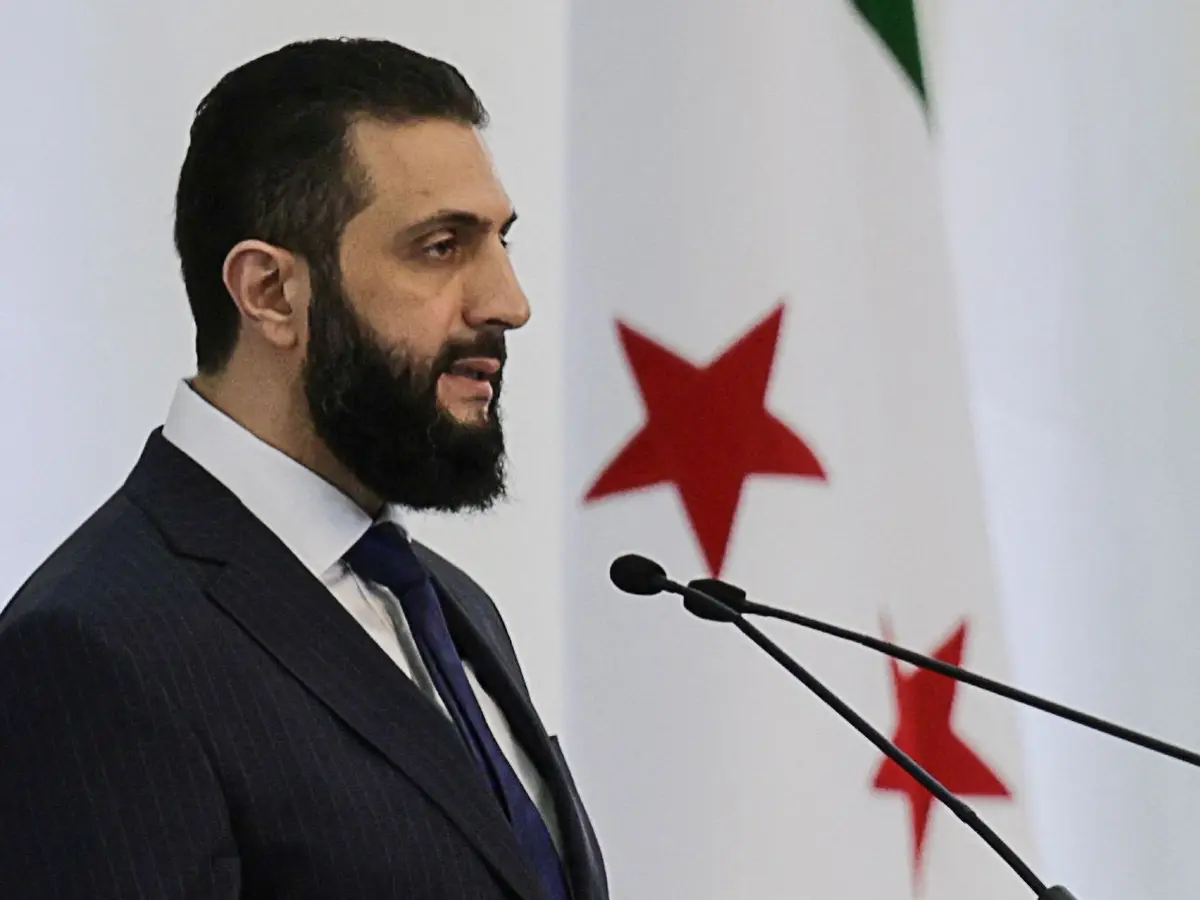
In the context of the geopolitical transformations sweeping the region, Syrian President Ahmad al-Sharaa’s visit to New York from September 21 to 25 stands out as a pivotal moment in the course of the Syrian political transition.
This visit, which will culminate in an official address to the UN General Assembly on September 24, reflects profound philosophical and political dynamics related to the redefinition of the Syrian state, its regional position, and its international relations amidst a complex transitional phase.
The Political Philosophy of the Syrian Transition:
The political transition in Syria can only be understood through the lens of political philosophy, which examines the relationship between authority, legitimacy, and society. President al-Sharaa, who appears to represent a reformist movement within the regime, seeks to rebuild the narrative of the Syrian state based on pluralism, sovereignty, and measured openness to the outside world. This philosophy challenges the traditional authoritarian model and proposes an alternative based on negotiation, regional balance, and a redefinition of the concept of “national security” beyond a military perspective.
The Visit to New York: Implications of Timing and Content
President Sharaa’s visit to New York came at a sensitive time, as international pressures intersect with the internal movement to restructure the state. His speech on Syria’s behalf before the UN General Assembly on September 24 will not merely present official positions, but will be an attempt to present a new vision for post-war Syria, which we believe includes a call to support a political roadmap, end foreign interventions, and establish the principle of national sovereignty.
Meetings with Arab Leaders… Rebuilding the Neighborhood:
President Sharaa’s meetings with a number of Arab leaders at the Doha Summit reflect a trend toward rebuilding Arab-Syrian relations on new foundations. We learned that these meetings were not merely protocol-related, but also discussed sensitive issues such as supporting the political transition, security cooperation, and reintegrating Syria into the Arab fold. From a political philosophy perspective, these meetings can be considered part of a “re-recognition” process, as Syria seeks to regain its status as a legitimate regional actor.
Participation in Research Conferences: Knowledge as a Tool of Legitimacy:
President Sharaa’s participation in research conferences, most notably a session organized by researcher Charles Lister with the participation of more than 150 researchers in New York, indicates a shift in the tools of Syrian diplomacy. Instead of relying solely on political rhetoric, academic knowledge is being used as a means of generating legitimacy and presenting a new Syrian narrative to the Western research community. This trend reflects a political philosophy that views cognitive dialogue as a means of dismantling stereotypes and building bridges of understanding with international intellectual elites.
Meetings with Western Researchers in Damascus… The Interior as a Center for Dialogue:
In a parallel move, President Sharaa will meet with a number of Western researchers in Damascus on Wednesday, September 17, 2025, which will precede his visit to New York. These meetings reflect a desire to make the Syrian capital a center for dialogue, rather than merely a recipient. These meetings reinforce the idea of ”cognitive sovereignty,” as we see it, as the state seeks to produce its own discourse and confront external narratives from a position of intellectual strength.
The Roadmap for Sweida: US-Jordanian Support and Local Transformations:
One of the most prominent outcomes of the recent political movement is the proposal of a roadmap for Syria, supported by US and Jordanian support. It focuses on Sweida Governorate as a laboratory for local political transition. This roadmap includes gradual steps toward local governance, institutional reform, and ensuring security.
Philosophically, this roadmap represents a model for “gradual transition,” balancing the need for change with the requirements of stability. It reflects shifts in the concept of the state from absolute centralization to administrative pluralism.
The Proposed Security Agreement in New York: US Pressure and Regional Negotiations:
The United States is pressuring Syria and Israel to sign a security agreement in New York, which includes arrangements for de-escalation in southern Syria. This pressure reflects an American political philosophy that views regional security as a gateway to reshaping the Syrian political system.
In contrast, Syria seeks to implement the 1974 “Disengagement Agreement” as a step toward an Israeli withdrawal from the south, without compromising sovereignty over the Golan Heights.
The Israeli Equation: Withdrawal in Exchange for Giving Up the Golan Heights
The Israeli proposal, which stipulates a withdrawal from southern Syria in exchange for Damascus abandoning its claim to the Golan Heights, presents the Syrian leadership with a philosophical and political dilemma. Giving up the Golan Heights would mean relinquishing part of its national identity, while accepting the withdrawal could open the door to a long-term ceasefire.
We believe this equation reflects a conflict between political realism and sovereign principles, which makes the Syrian decision complex and fraught with historical consequences.
Withdrawing Heavy Weapons from the South: A Dual Message:
Syria’s withdrawal of heavy weapons from the south represents a de-escalation step, but it is also a political message reflecting a willingness to negotiate without abandoning its principles. This step strengthens Syria’s position in any security negotiations and presents a model of “flexible power,” combining military capability with political openness.
Conclusion: Towards a New Transitional Philosophy:
It appears that President Ahmad al-Sharaa’s journey from Damascus to New York is not merely a diplomatic journey, but rather the embodiment of a new political philosophy that seeks to redefine the Syrian state, its regional position, and its international relations. This philosophy is based on a balance between sovereignty and openness, between principles and realism, and between internal and external realities. In light of the current transformations, Syria appears to be facing a historic opportunity to rebuild itself, not only as a state, but also as a new political and philosophical project.