
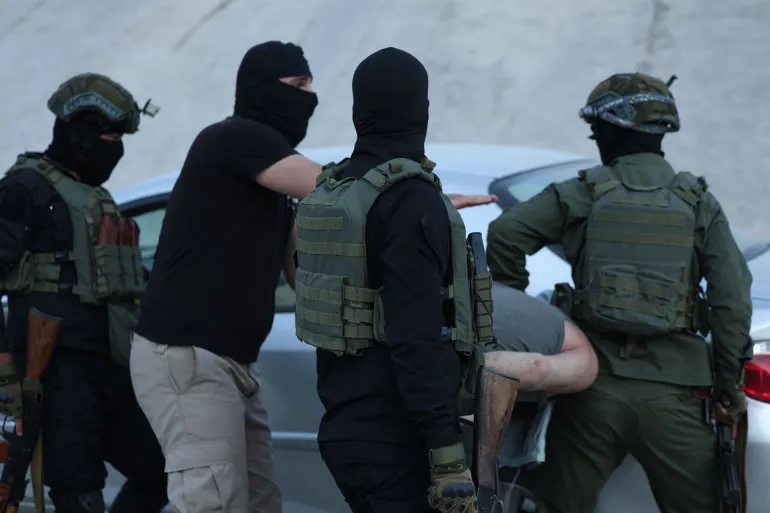
Syria has witnessed a series of accelerating security and political events, most notably the announcement by the Internal Security Forces in Idlib of the dismantling of an ISIS cell and the seizure of a weapons and explosives depot in the Harem area.
This event, despite its security nature, opens the door to a deeper philosophical-political analysis of the nature of power, the legacy of the former regime, and the challenges of state-building in the post-Assad era.
Since the beginning of the Syrian revolution in 2011, there have been indications that the Syrian regime has used extremist groups, most notably ISIS, as tools to distort the revolution and justify repression.
Numerous reports have spoken of the regime releasing extremists from Sednaya prison and facilitating ISIS’s expansion into opposition-held areas.
The dismantling of the ISIS cell in Idlib on August 6, 2025, represents a symbolic dismantling of one of the tools of the former regime. It is an implicit declaration that the era of authoritarian use of terrorism has ended, and that security is no longer a means of domination but rather a necessity for building a new political society.
Indicators of this shift include the following events of the week:
- Turkish Foreign Minister Hakan Fidan’s visit to Damascus – August 7, 2025. Syrian President Ahmed al-Sharaa received the Turkish Foreign Minister in an unannounced visit that focused on security coordination in northeastern Syria and Turkey’s concerns about the SDF’s expansion in Manbij and Aleppo.
- Formation of a temporary executive office in Sweida – August 7, 2025. The Supreme Legal Committee, under the direction of Sheikh Hikmat al-Hajri, announced the formation of an executive office to manage Sweida’s affairs and the appointment of a former Assad regime officer as commander of internal security.
This move sparked widespread debate about the intentions of secession or self-administration. - Thwarted church bombing attempt in Tartous – August 5, 2025. The Syrian Ministry of Interior announced the thwarting of a plot to bomb St. Elias Church in Tartous and the arrest of two individuals involved in the operation.
- Syrian-Turkish Talks to Enhance Security Cooperation – August 4, 2025. Syrian Interior Minister Anas Khattab met with his Turkish counterpart, Ali Yerlikaya, in Ankara to discuss opportunities for security cooperation, indicating a shift in relations from hostility to coordination.
Michel Foucault argues that power is not only exercised from the top, but is distributed across networks and institutions.
In Syria today, power is no longer truly centralized, but rather distributed between Idlib, As-Suwayda, northeastern Syria, and Damascus. However, these local authorities lack political legitimacy and face challenges in building accountable institutions.
In this context, the dismantling of the ISIS cell should be understood not only as a security success, but also as a test of the ability of local authorities to generate new legitimacy based on security, justice, and political representation.
Furthermore, in the post-Assad era, a state cannot be built without addressing the legacy of violations. Transitional justice is a philosophical process for rebuilding trust. ISIS members must be tried according to fair procedures, the role of the former regime in supporting terrorism must be exposed, and the rights of victims must be guaranteed.
Justice here is not revenge, but rather the establishment of a new social contract that redefines the relationship between state and society.
However, the security transformations in Syria cannot be separated from the regional context.
Hakan Fidan’s visit to Damascus and the security cooperation discussions point to a new regional partnership, but this partnership must place Syrians at the center of the equation, not merely as tools in power struggles.
The post-Assad philosophy must be based on restoring “popular sovereignty,” not just geographical sovereignty. This requires an active role for civil society, intellectuals, and local actors in shaping the country’s future.
Ultimately, the dismantling of the ISIS cell in Idlib could be the beginning of a new philosophical path in building a Syrian state based not only on power but on meaning. A state that defines itself not only as the antithesis of terrorism, but as an incubator of freedom, justice, and dignity.
This path requires thinkers, politicians, and citizens capable of imagining a new Syria that transcends both Assad and ISIS, toward a homeland not governed by fear but built on hope.