
the introduction:
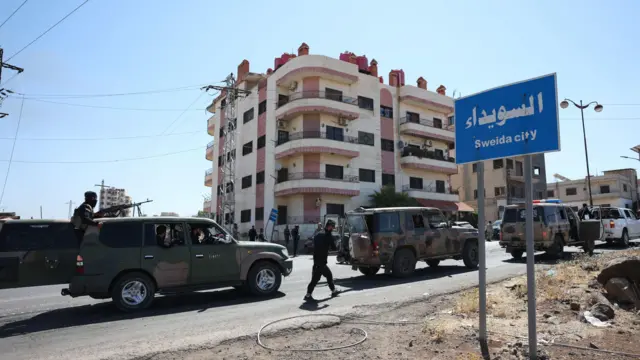
Since mid-2023, before the fall of the former regime, Sweida Governorate has witnessed rapid developments, ranging from widespread civil protests, limited armed confrontations, and diverse political initiatives both locally and regionally. Amid this landscape, Lebanese leader Walid Jumblatt’s statements in July 2025 stand out as a political intervention that places the crisis within a negotiating framework that intersects with the official Syrian state discourse on the centrality of a political solution.
This paper aims to deconstruct the Jumblattist approach, analyze the official Syrian discourse, and read the local movement from a perspective that believes in the nation-state as an institutional and societal contract that transcends the reduction of identity to sectarian or tribal affiliations. The paper also addresses the possibility of formulating a genuine negotiating process based on political participation, local representation, and redefining the relationship between the state and society in Sweida within the broader Syrian framework.
The position of Sweida in the Syrian political vision:
Historically and geographically, Sweida represents a unique demographic and political space, as it is the primary home of the Druze community and a southern gateway with tribal and social connections to Daraa and Quneitra. Sweida’s stance toward the Syrian regime since 2011 has been characterized by relative neutrality. However, this neutrality did not prevent the rise of protests at critical moments due to the deteriorating economic situation and the absence of effective political representation. The dynamics of Sweida can be summarized according to three levels:
- Purely civil protest manifested itself in movements demanding public services, independent local decision-making, and a rejection of the militarization of society.
- Local armed groups emerged as a response to the power vacuum, but they did not develop into a cohesive political actor, especially after the assassination of Sheikh Wahid al-Balous.
- Religious mediation and traditional leadership, such as the Sheikhdom of the Mind, receive invitations from multiple parties without the margin for independent decision-making. These intertwined levels make a political solution a challenge that requires rebuilding trust, dismantling the residue of isolation, and transcending the logic of identity polarization.
Jumblatt’s speech between regional mediation and identity control:
In his statements on July 20, 2025, Lebanese Druze leader Walid Jumblatt put forward four central positions:
- A call for dialogue with the Syrian government, including all religious and sectarian components in Sweida.
- Sheikh Hikmat al-Hajri urged participation in the negotiating process.
- Rejecting international and Israeli protection for the Druze community.
- Emphasizing the Druze’s belonging to the Arab and Syrian fabric.
These positions can be explained according to three strategic considerations:
- Setting the identity path by emphasizing Druze unity within the Arab framework and rejecting secession or internationalization.
- Containing the crisis without weakening the Syrian state. Although Jumblatt made indirect criticism, he did not question the legitimacy of the state as a negotiating framework.
- Restoring the Druze community’s mediating position, utilizing its negotiating role to formulate a comprehensive solution that neither contradicts nor subjugates the central authority. Here, Jumblatt appears to be balancing between preserving Druze uniqueness and preventing an internal explosion in the mountain region, even more so than it is currently. He also appears to be balancing between revitalizing the political process in coordination with Damascus without fully aligning with it.
Official Syrian Discourse and the Bet on State Centralization:
The most prominent statements made by Minister of Information Hamza al-Mustafa are:
- Considering the “absence of the state” a primary cause of the crisis, while emphasizing that the state has “been keen since the fall of Assad” to provide the necessities of life in Sweida.
- Holding armed groups responsible for rejecting political solutions.
- Adherence to the “one country, one government, one army” trilogy.
- Calling for responsible action based on the premise that “Syria is large enough for all its people.” It is noteworthy that this discourse contains a semantic and political paradox:
- The “absence of the state” is used here to justify the crisis, but it does not directly impose responsibility on the central authority.
- The emphasis on the unity of the state is not matched by a practical proposal to enable local representation or recognize political pluralism.
- The call for everyone to integrate into the national army contradicts the reality that many local actors do not trust the military establishment as a guarantor of stability and instead view it as a party to the crisis.
These paradoxes indicate that the state is adopting a unilateral political narrative that does not allow sufficient space for genuine negotiations. Rather, it imposes preconditions on the nature of the solution and the legitimacy of its actors. Toward a Negotiating National State: Conditions for Reconstructing the Contract in Sweida:
From the perspective of the contractual national state, five basic conditions can be proposed for rebuilding the relationship between the state and Sweida:
- Recognizing unarmed local representation as a legitimate negotiating component, without reducing it to traditional leadership.
- Lifting the siege and halting military escalation as a prelude to building trust and paving the way for dialogue.
- Forming an independent commission of inquiry, with the participation of local human rights activists, into incidents of violence and violations.
- Redefining the role of the army in special areas, such that it is viewed not as an imposing force but as an institution protecting the national contract.
- Creating a participatory political process that is not exclusively managed from Damascus, but rather open to national formulation by multiple parties and institutions.
These conditions are not outside the constitutional framework, but rather aim to interpret it as a flexible contractual framework, not a rigid document imposed from the center. The potential role of research centers and civil mediation:
National research centers should play a fundamental role in:
- Drafting specialized position papers that promote pluralistic political representation in governorates emerging from conflict.
- Adopting a communication discourse with the government based on political realism rather than symbolic confrontation.
- Establishing joint dialogue platforms between civil society representatives and the state, in a collaborative, non-top-down approach. These centers can serve as a link between local movements and the state, and between political and societal thinking, through research, mediation, and independent evaluation.
Conclusion:
Jumblatt’s statements, and the state’s response, represent an opportunity to stimulate a broader discussion about the shape of the Syrian national state after years of division. Between a center seeking to include everyone and a periphery demanding the right to independent representation, Sweida emerges as a model in which the state’s seriousness in adopting political solutions can be tested, not as a rhetorical maneuver, but as a new social contract.
Building a negotiated national state begins not only with structures, but also with restoring trust and pluralistic representation, and with recognizing that what is “local” can only be eliminated when it is embraced, and that solutions cannot be imposed but are produced through negotiation and mutual respect.
the reviewer:
- Al Jazeera Mubasher, Walid Jumblatt’s statements, July 20, 2025
- Syrian TV, coverage of the crisis in Sweida, July 2025
- Speech by Syrian Minister of Information Hamza al-Mustafa, press conference, July 19, 2025
- Nabil Saleh, “Sweida and the Dilemma of Syrian Centralization,” National Issues Magazine, 2024
- Fawaz Gerges, “The Nation-State in the Levant: The Dialectic of Center and Periphery,” Arab Center for Research and Policy Studies, 2022
- Azmi Bishara, “On the Question of the State in the Arab World,” Arab Foundation, 2018