Introduction:
The conceptual and analytical framework of Syrian-Saudi economic relations:
Following a series of geopolitical transformations, the Arab region is witnessing a reassessment of relations between states. This reassessment is not only based on traditional axes or political affiliations, but also on pragmatic foundations that take into account development interests, climate challenges, and the growing demands of youth and social development.
In this context, Syrian-Saudi relations stand out as a special case, representing a paradox between a tense political legacy and a declared economic ambition that has yet to be translated into a clear or sustainable institutional framework.
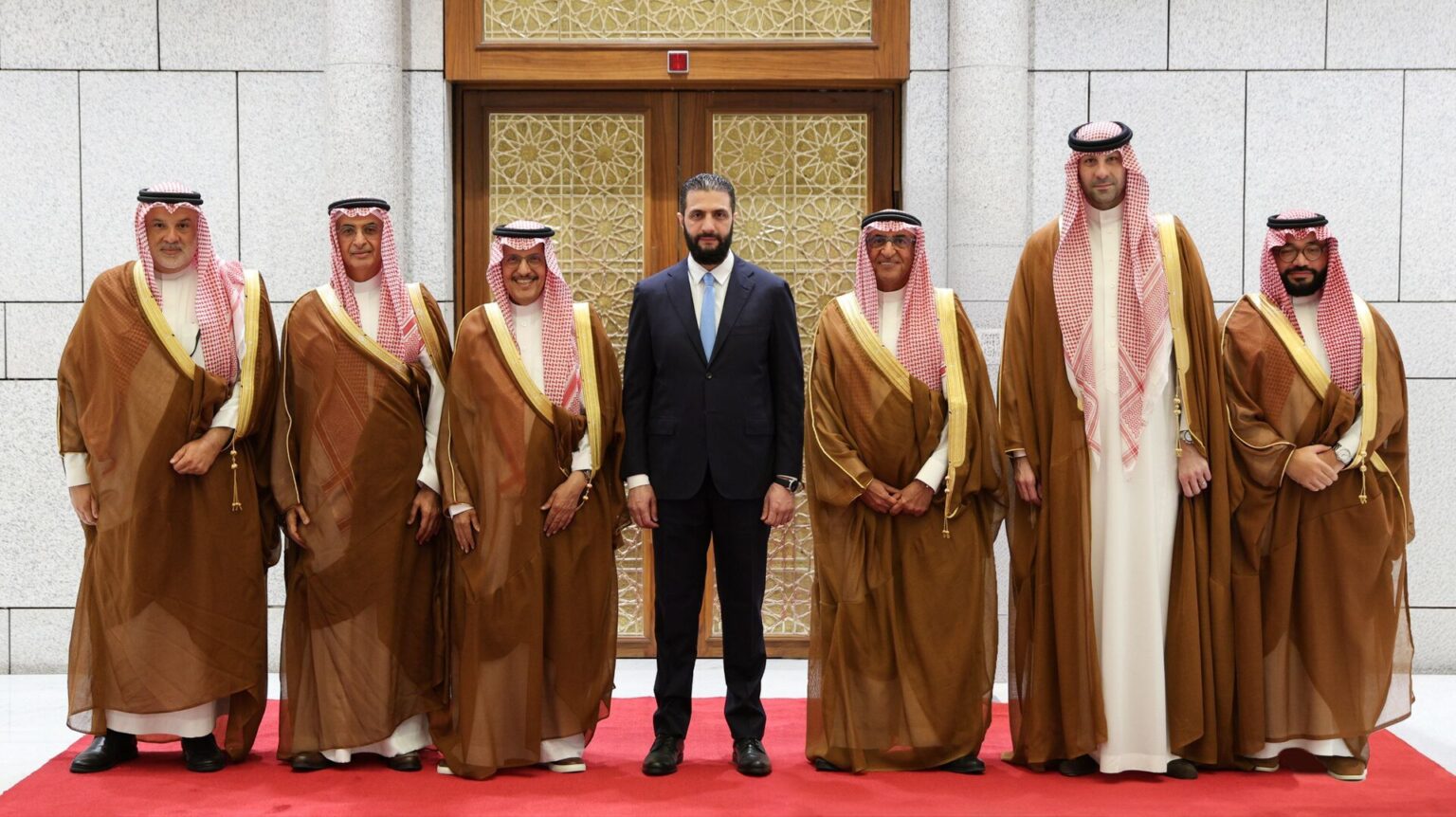
The meeting on Saturday, July 19, 2025, between Syrian President Ahmad al-Sharaa and a delegation of Saudi businessmen in Damascus transcends the mere protocol and is part of a series of moves that indicate the crystallization of a new economic-diplomatic climate, under the theme: joint exploitation of resources and opportunities in the post-war period. Despite the symbolic nature of the recent meetings, the essence of the relationship between Damascus and Riyadh in the economic field has remained hostage to political tensions, a flawed legal legacy, and deep structural differences between the two parties.
Building an economic relationship between Syria and Saudi Arabia requires a conceptual deconstruction of three levels:
The Nature of the Post-War Syrian Economy: 1
The Syrian economy suffers from profound imbalances in production, infrastructure, and legislation. It cannot be described as a traditional rentier economy alone. Rather, it is a distorted economy due to the systematic destruction of production centers by the former regime, capital flight, the dismantling of the domestic market, and the loss of confidence in the monetary and commercial authorities. This reality makes external cooperation a necessity, not a luxury. At the same time, it requires guarantees that go beyond formalities to create a genuine investment environment.
The Transformation in Saudi Economic Policy: 2
Since the launch of Saudi Vision 2030, the Saudi economy has been undergoing a transformation toward diversifying sources of income and expanding partnerships beyond the oil sector.
Opening channels of regional cooperation is one of the strategic pillars of this transformation, particularly through the private sector, which is now granted greater freedom to operate and invest outside the Kingdom. Here, the interests of both parties converge, but theoretical convergence does not mean practical agreement without careful institutional engineering.
Regional Framework for Joint Development: 3
The Syrian-Saudi relationship cannot be viewed in isolation from regional balances. This potential partnership represents an entry point for a new model of multilateral recovery, based on integrating private sector efforts into the reconstruction process, but under conditions that ensure integrity, equitable distribution, and avoid the politicization or commodification of funds to serve influential parties.
The Syrian Economic Environment – Investment Opportunities and Structural Challenges
The Syrian economic environment today represents a complex situation that is difficult to classify within traditional economic models, given the deep intertwining of structural collapse, the legacy of rentier policies, and the disastrous consequences of armed conflict. Any process of envisioning the future of cooperation with financially solvent Arab countries, such as Saudi Arabia, requires first delving into the nature of this economy: how it operates, what its weaknesses are, and where the opportunities lie.
At the current stage, the Syrian environment is characterized by the following characteristics:
- The weakness of the productive and service infrastructure, with more than 60% of industrial and service facilities destroyed or disabled as a result of the war, has rendered the local private sector unable to perform its traditional functions of creating jobs and generating value. This vacuum opens the door to foreign investment, provided it is managed according to a development model aimed at restructuring the economy, rather than merely maximizing short-term profits.
- The fragility of the legislative and institutional system, as local and international reports indicate the presence of contradictions and duplications in investment-related laws, along with the absence of an independent judiciary and the continued political impasse that prevents transparency in licensing and contract awarding.This context exacerbates the risks of what is known as an “investment-repelling climate” and calls for reform at the legislative and governance levels.
- The absence of legal and financial guarantees. Many investors face issues related to property rights, local currency exchange rate volatility, and the possibility of withdrawing profits, all of which are essential elements in assessing any economic environment. With continued restrictions on remittances and economic sanctions, Syria remains a high-risk area unless neutral mechanisms are in place to ensure contractual obligations are met.
- There are potential opportunities in the production and service sectors. Despite this reality, Syria retains a number of untapped investment opportunities, most notably in the agricultural sector, food industries, renewable energy, and medical and educational services. These sectors represent not only a domestic need, but also the potential to create export value if invested in within rational partnerships based on efficiency and the equitable distribution of benefits.
- The role of Syrian communities and expatriates. Syrian communities—particularly in the Gulf states and Europe—represent a potential source of capital and expertise, but the lack of guarantees and transparency makes their return to investment risky. Therefore, any model of cooperation with Saudi investors must take into account building new bridges of trust between the Syrian state and its globalized economic sector.
The Syrian Future Movement’s approach to the path of regional partnership:
The Syrian Future Movement’s economic vision is based on three foundational principles that distinguish its discourse from traditional approaches to managing international investment relations: the priority of people over capital, the centrality of institutional justice, and the rejection of the commodification of the national economy in the service of political or security forces. Based on these values, the movement’s economic office adopts a constructive, critical vision of the course of Syrian-Saudi cooperation, based on transforming the moment of economic openness into an opportunity to redefine the rules of the relationship between the state, society, and the private sector.
1- The philosophy of developmental economics versus rentier economics:
The movement is based on the conviction that Syria cannot return to the rentier economic model that dominated previous decades, which contributed to the creation of a parasitic class linked to centers of security and political influence, at the expense of distributive justice and productive efficiency. Economic cooperation with the Gulf states—primarily Saudi Arabia—must be used to build a multilateral development economy, managed by independent institutions, and whose formulation involves civil society, the local production sector, and Syrian expertise abroad.
This transformation requires dismantling the structural relationship between political capital and executive authority, and ensuring that foreign investment is not used as a tool to recycle privileges or impose non-developmental agendas on the Syrian people.
2- Investment as an Indispensable Entry to National Dialogue:
The movement believes that investment is not an end in itself, but rather a means to restructure the Syrian social contract.
Hence, the issue of economic partnership must be integrated into the national dialogue process, as a field that tests the state’s seriousness in reform, its willingness to distribute benefits fairly, and the creation of a truly participatory environment that restores Syrians’ confidence in public and private institutions.
Any investments concluded outside this context, and without independent societal or institutional oversight, will be subject to popular criticism, moral exposure, and the reproduction of relationships of dependency and corruption, not development.
3- Rejecting Selectivity and Isolation:
In the midst of the recent Saudi openness, the movement warns of the danger of selectivity in contracts or isolation in granting concessions, whether under the pretext of “strategic partnership” or “political exclusivity.”
These policies do not create a healthy economy. Rather, they perpetuate the dominance of certain groups over key areas of production and services, weaken the ability to create fair competition, and attract local talent, marginalized by centralization and marginalization.
Hence, the movement calls for ensuring that investment opportunities reach all Syrian regions. Projects should not be limited to narrow geographies or to entities affiliated with the regime. It also calls for adopting transparent and publicly announced criteria for granting licenses and contracts, which should be presented to the public and subject to independent oversight.
Strategic Visions and Recommendations for the Medium and Long Term:
In light of the ongoing economic and diplomatic transformations between Syria and the Kingdom of Saudi Arabia, the Economic Bureau of the Syrian Future Movement adopts a comprehensive vision that outlines a partnership based on integrity, justice, and regional integration.
This vision is not limited to financial and commercial issues, but rather integrates institutional and social dimensions, placing economic development at the heart of a comprehensive national project.
- A New Institutional Architecture for Investment:We must move beyond the traditional model based on bilateral agreements between ministries and move toward establishing independent institutions with a participatory nature, such as the Syrian-Saudi Council for Development. This council will include economic experts, representatives from the private sector, civil society organizations, and independent bodies concerned with financial oversight and governance. This council will form a coordinating umbrella that monitors, reviews, and evaluates investment performance, ensuring its fair geographical and social distribution.
- Developing a transparent national investment law:It is impossible to talk about attracting Arab or international investments without an advanced law that takes into account global developments in investor rights, legal protection, arbitration mechanisms, and environmental and social governance of projects. Therefore, the movement recommends launching a national legislative workshop to prepare a new investment law that will be submitted for public discussion and approved through a democratic mechanism that ensures participation and popular oversight.
- Involving local communities and expatriates:
- Development cannot succeed if it remains top-down or is implemented without involving local communities. Therefore, the movement proposes the formation of local economic councils in each governorate, to participate in setting investment priorities and monitor performance. Investment opportunities should also be opened to Syrians abroad, as part of the “Return of National Capital” program, through which expatriates are granted well-considered legislative and financial facilitations.
- Immunization against political dysfunction and corruption: One of the major challenges facing any investment partnership is the infiltration of political money and the lack of oversight of contracts and licenses. Therefore, the principle of “preventive transparency” must be adopted, with every investment agreement and financial contract published in an open public register and subject to annual public review by independent institutions. It is also proposed to integrate integrity rules into every investment contract, including clear environmental and social governance standards.
- Regional Integrated Development: It is important that the Syrian-Saudi partnership be part of a regional integration project that is not limited to bilateral interests. The initiative could expand to include tripartite or quadripartite partnerships with Jordan, Iraq, Egypt, or the UAE, within the so-called “Eastern Development Bloc,” which focuses on developing the productive and service sectors at the regional level, and sharing knowledge, innovation, and human and technological investment.
- Integrating the economy into a comprehensive political reform project: Economic cooperation should not be isolated from the process of political and constitutional reform. On the contrary, creating a fair and transparent economic environment is a true test of the credibility of institutional reform. Therefore, the Syrian Future Movement recommends that the investment portfolio be incorporated into the new social contract document and recognized as a central item in the national dialogue, through which the relationship between the state, society, and the market is redefined.
conclusion:
The Economic Bureau of the Syrian Future Movement believes that the current economic situation presents a rare opportunity to transform investment from a mere financial activity into a strategic tool for rebuilding the state and society.
If Syrian-Saudi relations are managed with transparency, independence, and partnership, they can serve as a model for integrated recovery and contribute to opening a new horizon for the entire region toward an ethical, developmental, and just economy.
Therefore, this paper is issued as an intellectual and political contribution aimed at stimulating dialogue, organizing priorities, and presenting workable visions to advance the path of economic cooperation toward a national-regional development partnership that respects the rights of Syrians and enhances their capabilities.