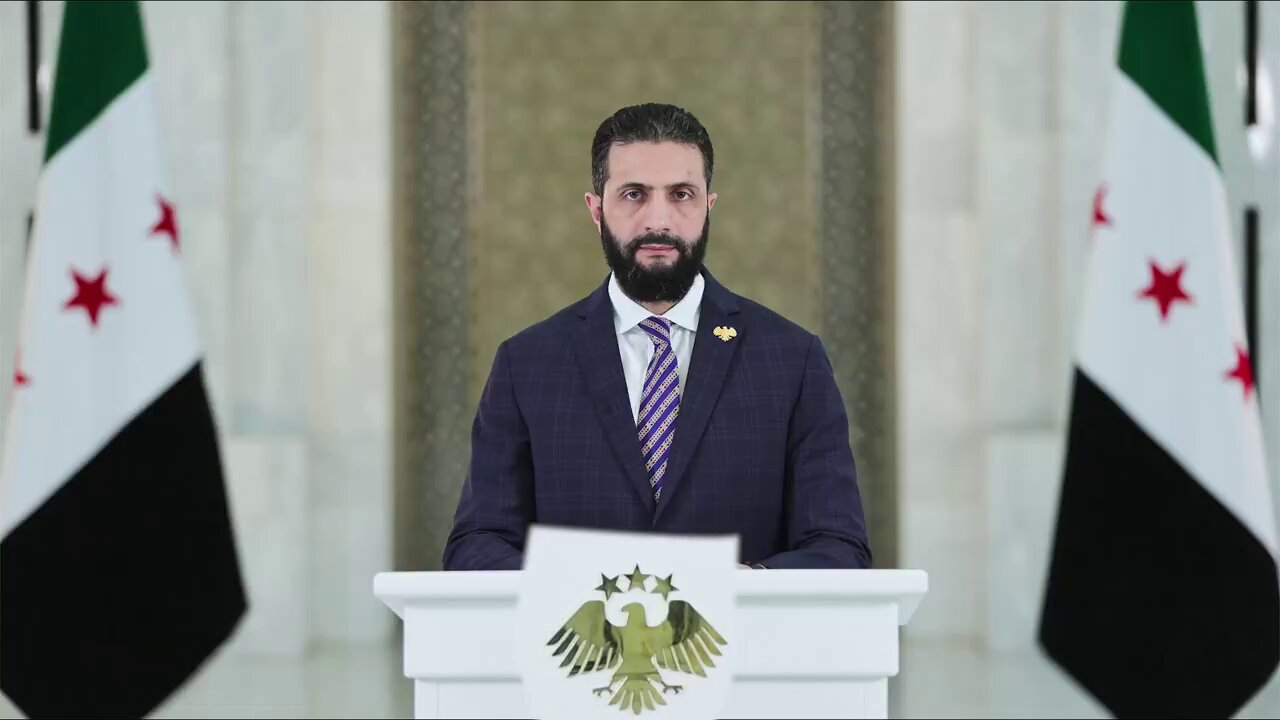
In one of the most tense moments, both domestically and internationally, Syrian President Ahmad al-Sharaa delivered a televised address following unprecedented Israeli airstrikes targeting the vicinity of the People’s Palace and the General Staff headquarters in Damascus. This came amid escalating internal tensions in the Sweida governorate, setting the record straight on a chaotic domestic and regional scene.
First: The air strike and the goal of the political message:
President al-Sharaa began his speech by commenting on the Israeli raids, saying: “Syria will not be lured into a trap, but we reserve the right to respond at the appropriate time and place.”
This statement is not merely a diplomatic positioning, but rather an affirmation of a shift in Syria’s deterrence doctrine. The response is no longer instinctive or hasty, as in previous phases, but rather is subject to calculations of the regional balance of power and linked to a comprehensive strategy aimed at neutralizing Israel as a chaotic actor without slipping into a broader war.
As for the raids on sites close to sovereign centers, they are not merely messages through fire, but rather a symbolic attempt to penetrate the newly emerging state after years of bleeding. The response to them in the speech was clear: Syria understands the game and will not be part of it.
Second: As-Suwayda from strife to national test:
In the axis of the internal discourse, the president was frank, saying: “We were faced with two choices: open war with the Israeli entity through the gate of Sweida, or allowing the Druze notables and sheikhs to come to their senses… so we chose the path of reason.”
Here, the philosophy of the new Syrian leadership is evident: power is not in firing bullets, but in containing the sedition before it spreads. Sweida was not merely an arena of local conflict, but rather a complex sedition project, both internal and external.
Al-Sharaa also said: “We have decided to delegate the responsibility of maintaining security to some local factions and wise sheikhs, because we believe that calm begins from the roots, not from the barrels of guns.”
This is a foundational statement for a political and security approach, stating that security in Syria will no longer be built solely by military force, but rather through community partnership and local responsibility.
Third: Israel as a destructive actor – engineering the new chaos:
Sharaa described Israel as seeking to turn our holy land into an arena of chaos, fueling sectarian divisions, and preventing Syrians from healing their wounds.
Here, the president reproduces a national narrative that views Israel not only as a military enemy, but also as a political actor using internal tools to divide, just as happened in Lebanon and Iraq. By opening lines of communication with specific Syrian factions, Israel is attempting to create the model of a “safe zone under the protection of Israeli airspace,” a concept the Syrian leadership has categorically rejected.
Fourth: International mediation – flexibility without compromising sovereignty:
In a remarkable precedent, President al-Sharaa announced that “American, Arab, and Turkish mediation contributed to halting a dangerous escalation that could have dragged the country into undesirable confrontations.”
However, he added firmly, “We dealt with these mediations flexibly, but without granting anyone the right to interfere in our internal affairs or violate our sovereignty.”
Here, we witness a mature diplomatic shift. Recognizing international efforts does not mean submitting to them; rather, it represents a partnership in avoiding escalation, not guardianship over national decision-making.
Fifth: A special message to the Druze community:
President al-Shara’ addressed the people of Sweida, saying, “You are an integral part of the homeland, and protecting you is our duty. We will not allow anyone to drag you into partition or guardianship schemes.” This statement reaffirms that Syrian national identity transcends sectarian alignments and simultaneously thwarts attempts by Israel and some Western countries to isolate the Druze and present them as a community in need of external protection.
Sixth: The logic of justice, not dominance:
The president said, “We will hold accountable those who transgress and abuse our people, whether they are from the regular forces or outside them. No one is above the law.” Thus, he explicitly declares that the state does not grant cover to any party, even if it is affiliated with the state. This is an implicit declaration of the beginning of a phase of dismantling the structure of exceptions that covered security violations in the name of war or loyalty to parties or individuals.
Seventh: The New National Project – Reengineering the State:
At the conclusion of his speech, the President said: “Syria is not just post-war, but post-division, post-sectarianism, and post-dependency. Unity is our weapon, hard work is our path, and our solid will is the foundation upon which we will build this prosperous future.”
This is not just a conclusion, but a “political manifesto,” one that goes beyond crisis management to reshaping the Syrian state based on the principles of partnership, conscious decentralization, and good governance.
Analytical Conclusion – Post-Discourse:
- For the first time, we are witnessing a presidential speech that acknowledges the existence of international mediation, without submitting to it.
- For the first time, community factions are being delegated security duties within an organized and legitimate framework.
- For the first time, it is announced that accountability will include any party that violates the law, even those within the regime.
- Finally, for the first time, we are witnessing a speech that effectively establishes a new political project that is inclusive of all Syrians, one based not on force alone, but on awareness, balance, and cautious openness.