
Executive Summary:
The relationship between the Syrian Democratic Forces (SDF) and the new Syrian state constitutes one of the most prominent political and institutional challenges in the context of the national transition following the fall of the former regime in December 2024.
This relationship has become the focus of a delicate equation that attempts to balance the imperatives of sovereignty and the unity of state institutions, on the one hand, and the requirements of justice and political and cultural representation for the communities of northeastern Syria, on the other.
This paper presents a practical vision for a balanced settlement between the two parties, taking into account the constitutional and political principles of the emerging state and drawing on the transitional experiences of countries that have emerged from armed conflict toward national reconciliation, such as South Africa and Bosnia.
The paper also recommends a multi-pronged framework that includes conditional military restructuring, broad administrative decentralization, constitutional recognition of cultural rights, and transitional justice guarantees with international technical participation.
First, the political context and the transitional phase:
Since the fall of the Assad regime, Syria has been experiencing an unprecedented phase of re-establishing a new social contract that redefines the form of the state, the nature of its institutions, and the citizen’s position within it. This phase imposes the necessity of reintegrating all the forces that emerged during the years of conflict into the state system in a way that does not weaken its sovereignty or reproduce manifestations of exclusivity and division.
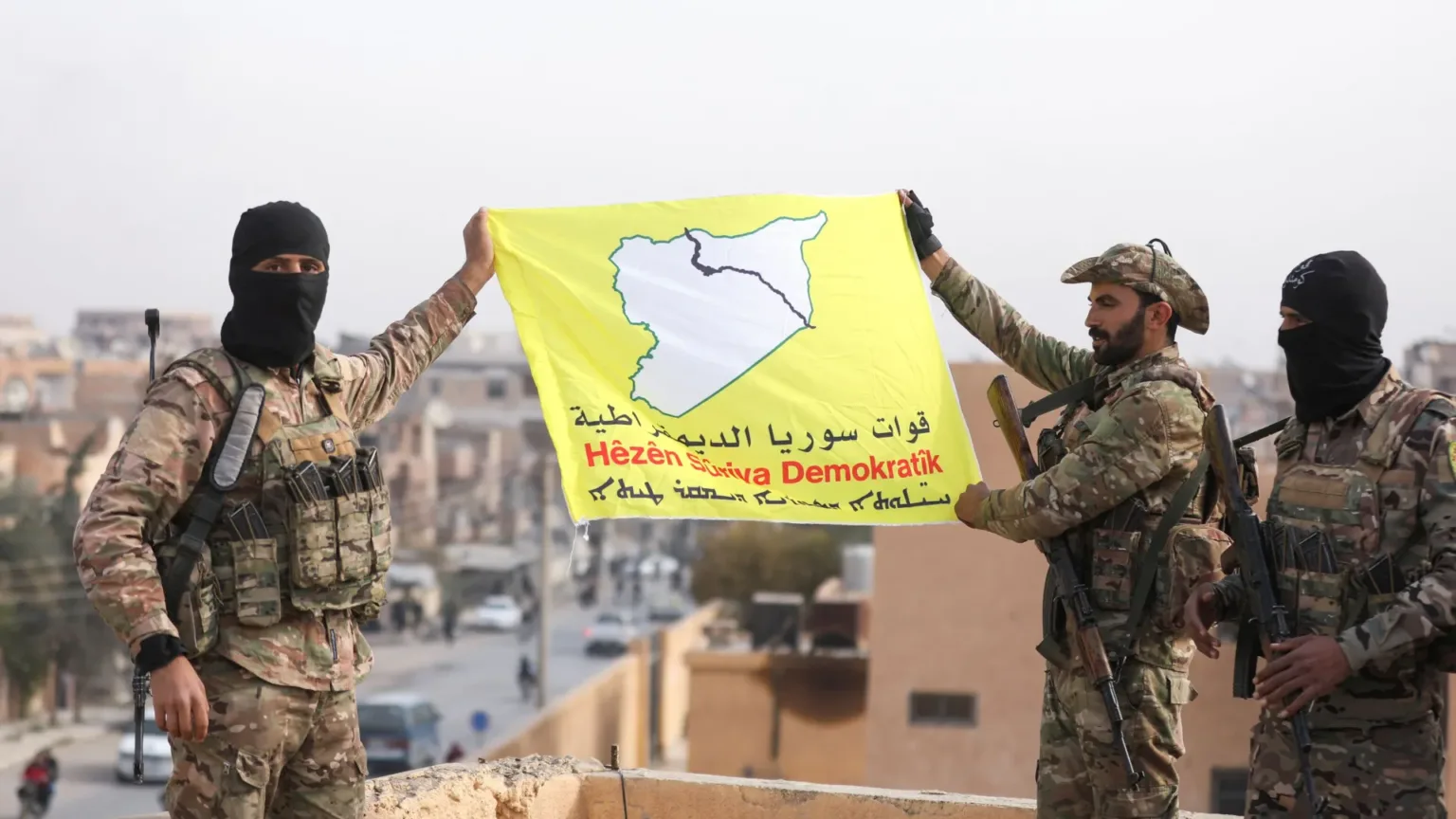
The Syrian Democratic Forces (SDF) emerged over the past decade as an armed force with a local-national dimension. They were able to impose their control in the northeastern regions of the country and enjoyed broad international support, particularly from the United States in the fight against ISIS.
Despite the signing of a framework agreement between them and the new Syrian government in March 2025, the SDF continues to refuse full integration into state institutions and demands the maintenance of an independent military structure and a decentralized political formula, which they see as a guarantee of Kurdish representation in the new Syria.
In contrast, the Syrian government, headed by Ahmed al-Sharaa, asserts that the state cannot operate on a basis of incomplete sovereignty. It views the SDF’s demands as a threat to the unity of political and military decision-making, despite its commitment to constitutional recognition of the cultural and linguistic rights of the northeast’s ethnic groups, most notably the Syrian Kurds.
Second, the institutional problem in the relationship between the two parties:
The core of the dispute between the SDF and the Syrian state lies in the position of power and identity within the state. On the one hand, the SDF demands recognition as a semi-independent military and administrative component, with symbolic integration into state institutions and guaranteed representative rights for Kurds.
On the other hand, the government believes that integration should be purely individual and institutional, without a political or military bloc, to preserve the prestige of institutions and the cohesion of sovereignty.
This divergence leads to different conceptions of the state itself.
While the Syrian government seeks to rebuild a flexible, non-authoritarian, centralized state, the SDF believes in an expanded decentralized model that amounts to administrative federalism and maintains a powerful militia with special funding and equipment.
This conflict threatens transitional stability and creates a real risk of entrenching duality within the emerging state institutions.
Third: Constitutional and legal determinants of merger:
The idea of a state monopoly on the use of force is based on the principles of international law and the UN Charter and is an essential element of any democratic transition process.
However, the experiences of post-conflict countries indicate that this monopoly cannot be imposed all at once. Rather, it requires a gradual institutional restructuring that ensures the integration of irregular forces into state institutions and achieves fair representation, without granting them privileges outside the sovereign framework.
The paper recommends that the solution be based on the principle of “conditional and phased integration,” by establishing an official unit within the military institution composed of SDF members. This unit would have a geographic, non-political character and would be managed during a transitional phase by a joint command subject to strict central oversight. This unit would be incorporated into the structure of the national army in accordance with service laws, and its members would undergo retraining in accordance with national doctrine, leading to full integration. At the same time, the demand for recognition of Kurdish identity and other Syrian identities as a national cultural treasure should be taken into consideration through a constitutional amendment that stipulates the cultural and linguistic rights of Kurds and guarantees the use of the Kurdish language in local education and media without establishing an independent political entity (which we explicitly stated in the Syrian Future Movement papers years ago as part of our comprehensive vision for the form of the new state). This would achieve representation without compromising the unity of the state, opening the door to federalism, or violating the principle of the centrality of national education.
Fourth, the proposed administrative structure for the northeastern region of Syria:
The Syrian Future Movement believes that the realistic solution lies in adopting a model of cooperative and expanded administrative decentralization, granting elected local councils broad powers in the areas of services, planning, development, project management, education and health affairs, and resource management. This is provided by ensuring that these councils remain legislatively and financially linked to the central government and subject to national oversight through the Ministry of Local Administration, as we presented in a paper published on our website entitled: Centralization, Decentralization, and the Third Option Between Them. It is advisable to draw on comparative models, such as the Spanish model, which grants regions significant local powers without compromising the unity of the state, and the German model, which balances federalism and federal authority through what is known as “integrated decentralization,” although there is a difference between the standard and the one being measured.
Fifth, transitional justice mechanisms and addressing violations of the previous phase:
No agreement can succeed without including a clear mechanism to address violations committed during the years of conflict, whether by the SDF or other parties, in a manner that achieves accountability without political liquidation.
Hence, the paper recommends the establishment of an independent national transitional justice commission, with the participation of human rights, legal, and community figures from both sides. This commission would oversee investigations into allegations of arbitrary detention, displacement, abuses, and the erasure of identity, and issue recommendations to be implemented in phases through the national judiciary or local reconciliation committees.
This commission is not a tool for collective condemnation, but rather a means of achieving justice and preparing local communities for a new phase in which trust is built between components and shared citizenship is restored.
Sixth, the role of the international community in the consensus process:
The international community, particularly the United Nations, should contribute a technical oversight role to the integration and settlement process, without interfering in sovereign decisions. The United Nations could establish a field office in northeastern Syria to monitor implementation, submit quarterly reports on adherence to military and administrative protocols, and monitor indicators of escalation or failure. This would serve as a support tool for the national process, not a guardianship of it. Unconditional military support for the SDF must cease once the consensual process has truly begun and be transformed into development support to build local capacities within the framework of the state.
Seventh, political messages directed to the parties:
1- To the Syrian government, the paper recommends openness to a phased integration formula that allows the inclusion of components of northeastern Syria within state institutions without compromising their unity, and takes into account cultural diversity and local specificities as an element of enrichment, not a threat.
2- To the SDF leadership, the paper calls for transcending the duality of maintaining independent military structures or withdrawing completely, by accepting the principle of national partnership under the state umbrella and interpreting the political moment as an opportunity to shift from a position of control to one of participation.
3- To the international community, the paper calls for focusing support on the process of institution-building and creating an environment for national reconciliation, refraining from supporting any entity outside the state system, and refraining from adopting a dual approach to the Syrian file based on transient interests.
Conclusion and final recommendations:
The paper believes that the future relationship between the SDF and the Syrian state must be built on the foundations of citizenship, equality, and pluralism, within an indivisible unity of sovereignty.
The acceptance of reasonable concessions by both parties and mutual recognition of the need for change is the true gateway.
We believe that the future relationship between the Syrian Democratic Forces and the Syrian state cannot be limited to a security formula or circumstantial understandings. Rather, it must be based on an institutional vision that accommodates the complexities of the current situation and enshrines the principle of a unified state, not a divided one.
The founding moment Syria is experiencing today offers a rare opportunity to rebuild the nation-state on a new foundation, based on a just partnership between its components, sovereignty that does not contradict diversity, and institutions that are not tied to loyalty but rather to competence and citizenship
In this context, we recommend the following for political transition and state-building:
- Launching a formal negotiation process between the new Syrian government and the SDF leadership under a national umbrella and international technical supervision. This process will build on the protocol signed in March 2025 and develop into a binding agreement within a monitorable timetable.
- Adopting a formula for the phased integration of the SDF into the military establishment, beginning with the formation of a northeastern unit affiliated with the Syrian army. This unit will be managed during the transitional phase under a joint command, which will later be dissolved within the structure of the Ministry of Defense.
- Adopting broad administrative decentralization in northeastern Syria and all Syrian regions, enhancing the ability of local communities to make development and service decisions, under central oversight that ensures balance and prevents division.
- Including recognition of Kurdish cultural identity in the new Syrian constitution, including the use of the Kurdish language in education and local media, without establishing independent political entities or parallel authorities.
- Establishing a national transitional justice commission to ensure that documented violations are addressed with the participation of legal experts, victims’ representatives, and civil society, and producing recommendations for justice and reconciliation that restore civil peace.
- Shift international support from parallel military programs to support local development and institutional capacity building within the Syrian sovereign framework, while halting uncoordinated foreign funding that reinforces division.
- Establish a joint civil-military oversight unit to monitor the integration and rehabilitation process and issue periodic reports that are made public, promoting transparency in the rebuilding of military institutions.
- Launch an open national dialogue that includes representatives of the SDF, the government, and political and community forces. The Syrian Future Movement, on its own behalf and on behalf of the Syrian Democratic National Forces Gathering (Syrian Democratic Forum), as its rotating president, can contribute positively to this dialogue. This dialogue should discuss the future of political pluralism in Syria and lay the foundations for a national charter that excludes no one and does not establish supranational powers.
In conclusion, we affirm that this model is not only applicable, but also necessary to end the era of tension and division and begin the process of building a state based on representation, integration, and comprehensive justice. We renew our call to the concerned parties to engage in a frank and responsible dialogue that leads to a settlement that preserves Syria’s unity, strengthens its capabilities, and restores dignity to its people and citizens across its geography.