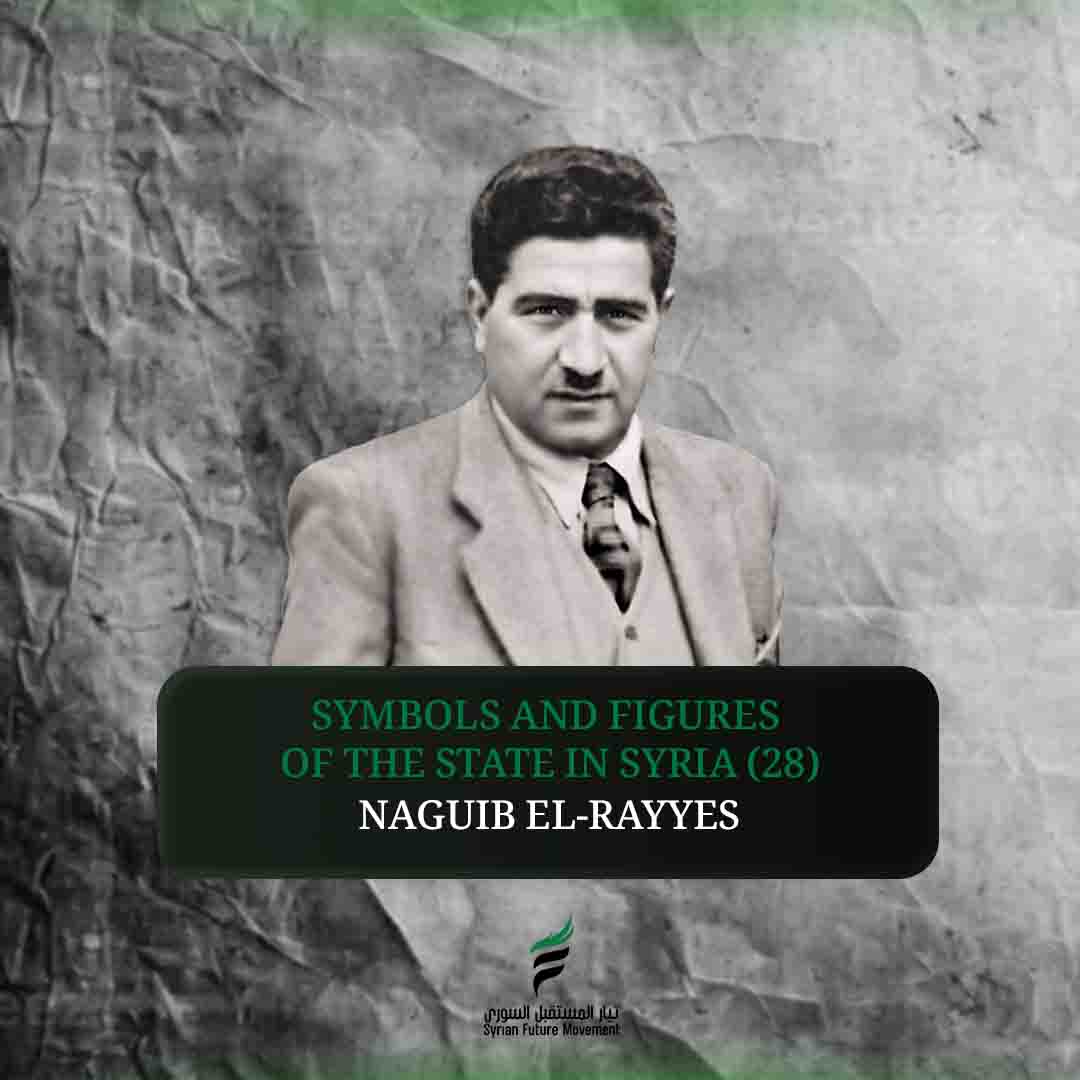
Najib al-Rayyes, a pillar of journalism and national struggle in modern Syrian history, was born in 1898 in the city of Hama. As a young boy, he moved to Homs and then to Damascus in 1919, where he embarked on his journalistic and nationalist career.
Press and resistance platforms:
He began his career as a correspondent for Lebanese newspapers such as Al-Ahrar and An-Nahar, before founding Al-Qabas in 1928, which became a major platform for the Syrian nationalist movement and the renaissance of the Syrian people. Al-Qabas became the most prominent and influential voice in the press, to the point that the French colonialists repeatedly suspended it due to its bold nationalist stances.
In 1952, Al-Qabas merged with Al-Alam newspaper by decision of President Adib Shishakli, under the name Al-Zaman newspaper. It later regained its independence and was published for a short period under the name Al-Qabas Al-Alam, until it reverted to its original name by the will of the heirs.
Prison is the exile of the free:
Najib al-Rayyes paid the price for his stances, spending more than eight years in prison and exile, divided between the Damascus Citadel and the prisons of Mezzeh, Aleppo, Beirut, and Rashaya. The most notable legacy of this experience was his immortal national anthem: “O darkness of prison, descend!”
Oh darkness of prison, descend!
We love darkness.
After night there is nothing but
a glorious dawn that rises.
This anthem, written during his exile on the island of Arwad in 1922 and composed by the artist Muhammad Fleifel, has become an icon of resistance literature and Syrian national memory.
In politics and parliament:
In 1943, he was elected as a representative of Damascus on President Shukri al-Quwatli’s list. He emerged as a nationalist orator in Parliament before devoting himself to journalism, raising the banner of independence and calling for increased production and the development of the national economy.
His works and his end:
He published his first book, “Nidal,” in 1934, in which he collected his articles in Al-Qabas newspaper, documenting important turning points in the struggle against the occupation.
He later suffered a health problem, which led him to go to the Syrian Hamma Baths for treatment, but he returned exhausted and passed away after a final attempt at treatment. He was buried in Damascus, which he loved and fought for.
As we, the Syrian Future Movement, commemorate the life of the struggling journalist Najib al-Rayyes, we reaffirm the need to build a modern state inspired by the sacrifices of national symbols who combined speech, dignity, and sovereignty, as part of our series on “Symbols and Flags of the Syrian State.”As a reminder of the importance of building a future Syria on scientific, intellectual, and humanitarian foundations, inspired by icons who made history, built the state, confronted tyranny, and presented shining models of leadership, citizenship, and civilized vision.