
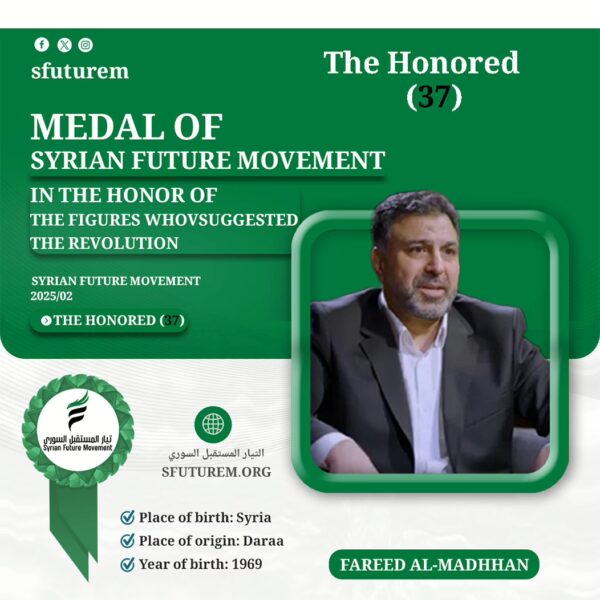
- Farid Nada Al-Madhhan belongs to a family from Daraa, southern Syria, and was born in 1969.
- Before the Syrian revolution, he worked as a photographer in the documentation unit of the Syrian military police, where his job was to photograph crime scenes and incidents involving military personnel.
- From March to April 2011, coinciding with the early days of the revolutionary uprising in Syria, until his escape in 2013, he was tasked with photographing numerous corpses of detainees, both civilians and military personnel.
- The process began in March 2011, with bodies of protesters being sent from Daraa, and as numbers increased noticeably, different methods of execution and torture emerged.
- The corpses he photographed in Al-Mezzeh and Tishreen military hospitals came from 24 security centers, all within Damascus province.
- He was assigned to photograph only men, excluding women and children.
- Each corpse was accompanied by numbers that had to be visible in the photographs, indicating the detainee’s number, the branch where they died, and a third number corresponding to the medical report, used for classification and archiving.
- The condition of the corpses—broken teeth, deep wounds, gouged-out eyes, burns, lacerations, and bloody bodies—left no doubt about the regime’s violations.
- He continued his work, secretly collecting as many photographs as possible and storing them on multiple USB drives, risking his life for two years.
- By 2013, suspicions about him grew, prompting his escape with the help of a friend who contacted a member of the Free Syrian Army.
- He reached Jordan and later found refuge in Europe, carrying 45,000 photographs.
- To protect his identity, he used the alias “Caesar” as a security measure and refrained from revealing his face or personal details.
- The authenticity of these images was verified, studied, classified, and analyzed in legal institutions’ laboratories, allowing Syrian families to search for information on the fate of their loved ones who had been arrested by the regime’s security apparatus or had fallen victim to enforced disappearance.
- Human rights organizations used these documents to prepare reports on detention conditions in Syria, as did the United Nations and international courts.
- On January 12, 2014, the file was presented behind closed doors to 11 foreign ministers.
- Based primarily on the documents leaked by Caesar and testimonies, the Paris prosecutor’s office launched a preliminary investigation into war crimes committed by Bashar al-Assad’s regime.
- In January 2015, Bashar al-Assad claimed that this military photographer did not exist.
- In November 2016, the U.S. House of Representatives overwhelmingly passed two bills—one imposing strict measures on supporters of the Syrian regime and another extending decades-old sanctions on Iran.
After Congress approved it, former U.S. President Barack Obama officially signed the bill into law. - U.S. lawmakers accused the Syrian regime of committing war crimes amid rising casualties from the ongoing conflict.
- The legislation, known as the “Caesar Syria Civilian Protection Act,” aimed to stop the massacres inflicted on the Syrian people.
- On December 11, 2019, the U.S. Congress, in both chambers, passed this law, imposing severe economic sanctions on the Syrian regime and its allies, targeting Assad’s financial resources to pressure him into returning to UN-sponsored negotiations to end the war in Syria.
- Among the death certificates issued by the Syrian regime in the summer of 2018 were the names of two Syrian-French citizens, Mazen and Patrick Dabbagh, which allowed their family to file a lawsuit in France.
Based on the information in the “Caesar Files,” the French judiciary issued three arrest warrants against regime figures accused of involvement in those deaths. - At the beginning of 2019, an investigation—largely based on the photos Caesar provided—led to the arrest of a torture suspect in France and two others in Germany.
The three were alleged former Syrian intelligence agents accused of committing acts of torture and crimes against humanity between 2011 and 2013 in Syria. - Caesar’s photos allowed investigators to examine corpses for distinguishing marks linked to specific intelligence branches.
- A hundred photos leaked by Caesar represented detainees who died in Branch 251 during Anwar Raslan’s tenure as its director.
- In 2017, Sami presented 27,000 high-resolution photos of detainees held by the Syrian regime to the German prosecutor’s office.
German investigators tasked an independent forensic service with analyzing all the images.
Due to the brutality of the photos and their content, this work took two years.
The analyses enabled a comparison of visible marks on the bodies of 6,812 individuals with testimonies from torture survivors.
These analyses were then made available to any European prosecutors requesting them. - Hundreds of thousands of Syrians seek to learn the fate of their relatives from the images published by various human rights websites.
- On January 26, 2018—International Day in Support of Victims of Torture—many families decided to establish the Caesar Families Association.
Its goal is to help victims’ relatives recover their loved ones’ remains for proper burial, provide moral and psychological support to families seeking information on detainees and the missing, and ensure that those responsible face justice. - On the evening of Thursday, February 6, 2025, Al Jazeera Network revealed the true identity of the person known as “Caesar,” sparking widespread reactions among Syrians on social media following his first public appearance.
In recognition of his exceptional and impactful contribution to the course of the Syrian revolution, for standing alongside his people in their uprising against oppression and tyranny, and in gratitude for Syria’s great figures and heroes, we in the Syrian Future Movement present this week’s Syrian Future Movement Shield to Syria’s contemporary “Caesar,” Farid Nada Al-Madhhan—a symbolic Syrian shield embodying our vision and national unifying approach.
We call on the future Syrian state to immortalize his name and honor him as he deserves, as a Syrian national symbol.