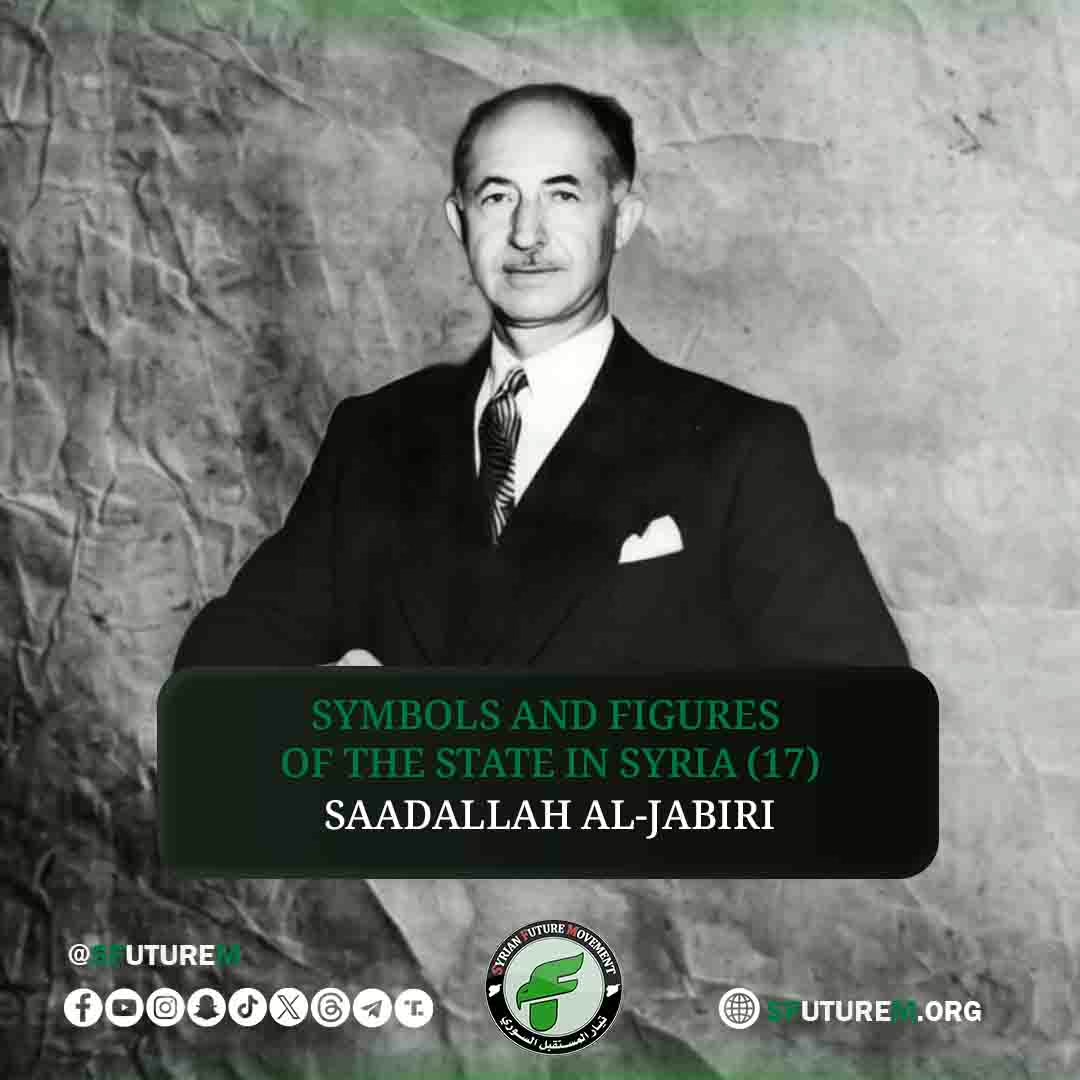
- He was born on October 14, 1892, in the city of Aleppo to an old family famous for patriotism, religion, and wealth.
- His father is Mr. Hajj Abdul Qadir Lutfi Al-Jabri Al-Husseini, Mufti of Aleppo, son of Allama Sayyid Murad bin Sayyid Hajj Abdul Qadir, Mufti of Aleppo and Captain of its Sharaf.
- He finished high school in Aleppo, and his brother Ihsan al-Jabri brought him to Istanbul to continue his studies at the Royal Royal Royal College.
- He contacted Arab youth in Astana and they founded the Arab Girl’s Association and swore an oath to work for the realization of Arab rights.
- He was sent to Germany where he studied for two years and returned to Istanbul.
- Due to the declaration of World War I, he was conscripted into the Ottoman army (as an officer) and was appointed as an overseer of livelihoods and caravans in the town of Ard al-Rum and spent the duration of the war there.
- When the war ended, he returned to Aleppo and became involved in the human rights movement.
- When revolutions arose in 1919 after the Allies’ intention to divide the Arab countries and the French entered Syria, he was in contact with the leader of the revolution in the north, Ibrahim Hanano, and supported his revolution.
- He renewed his contact with the nationalists who were with him at the Sultaniya College, such as Shukri al-Qutli and other nationalist elements.
- He participated in the General Syrian Conference held in 1919 and 1920 and called for the unity of Syria.
- For confronting the French, he was detained in Arwad prison for a period of time along with Hashim al-Atasi and a group of nationalists.
- Al-Jabri and his group would hold meetings and submit protests and memos to the Assembly of Nations complaining about the French.
- When the French authorities announced their readiness to establish constitutional rule in the country, the nationalists had decided in their conference to enter the elections. When Ibrahim Hanano and al-Jabri were elected to the first Constituent Assembly, the French saw that this Assembly could not serve their interests, so they canceled it, and the nationalists returned to the struggle, demonstrations and protests took place, and al-Jabri was arrested again.
- After his release, patriots gathered to draw up the National Bloc’s charter and statutes, with Hashim al-Atassi as president and Ibrahim Hanano and Saadallah al-Jabri as vice presidents.
- When the National Bloc rejected the 1933 treaty, demonstrations took place throughout Syria and patriots were arrested, including Saadallah al-Jabri, who was sentenced to eight months in prison.
- The French tyranny in Syria intensified, and the offices of the National Bloc were closed, and the men of Aleppo, Damascus, and other cities were arrested, and panic increased and all Syrian cities went on strike, and Al-Jabri was arrested again and exiled to the island of Ain Diwar.
- The French summoned the patriots and agreed with them to send a delegation representing the country’s patriots to France to negotiate a treaty, and Al-Jabri was a member of this delegation, so a general amnesty was issued for the Syrians and the patriots were released, and a treaty was signed in 1936.
- He served as minister of interior and then foreign affairs in the ministry of Jamil Mardam Bey, in the first national government in which Hashim al-Atassi was president of the republic.
- However, the French stirred up sedition and sectarian strife, which led to the suspension of the constitution and the termination of the government, and the president of the republic resigned.
- By disrupting constitutional life and removing the patriots from the government, the French further persecuted the patriots, seizing power directly and establishing a government loyal to them. In this circumstance, an incident occurred that caused Saadallah and his companions to leave Syria as refugees to Iraq, when the murderer of the nationalist Dr. Abd al-Rahman al-Shahbandar was promised a pardon if he confessed that he was motivated to kill by the men of the nationalist bloc: Shukri al-Qutli, Saadallah al-Jabri and Jamil Mardam Bey, but they were acquitted by the judiciary.
- He did not return to Syria until British armies entered Syria with the Free French army and the country’s independence was declared.
- When Shukri al-Qutli was elected to the presidency of the Republic in 1943/08/17 AD, al-Jabri headed his ministry. This ministry, whose nationalist stubbornness led to the French aggression against Syria in 1945.
- He was the head of the Syrian delegation at the signing of the Alexandria Protocol and the head of its delegation to the Preparatory Committee for the General Arab Conference.
- He attended the announcement of the establishment of the Arab League.
- He was elected as a deputy for Aleppo in the Syrian parliament several times, and was arrested by the French more than once and took over the Ministry of Foreign Affairs, Interior, and Prime Minister, as well as the Speaker of the Syrian Parliament in 1945.
- He ordered the dissolution of the parliamentary session before it was convened when the French bombed the parliament on May 29, 1945, thereby saving the lives of the deputies.
- When the French forces learned that the members of the Syrian Parliament had survived the bombing, they sent their forces to arrest Al-Jabri, who was staying at the Orient Hotel. He disguised himself as a monk and left in the car of the Russian ambassador (Solod). He reached Haifa and from there he telegraphed to London and the Security Council, and the British command in Palestine ordered to intervene in the events in Syria, and English armored vehicles entered Damascus on that day on April 17, 1946, and that day was a national holiday for Syria, the Evacuation Day, and Saadallah Al-Jabri had the first credit in achieving its results and confirming its effects.
- On April 17, 1946, the French forces were evacuated from Syria, and the last French soldier left the Syrian soil, and the Syrian masses celebrated with their leaders, the liberation leaders [the National Bloc] led by Al-Jabri.
- He fell ill on his last visit to Egypt, where he was there to attend the Arab League Council in 1947. He stayed in Alexandria to be treated for hepatitis, which he contracted during his frequent imprisonment.
- As a result, President Shukri al-Qutli asked him to resign as prime minister, which he did.
- Al-Jabri returned to Aleppo and spent a few months there, but soon passed away in June 1947 at the age of 54.
- He devoted his life to the struggle and was preoccupied with his private life. He did not marry or have children, and sold all his possessions and spent them on his long struggle.
- The President of the Republic, the Prime Minister, ministers, parliamentarians, representatives of the gendarmerie, heads of Arab countries, and large crowds attended the funeral procession in his hometown of Aleppo.
- He was buried next to his comrade in arms, leader Ibrahim Hanano.
- The President of the Republic paid tribute to him with a moving speech that was full of sorrow for his loss, in which he discussed the companionship of his jihad with him since the early years of study, enumerating his qualities and virtues, crying out for his honorable qualities and noble virtues.
- After the first president finished, Prime Minister Jamil Mardam followed with a comprehensive speech in which he addressed the history of his jihad and its impact on the country’s strength, pride, and independence.
- Royal missions representing King Farouk and King Abdulaziz Al Saud, heads of state from the Arab League, ministers, consuls, representatives of political bodies, parties, Syrian organizations, representatives of associations and clubs, neighborhood dignitaries, and mourners took part in the funeral.
We at Syrian Future Movement, as we recall the memory of the founding statesmen of Syria, we recall one of Syria’s influential statesmen and one of the symbols of the first Syrian state flags who contributed to influencing its structure, the architect of Syrian independence “Saadallah al-Jabri” within a sequential file that we present to you to include the symbols and flags of the Syrian state, in our desire to link our contemporary revolutionary present to a solid past and historical stations, hoping to revive in our people the need to build and manufacture statesmen par excellence, learn from their experiences, overcome their negatives, and build on their history to link our contemporary revolutionary present with a solid past and historical stations, hoping to revive in our people the need to build and create statesmen par excellence, learn from their experiences, overcome their negatives, build on their history, preserve the homeland, safeguard the gains, and restore the Syrian state to its glory after years of injustice, tyranny and corruption.