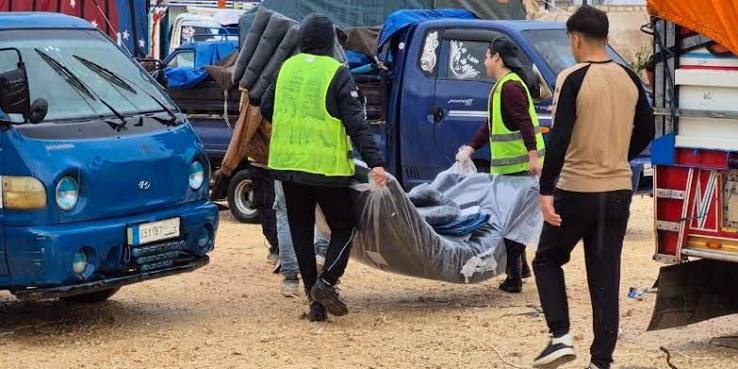
The Syrian Future Movement is following with great interest the departure of a new return convoy from displacement camps in the Idlib countryside on Sunday, November 8, 2026. The convoy, comprising 254 families, is heading toward their original home areas across several governorates as part of the “Syria Without Camps” vision. The initiative was facilitated under the auspices of the Idlib Directorate of Social Affairs and Labor, the Directorate of Emergency and Disaster Management, the Syrian Arab Red Crescent, and the UNHCR, in implementation of Decree No. 59, which concerns the rehabilitation of affected areas and the creation of suitable conditions for return.
The Syrian Future Movement views the continuation of these convoys as an indication that the issue of displacement is finally moving in the right direction, following years of stagnation and neglect. However, it cautions that the true measure of success lies in the families’ ability to remain in their home areas and not be forced to return to the camps.
The Syrian Future Movement notes that today’s convoy is part of a broader wave of returns. According to statements made by the Governor of Idlib, Mohammed Abdul Rahman, in August 2026, 162,601 families had already returned from the camps to their original areas, while 85,515 families remained in the camps.
The Syrian Future Movement points out that these figures indicate that approximately two-thirds of the families who were in the Idlib camps have now departed—a tangible sign of progress. Nevertheless, it acknowledges that tens of thousands of families are still waiting for conditions to become suitable for their return. The Syrian Future Movement points out that the challenges facing returnees persist. As of July 2026, there were approximately 1,126 camps in northwestern Syria, sheltering nearly 700,000 displaced persons—comprising 786 camps in Idlib and 340 in the Aleppo countryside. This figure has since decreased to 631 camps (according to the most recent update in October 2026).
While these numbers have declined, they underscore that there is still a long way to go; the closure of camps cannot—and should not—precede the establishment of the necessary conditions for a sustainable return.
The Syrian Future Movement acknowledges the efforts made by the Directorate of Social Affairs and Labor in Idlib, the Emergency Directorate, the Red Crescent, and the UNHCR in organizing return convoys and facilitating the procedures for families preparing to leave the camps.
Nevertheless, the Syrian Future Movement reaffirms its consistent position—as stated in its official release titled “Voluntary Return Convoys from Northern Camps,” dated July 30, 2026—that “the sustainability of the return—rather than the number of convoys—is the true measure of success.” It further warns that “inadequate infrastructure and basic services—such as roads, electricity, water, and sanitation—combined with limited employment opportunities, could turn what is intended as a return into nothing more than a temporary relocation.” The Syrian Future Movement also recalls its statement titled “A Vision for a Syria Without Camps: A Warning Against the Return of Displaced Persons Before Their Areas Are Prepared,” published on October 17, 2026. In it, the movement emphasized that “preparing the conditions for return is a prerequisite for closing the camps, not a subsequent outcome,” and advocated for the principle of “an alternative before removal.”
The Syrian Future Movement believes that today’s convoy—while significant—puts this principle to a real test: Are the areas to which these families are returning truly prepared to receive them? Or is this return driven by the pressure of circumstances rather than the readiness of the areas themselves?
The Syrian Future Movement notes that the continuation of these return convoys, despite their importance, presents a number of challenges that cannot be ignored:
First: The absence of basic services in the areas of return. The Syrian Future Movement points out that many of the areas to which families are returning still suffer from a lack of electricity and water, an absence of schools and healthcare centers, and dilapidated infrastructure. The movement maintains that returning to an area devoid of services is merely a return to new forms of suffering rather than a lasting solution; therefore, every return convoy must be accompanied by an immediate plan to rehabilitate services in the receiving area.
Second: The persistent threat of landmines and remnants of war. The Syrian Future Movement highlights that landmines continue to claim the lives of civilians—especially children—in areas experiencing returns. The movement stresses that demining is an essential condition for a safe return, and that any return to an area that has not been cleared of landmines places the lives of those returning at risk. Third: Lack of Job Opportunities and Economic Stability – The Syrian Future Movement notes that returnees require sources of income to ensure they can remain in their areas. The absence of employment opportunities in rural regions and affected cities may force them to be displaced once again or to emigrate. The Syrian Future Movement maintains that the provision of livelihoods is a fundamental component of sustainable return, rather than a luxury.
Fourth: The Need for Transparency in Selecting Beneficiary Families – The Syrian Future Movement observes that the mechanism for selecting families included in these convoys remains unclear to the public. There are no publicly stated criteria to ensure fairness and equal opportunity. The Syrian Future Movement calls for the publication of selection criteria, the establishment of an appeals process, and a guarantee that no specific group is favored over others.
Guided by its national responsibility, the Syrian Future Movement makes the following recommendations:
First: Each convoy should be accompanied by a plan to rehabilitate services in the receiving area—including electricity, water, schools, and healthcare centers—to ensure that returnees do not arrive in an environment devoid of essential services.
Second: Priority should be given to areas experiencing returns in terms of demining operations. These areas must be surveyed before the arrival of families, and returnees should be educated about the risks posed by explosive remnants of war.
Third: Temporary employment opportunities should be created within rehabilitation projects, alongside support for small-scale enterprises and the provision of accessible loans to returnees, to ensure their economic stability. Fourth: Publishing the criteria for selecting the families included in the convoys, making this information accessible to the public, and ensuring the right to appeal—in line with the principle of transparency that the Movement has long advocated.
Fifth: Completing the closure of camps in accordance with the principle of “an alternative before removal.” The closure of any camp must be preceded by the provision of a dignified residential and service-oriented alternative, ensuring that no displaced person is left without a genuine option.
The Syrian Future Movement welcomes the departure of a convoy carrying 254 families from the camps in Idlib, and views it as This is a positive step toward resolving the issue of displacement. However, the Syrian Future Movement points out that a genuine return is not measured by the number of families leaving the camps, but rather by the number of families who remain in their home regions a year or two later—having found access to essential services, employment, and security.
The Syrian Future Movement emphasizes that building a new Syria requires investing in both its people and its places; any return not accompanied by the necessary conditions merely shifts suffering from one location to another.
For its part, the Syrian Future Movement will continue to support efforts that foster a safe and sustainable return, while remaining critical of any shortcomings and closely monitoring developments on the ground—all in pursuit of a new Syria where every citizen can return home and find the dignified life they deserve.