
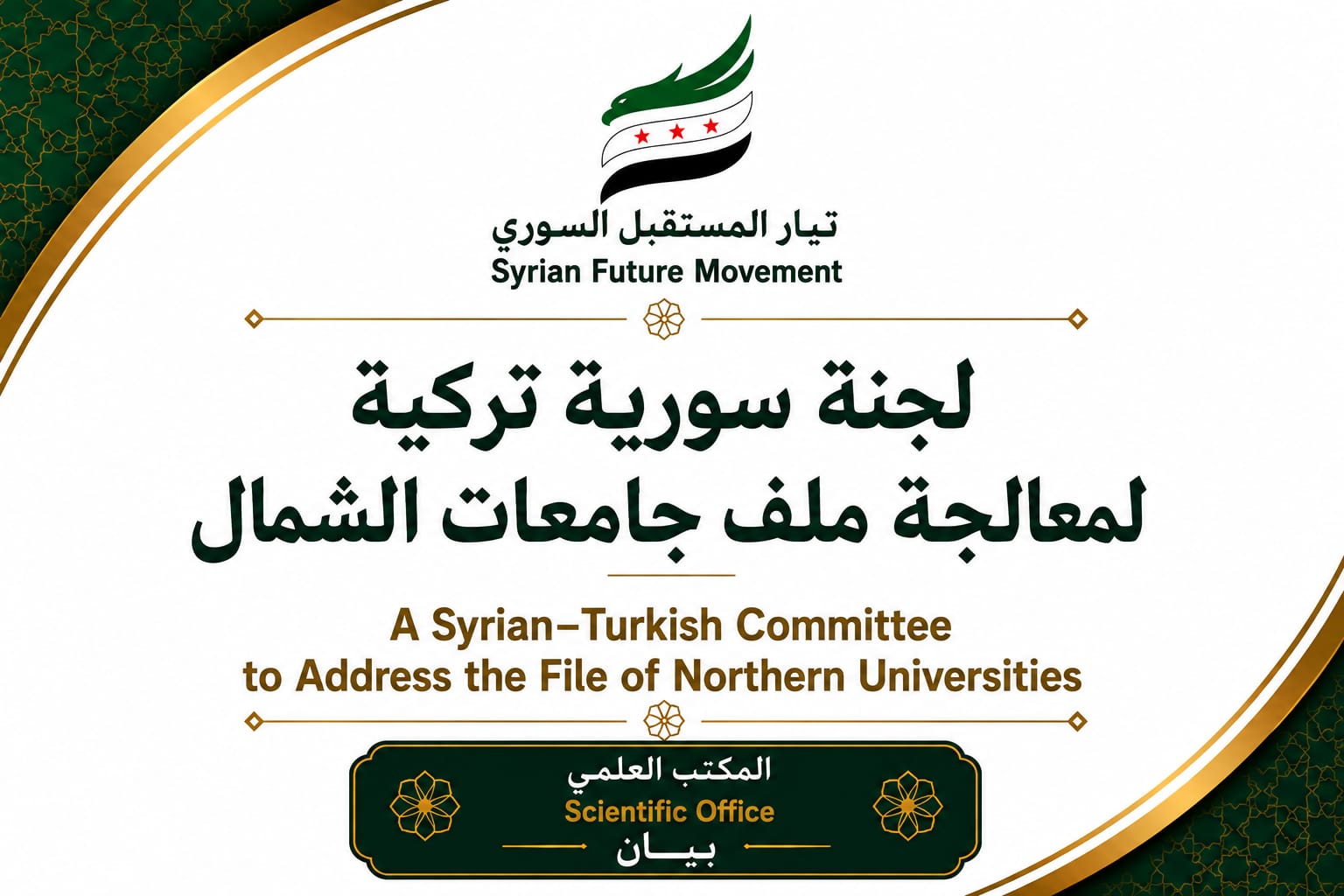
The Syrian Future Movement is following with great interest the announcement issued by the Minister of Higher Education and Scientific Research, Dr. Marwan al-Halabi, on Saturday, August 8, 2026, regarding the agreement with the Turkish Council of Higher Education (YÖK) to form a joint Syrian-Turkish committee to address the issue of universities operating in northern Syria. The committee is scheduled to begin its work at the start of this week with the aim of reaching final solutions before the start of the next academic year.
This announcement came at the conclusion of the Minister’s official visit to Turkey, which was preceded by the signing of a framework agreement for cooperation in the fields of higher education and scientific research between the two countries last Wednesday. This reflects a shared commitment to strengthening academic partnerships and developing joint institutional work.
The Syrian Future Movement supports this step, which represents a shift in the approach to the issue of universities in the north, moving from an isolated administrative approach to a participatory, institutional one.
This approach reveals three key implications:
First, the formation of the joint committee demonstrates a governmental commitment to finding fundamental solutions to a long-standing issue, rather than merely resorting to temporary measures. This is something we support and have long advocated for.
Second, the Syrian Future Movement notes that the committee’s formation—comprising the Syrian ministerial team headed by the Deputy Minister for Student Affairs, and representatives from the Turkish Council of Higher Education—embodies an institutional approach based on dialogue and coordination, not unilateral decisions.
We see this as a model for international cooperation in higher education, one that prioritizes students’ interests and ensures the stability of their educational journey, while guaranteeing quality education and enhancing academic recognition.
Third, the Syrian Future Movement appreciates the connection between addressing the issue of universities in northern Syria and the broader academic partnership with Turkey, which culminated in the framework cooperation agreement. This agreement encompasses strengthening collaboration between universities, exchanging expertise, and developing scientific research, quality assurance, and accreditation.
This comprehensive vision indicates that the transitional government views higher education as an integrated system, not as a collection of isolated issues.
In this context, the Syrian Future Movement reiterates its consistent positions, published on its official website, which emphasize the priority of unifying the national academic institution and ensuring quality education for all Syrian students:
- Statement on the “Establishment of the Higher Education and Scientific Research Committee in the People’s Assembly” (dated August 2, 2026): This statement commended the establishment of the Higher Education and Scientific Research Committee in the People’s Assembly, considering it an institutional step that enhances attention to the academic sector and solidifies the partnership between the legislative and executive branches in developing the higher education system, ultimately leading to the enactment of legislation guaranteeing the independence and academic freedom of universities.
- Statement on the “Signing of a Syrian-Chinese Partnership Agreement to Establish a Modern Vehicle Factory” (dated July 30, 2026): This statement stressed the importance of knowledge transfer and developing local expertise, asserting that industrial development cannot be achieved without genuine investment in education and training.
- The study “Priorities for Advancing Scientific Research and Higher Education in Syria” (dated May 13, 2026) discussed the challenges facing the education sector in Syria and called for the adoption of national policies that guarantee quality education for all Syrians, regardless of their region.
The Syrian Future Movement believes that the formation of the committee, despite its importance, faces major challenges that require fundamental solutions addressing the core of the issue, which has remained unresolved for years:
- The legal framework of universities: The process is not limited to the administrative aspect but also includes a review of the legal framework under which these universities operate, ensuring that their curricula and standards are consistent with the academic frameworks adopted in Syria, thus achieving quality education and enhancing the academic recognition of their degrees.
- The situation of students and academic staff: The final solutions must consider the interests of current students and graduates, ensuring the stability of their educational journey, in addition to regulating the conditions of the academic and administrative staff working in these universities and guaranteeing their professional and academic rights.
- Ensuring Sustainability: The solutions presented by the committee must be sustainable, not merely addressing the current situation, but laying the foundations for the long-term integration of these universities into the Syrian higher education system, thus ensuring that exceptional circumstances are not repeated.
- The Need for Supportive Legislation: Addressing this issue may necessitate legislative amendments or new laws regulating the status of universities that operated under exceptional circumstances, guaranteeing their legitimacy and continuity in the future.
Based on its national responsibility to monitor higher education issues, the Syrian Future Movement recommends the following:
- Ensuring transparency in the work of the joint committee by informing the public and academic circles of its outcomes and providing an opportunity for public discussion on the proposed solutions, to ensure that these solutions reflect a national consensus.
- Benefiting from the experiences of Turkish universities in the areas of quality assurance, academic accreditation, and digital transformation, which were covered during the Minister’s visit to public universities in Ankara, and transferring this expertise to Syrian public and private universities.
- Linking university solutions to comprehensive development plans ensures that addressing the issue of northern universities is not isolated from broader higher education development plans in Syria. This includes modernizing curricula, improving the quality of graduates, and aligning education with the labor market and development needs.
- Involving academics and students in the dialogue is crucial to ensure that solutions are practical, acceptable to stakeholders, and address their aspirations and concerns. This aligns with the Syrian state’s vision for building a modern higher education system.
The Syrian Future Movement commends this step, which strengthens the unity of the national academic institution and contributes to ending the administrative and legal fragmentation that has plagued the higher education sector in Syria for years.
The Syrian Future Movement reiterates that higher education is the cornerstone of development and the future of a new Syria, and that stability…
Its unity and integrity are essential prerequisites for building a state based on institutions and knowledge.
The Syrian Future Movement affirms that the success of this committee will not be measured by the speed with which solutions are reached, but rather by the quality and sustainability of these solutions, their ability to achieve justice for all students, and their capacity to guarantee the quality of higher education throughout Syria.
For its part, the Movement will remain a supporter of all that strengthens the development and unity of higher education, a critic of all that hinders the achievement of quality and academic justice, and a monitor of all that is accomplished on the ground, striving for a new Syria where science and knowledge are at the forefront of priorities.