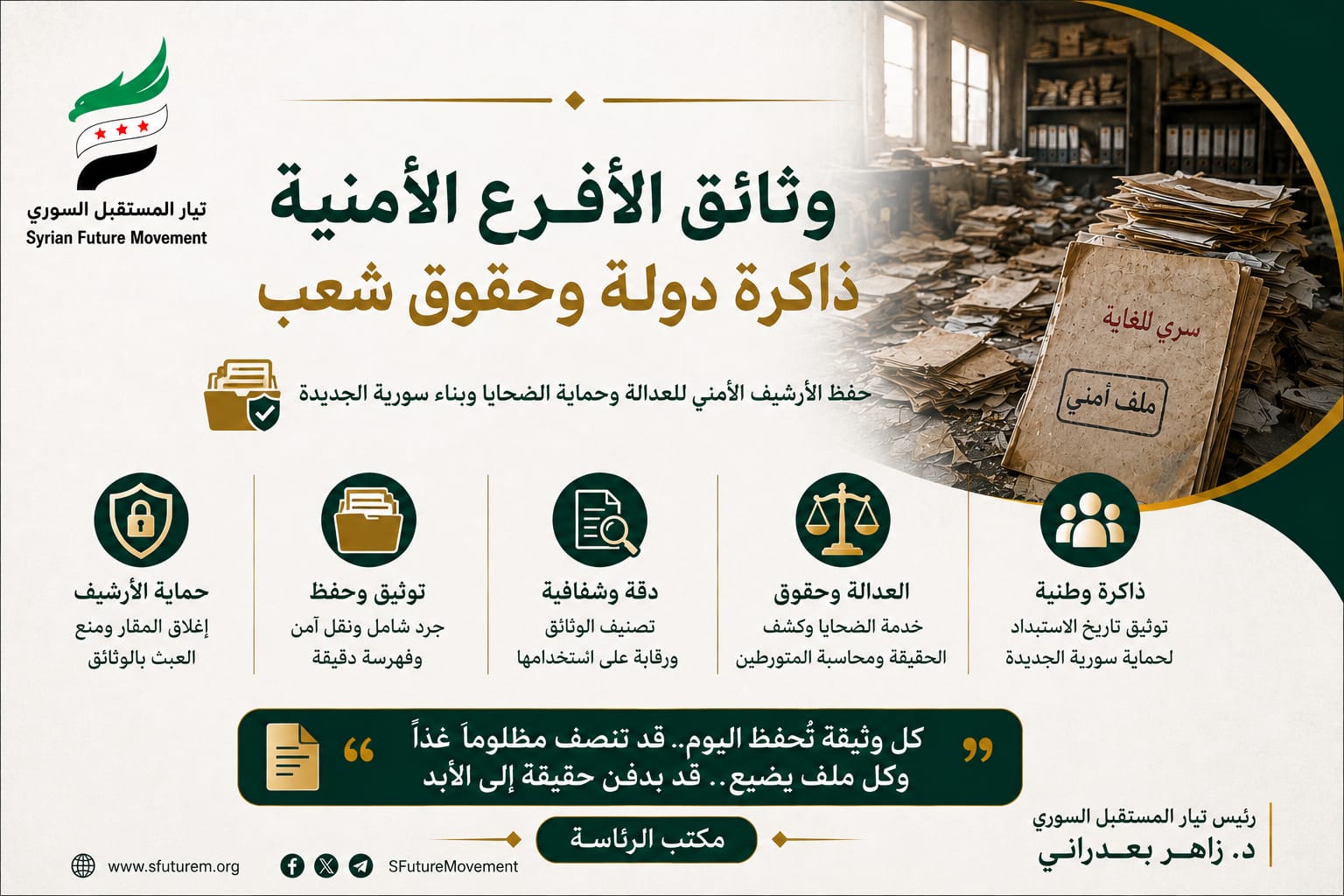
What prompted me to write this article were images and videos circulating on social media showing people entering government and security buildings that belonged to the former regime. They wander through the offices and rooms, posting pictures of documents, records, or folders found inside. In the background of some of these images, dozens, perhaps hundreds, of files and papers are scattered and strewn about the floor.
Some people might be drawn to these images by an old logo, a plaque from the era of sham referendums, or a symbol of a regime whose leaders believed their rule would last forever.
However, what should concern us more deeply and dangerously is not just the plaques and logos, but the documents, records, and security archives that appear behind them, unprotected and seemingly neglected remnants of a bygone era.
Herein lies a far more serious issue than any symbolic meaning held by a single image or plaque. How could an unauthorized person enter a former security building, browse its documents, photograph whatever they pleased, and perhaps even touch, move, or remove some of its contents, when those files might contain secrets, rights, and historical, judicial, and security evidence related to the lives and fates of thousands of Syrians?
This question isn’t about a single image or a specific individual, but rather about the fate of a massive security archive. This archive is supposed to contain information related to decades of Syrian life, the fates of detainees, the missing, and the displaced, the names of victims, perpetrators, informants, officials, and witnesses, and networks of influence and internal and external relationships—knowledge of which may be essential for protecting the new Syria.
I personally saw, some time ago, documents lying on the sidewalk next to a security branch in the Malki district of Damascus. Some of them contained security information related to a neighboring country.
If it is true that these documents remain vulnerable to loss, transfer, or tampering to this day, then we are not facing a mere case of administrative negligence, but rather a national, legal, and moral danger that may prove difficult to remedy later.
A security document can be the key to a person’s fate:
Some papers may appear old or insignificant to those who see them lying on the ground.
However, each one could prove the arrest of a person whose existence the regime denied at some point.
A single record might reveal the location where a detainee was transferred, the authority that ordered their arrest, or the names of those involved in their interrogation, transfer, or disappearance.
An internal or external correspondence might provide evidence of an officer’s or official’s responsibility for a crime or violation.
A list of names might reveal a network of collaborators, those involved, or beneficiaries of the system of repression.
Other documents might reveal the nature of the former regime’s relationships with external parties, its methods of infiltrating society, or its mechanisms for monitoring, blackmailing, and manipulating Syrians and state institutions.
Conversely, a document might prove the innocence of someone unjustly accused, reveal that their name was used without their knowledge, that they were the victim of a malicious report or personal denunciation, or that they were forced to divulge information under threat and torture.
Therefore, protecting archives is not an act of revenge, nor a means of settling scores, but rather a prerequisite for justice and a safeguard for both victims and the innocent.
The loss of documents could mean a family losing their right to know the fate of their loved one.
It could mean a criminal escaping accountability.
It could mean an innocent person being accused based on incomplete and unverifiable accounts.
It could also mean the erasure of a crucial part of Syria’s political, security, and social history.
The Dangers of Tampering, Leaks, and Selection:
Leaving documents unprotected opens the door to numerous dangers.
Files could be destroyed to conceal crimes or protect influential individuals.
Documents could be stolen to blackmail individuals, officials, or institutions.
Papers could be taken out of context and used for defamation and settling personal and political scores. Names may be published without verification, turning victims, witnesses, or those coerced into defendants in the eyes of the public.
Files may be transferred abroad, causing the Syrian state to lose part of its sovereign memory and its capacity for independent investigation.
Furthermore, the indiscriminate release of documents could endanger lives, expose sensitive security information, harm ongoing investigations, or allow implicated networks to escape and destroy remaining evidence.
Some documents may be used selectively, highlighting what serves a particular party while concealing what incriminates it, thus transforming the document from a tool for uncovering the truth into a weapon in the political and media conflict.
Therefore, the issue is neither a call to open the files to everyone nor a call to close them permanently.
Rather, what is required is their preservation, cataloging, and study within a legal and institutional framework, followed by their release to the relevant authorities under clear levels of confidentiality, protection, and oversight.
The archives of the former regime are a tool for protecting the new state:
Some may treat the documents of the former regime as mere relics of a bygone era.
But the truth is that these documents can be a crucial tool in safeguarding the new era.
Through them, we can understand the structure of the Assad regime, its mechanisms for infiltrating society, its networks of corruption and espionage, its foreign connections, its methods of recruiting informants, its security decision-making processes, and how it managed arrests, torture, extortion, and the manipulation of institutions.
The documents can also expose figures who are currently attempting to reinvent themselves under new names, positions, or slogans.
They can help the state distinguish between those who made decisions, those who carried them out, those who were forced to cooperate under duress, and those who were victims of the regime itself.
This distinction is essential to prevent transitional justice from becoming collective punishment and to ensure that social groups, families, or regions are not held responsible for crimes committed by specific individuals.
A strong state does not punish based on suspicion, nor does it prosecute based on hearsay, nor does it base its cases on social media posts.
A strong state preserves evidence, scrutinizes it, contextualizes documents, and subjects them to judicial and professional investigation.
An urgent national plan to protect archives:
The handling of these documents must be part of an urgent national plan, not through ad hoc or spontaneous measures. Individual cases.
We in the Syrian Future Movement believe that the following priorities should be given:
First: Closing all former branch and security headquarters and prohibiting entry except with official permission, while placing responsible guards and holding accountable any party that allows tampering with their contents.
Second: Forming a specialized national body to preserve the archives of the Assad regime, comprising judges, archivists, technicians, and specialists in forensics, human rights, and national security.
Third: Conducting a comprehensive inventory of every document, file, record, and storage device, documenting where it was found, its condition, and the entity that received it, to prevent tampering, substitution, or subsequent claims that documents were added or deleted.
Fourth: Transferring the documents to secure and monitored centers, while preserving their original order as much as possible, because the location, sequence, and relationship of a document to other files may be as important as its content.
Fifth: Digitize the archive and create encrypted backups, recording every access, copy, or modification, to prevent the loss of documents due to fire, humidity, theft, or damage.
Sixth: Classify documents according to their sensitivity and legal, security, and historical value, and prohibit random publication or selective leaks.
Seventh: Prioritize files related to detainees, missing persons, mass graves, arrest warrants, transfers, and investigations, given their direct impact on the rights of thousands of families.
Eighth: Establish a legal mechanism enabling victims, families of the missing, courts, and relevant committees to request information, while protecting individuals’ data, privacy, and their right to object and correct information.
Ninth: Utilize the expertise of Syrian specialists and international best practices in preserving the archives of repressive regimes, without compromising national sovereignty over the documents or allowing the originals to leave the country.
Tenth: A clear official statement must be issued explaining to the Syrian people what has been preserved, what has been lost, and what measures have been taken, because ambiguity surrounding this issue opens the door to rumors, blackmail, and mutual accusations.
Not spoils of war or souvenirs:
A clear national principle must be established stating: everything found within the former security branches is not spoils of war for anyone, nor a souvenir, nor an opportunity for taking photographs, nor the property of the entity or individual who first accessed it.
It belongs to the Syrian state, is the right of the Syrian people, and is a trust linked to the blood of the victims, the rights of the living, and the memory of future generations.
Even photographs, slogans, and plaques that appear to have only symbolic value must be documented before being removed from their locations, as they may be part of the historical landscape of the institution where they were found.
Access to these sites must not be based on personal connections, media influence, political affiliation, or military status.
When someone enters an archive and leaves with a single document, it becomes impossible to ascertain whether that document was the only thing taken, nor can it be guaranteed that other files were not moved, photographed, or destroyed.
Furthermore, good faith alone is insufficient when dealing with an archive of this nature.
This concerns evidence, rights, and state secrets, not ordinary journalistic material or historical artifacts that can be freely circulated.
Preserving memory is part of honoring the victims:
The fall of the Assad regime was not the end of responsibility, but rather the beginning of a greater one.
The revolution, which has offered martyrs, detainees, and displaced persons, cannot allow the evidence of their crimes to be scattered in the streets or become mere fleeting content on social media.
Honoring the victims means not only displaying images of the tyrants’ downfall, but also preserving the documents that reveal how they ruled, who aided them, who suffered at their hands, and how their experience can be prevented from recurring.
Building a new Syria begins not only with removing the symbols of the past, but also with understanding that past, documenting it, revealing its truth, and holding those responsible accountable under the law.
Every document preserved today may bring justice to a wronged person tomorrow.
Every lost file may bury a truth forever.
Any failure to protect this archive is a failure to protect justice, the memory of the Syrian people, and the security of the new state.
Therefore, the images circulating from inside the former security branches should not be dismissed merely as symbolic scenes of the end of the Assad era. They must become an official and public warning: save the archives of the security branches before the truth is lost, and before the memory of tyranny becomes a void that allows the oppressor to escape justice and the innocent to be oppressed once again.