Executive Summary:
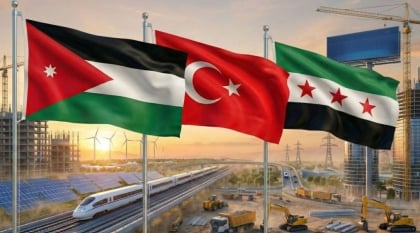
Reviving the land corridor linking Turkey, Syria, Jordan, and the Gulf states represents one of the most ambitious geopolitical projects in the post-2026 Middle East.
This initiative was driven by the Strait of Hormuz crisis, which threatened maritime security and energy prices, as well as the political transformations in Syria that reopened roads closed since 2011.
The Turkish vision includes rehabilitating a network of roads and railways, most notably the historic Hejaz Railway, to create a regional transport corridor connecting Europe to the Arabian Gulf via Syrian and Jordanian territory.
It is estimated that this corridor could reduce transport costs by 20% to 30% and shorten shipping time from 15 days to just 6 days.
However, the project faces significant challenges, most notably the tense security situation in southern and eastern Syria, the dilapidated infrastructure requiring massive investment, and the fierce regional competition for trade routes, particularly between Turkey and Israel.
First, the general framework and facts:
The nature and dimensions of the project:
On June 2, 2026, Turkish Foreign Minister Hakan Fidan announced that his country was in talks with Saudi Arabia and other countries in the region to revive a regional transport corridor extending from Turkey through Syria and Jordan to Saudi Arabia and the Gulf states (the UAE, Qatar, Kuwait, Oman, and Bahrain).
Fidan explained that the project aims to enhance trade and the transport of energy and goods, considering that improving transport projects and regional connectivity can create new opportunities for economic and trade cooperation and support stability and shared development in the region.
Stages of historical development:
This announcement was preceded by a series of diplomatic and technical moves that confirm the seriousness of the parties involved.
In April 2026, Turkey, Jordan, and Syria agreed to develop a “north-south” transport corridor that includes a modern highway system that will later connect to the Saudi railway network.
Riyadh announced the completion of the feasibility study for the railway section before the end of 2026. In May 2026, Syria and Turkey discussed reviving rail transport, with Syrian Transport Minister Ya’rub Badr confirming that the land corridor between the Turkish and Jordanian borders carried between 100,000 and 115,000 trucks annually before 2011, reflecting the project’s enormous economic potential. Badr also indicated that the Hejaz Railway could resume operations before the end of 2026 if the necessary support was secured.
It is worth recalling that Turkish Trade Minister Ömer Polat stated in October 2025 that the proposed corridor would become a fully operational land route for Turkish trucks to Jordan and the Gulf by 2026.
Secondly, an analysis of potential and resources:
Economic and trade potential:
This initiative represents a vital trade corridor. The high costs and security risks associated with maritime transport through the Strait of Hormuz, which carries approximately 20% of the world’s oil annually, make this alternative route of significant strategic value for securing supply chains and food security.
Shipping industry estimates indicate that the land corridor could reduce transport costs between Turkey, Jordan, and the Gulf by 20% to 30% compared to traditional maritime routes.
Syrian Transport Minister Ya’rub Badr explained in May 2026 that Syria had agreements with Turkey and Jordan to rehabilitate damaged sections of its railway network and was also negotiating with Saudi Arabia to simplify customs and border procedures. The agreements signed with Turkey and Jordan are expected to begin yielding results before the end of 2026.
Geopolitical and Political Implications:
- For Turkey: Through this project, Ankara seeks to solidify its role as a major logistics and energy hub in the region and enhance its economic influence in the new Syria.
- For Saudi Arabia and the Gulf States: The corridor represents a vital trade artery connecting them to European and West Asian markets, and a tool for securing supply chains away from congested waterways.
- For Jordan: The initiative is seen as an opportunity to strengthen Jordan’s role as a regional logistics hub between the Gulf and Europe, despite the security challenges associated with securing its borders.
- For Syria: Reviving the corridor represents a return to its historical role as a land bridge and regional transit route for goods between Europe and the Arabian Gulf, with enormous economic benefits in the form of annual transit revenues estimated at at least $500 million.
Railways – The Backbone of the Corridor:
The Hejaz Railway Revival Project stands out as a regional rail corridor linking Saudi Arabia to Turkey via Jordan and Syria, extending to Europe, amidst rapidly evolving geopolitical landscapes.
The historic Hejaz Railway, stretching approximately 1,750 kilometers from southern Turkey to Medina, will be rehabilitated under this ambitious plan. The Syrian and Jordanian sections will be renovated to reconnect the Middle East’s rail network.
Third, Expected Scenarios:
Scenario One: Gradual Implementation and Limited Operation (Most Likelihood: 60%):
Under this scenario, partial operation of the corridor will commence in 2026 with a road route for trucks only. The railway rehabilitation work will be delayed by an additional two to three years due to regulatory, financial, and security obstacles.
Truck traffic between Turkey and Jordan will continue at a reasonable level, while truck traffic to the Gulf will remain limited by customs procedures and logistical constraints.
Scenario Two: Freezing due to security escalation (Probability: 25%):
A security escalation in southern Syria (As-Suwayda – Daraa) could lead to the suspension of truck traffic or the diversion of some of it, especially if Iranian activity in the region increases or local clashes resume.
The likelihood of increased terrorist operations or attacks on commercial convoys also remains high.
Scenario Three: Rapid implementation and complete success (Probability: 15%):
This scenario requires complete security stability in Syria, along with massive Gulf investments that are not currently anticipated.
However, if the With Saudi Arabia and the UAE funding reconstruction, and Turkey expediting the resolution of outstanding disputes, the aforementioned corridor could be fully operational by rail before the end of 2028, effectively transforming Syria into a major bridge between Europe and the Gulf.
Fourth, Recommendations:
Internal Recommendations:
Building a Comprehensive National Vision: The Syrian government and national forces should formulate a comprehensive political and economic project that demonstrates the national benefits of the corridor and promotes its investment to strengthen sovereignty.
Focusing on Balanced Development: It is essential to ensure that the corridor does not become a tool for enhancing foreign influence, but rather an engine for balanced development across all Syrian regions.
Presenting an Alternative Vision: Formulating an alternative Syrian vision for the future of the corridor that focuses on the rights of Syrians to transit revenues and reconstruction.
Building Regional Alliances: Strengthening relations with Jordan and the Gulf states regarding the shared benefits of the corridor to counter Turkish or Israeli dominance over trade routes.
Technical and Implementation Recommendations:
Establishing a Regional Coordination Body: It is proposed to establish a “Regional Corridor Authority” with a rotating chairmanship to monitor implementation and coordinate customs and transportation procedures.
Activating Transport Insurance Programs: Developing insurance programs against geopolitical risks in partnership with the World Bank and regional financial institutions.
Establishing Unified Technical Standards: Standardizing road and railway specifications and customs regulations among the four countries to avoid transport complications.
Securing Funding Sources: Attracting investments from the Arab Monetary Fund, the OPEC Fund for International Development, and the Islamic Development Bank, in addition to Gulf financing.
Conducting Updated Feasibility Studies: Updating economic feasibility studies, taking into account insurance costs and damaged infrastructure.
Fifth, Conclusion:
Reviving the Turkish-Syrian-Jordanian-Gulf land corridor represents a crucial geopolitical and economic project for the region’s future.
This project also demonstrates a rare convergence of interests among several major regional players: Turkey, seeking to secure safe trade alternatives and consolidate its influence in Syria; Saudi Arabia and the Gulf states, looking to diversify supply routes away from the Strait of Hormuz; Jordan, which is banking on transport revenues; and Syria, which may rediscover its historical role.
But the success of the corridor hinges on resolving the complex equation of regional power balances in the face of Turkish-Israeli rivalry, securing funding for the massive Syrian reconstruction effort, and achieving security and stability in the sensitive areas of southern and eastern Syria.
Despite optimistic pronouncements, the corridor remains a project in its early stages and requires more time, investment, and wise policy to transform from an ambitious plan into a tangible commercial reality.
In this context, the Syrian Future Movement bears a significant national responsibility to demand that the corridor be, first and foremost, a project for Syrian development, not a tool for bolstering the influence of regional powers at the expense of sovereignty and national unity.