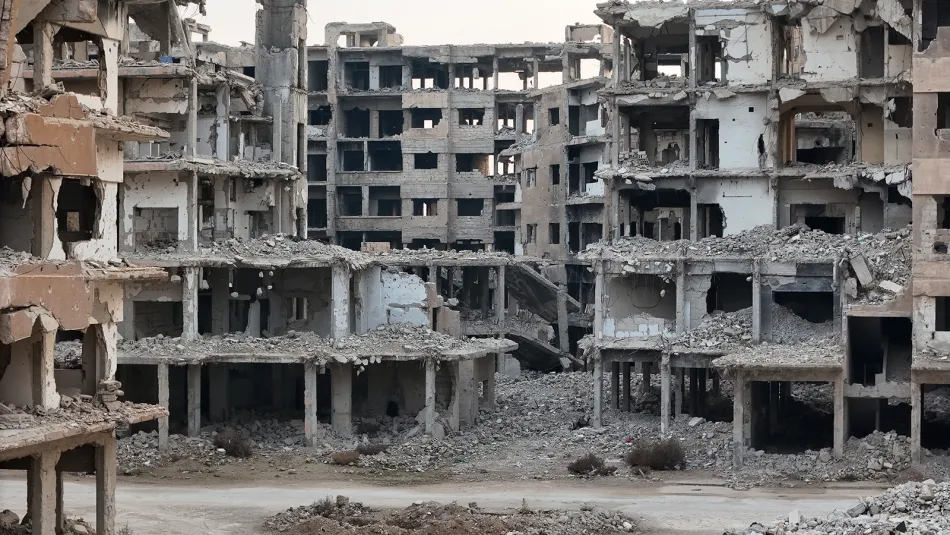
The issue of property ownership emerged following the fall of the former regime on December 8, 2014, and the transfer of power to a government formed by the liberation leadership under the Salvation Government. This issue has become one of the most prominent national challenges facing the transitional phase.
Local councils in various regions are implementing widespread expropriation orders for private lands and homes to expand infrastructure. The city of Dana in the northern Idlib countryside serves as a prime example of this problem.
Since the beginning of 2015, Dana has witnessed a series of successive regulatory decisions that have included the expropriation of portions of land and homes to widen main and agricultural roads (such as the Dana agricultural road, which is over 1,700 meters long and up to 24 meters wide in some sections). This has sparked public controversy focusing on the nature of the compensation and the connection of some projects to major commercial interests.
These decisions were not isolated incidents, but rather reflected a national pattern repeated in other areas such as Sarmada and Maaret Misrin, where ordinary citizens face increasing economic pressure in the absence of an elected legislative body.
This urgency comes in a transitional context marked by an unprecedented population explosion following liberation. According to estimates by the International Organization for Migration (IOM) as of March 2025, the population of Idlib Governorate reached approximately 2,848,168 (including internally displaced persons and returnees), while the World Health Organization estimated the figure at around 3,179,920.
The United Nations Human Rights (UNHCR) recorded the return of more than 1.14 million internally displaced persons to northwestern areas since December 2024, in addition to some 507,672 returnees from abroad as of May 2025. This demographic influx—resulting from the return of thousands to cities like Dana, which has become a bustling commercial center—has placed significant pressure on traffic and basic services, making the need for road expansion a pressing necessity.
However, focusing on post-liberation statistics remains crucial because it reflects the new reality of the transitional phase. The region no longer suffers from the siege imposed by the former regime but rather from the challenges of self-governance under a de facto situation striving for national stability.
From a legal perspective, private property is a fundamental right protected under Article 17 of the Universal Declaration of Human Rights and the International Covenant on Civil and Political Rights. During periods of conflict and transition—as defined by the UN’s principles of transitional justice—any expropriation must be proportionate, necessary, and non-discriminatory, with fair compensation reflecting market value and implemented through transparent mechanisms.
Philosophically, the tension lies between John Locke’s view of property as a natural right preceding the state and John Rawls’s theory, which emphasizes the priority of the less fortunate in the distribution of public goods.
In Dana, as in the national context, the urgency of the situation is sometimes interpreted as serving the “public interest” (such as alleviating congestion), but it raises questions about whether it truly protects ordinary citizens or reinforces the “power of money” of large merchants who benefit from the rising values of adjacent commercial land.
The Islamic legal dimension—which constitutes a fundamental reference point for Syrian society at this stage—adds a profound intellectual and jurisprudential layer.
Islamic jurisprudence views private property as a sacred right (the inviolability of wealth), derived from the Quran and Sunnah. However, it permits its expropriation for the public good (expropriation or eminent domain) provided there is necessity and fair, immediate compensation.
The four Sunni schools of thought agree on this principle, with slight differences in detail:
The Hanafi school emphasizes “Sharia-compliant governance” as the basis for expropriation in matters that serve the community (such as widening roads or public facilities), provided that the compensation is monetary or in kind, preserves the owner’s dignity, and is assessed by experts.
The Maliki school stipulates that the benefit must be “overriding” and unattainable by other means, emphasizing that the individual should not be harmed except to the extent necessary.
The Shafi’i school links permissibility to the realization of “public necessity” that outweighs the individual’s harm, with the obligation of immediate compensation to prevent injustice.
Finally, the Hanbali school of thought—which is the most stringent in protecting property rights—holds that expropriation is permissible only if it is for a clear and legitimate purpose (such as building a mosque or a public road) and after fulfilling the conditions of legal authorization and fair valuation. It warns that any negligence in providing compensation constitutes unlawful usurpation.
This jurisprudential perspective, based on the principle of “harm must be removed” and “public interest takes precedence over private interest, provided there is justice,” obligates the transitional authority to ensure its decisions adhere to clear legal standards, rather than being merely hasty administrative procedures.
However, the reality in Dana—a model of national challenge—reveals a gap between theory and practice: compensation is often merely symbolic or meager, preventing small landowners from purchasing alternative land in the same area, where prices have risen due to commercial development.
This situation threatens the legitimacy of the transitional administration itself, as an authority acting like a stable state before its constitutional institutions are fully established risks undermining public trust.
From a forward-looking perspective, addressing this national challenge requires a comprehensive strategy that balances immediate development with lasting justice.
Therefore, we in the Syrian Future Movement believe it is essential to immediately halt all unnecessary expropriation until an elected transitional legislative body or an advisory council comprising local representatives is formed. Every decision must be subject to an independent market valuation, and plans must be published in advance through public hearings.
We also recommend establishing a central compensation fund, partially financed by fees on major commercial investments, to guarantee in-kind or monetary compensation equivalent to the true value and prevent “economic displacement.”
In the medium term, a unified transitional law should be enacted, defining the conditions for expropriation according to the aforementioned legal and Sharia standards, with independent judicial oversight that activates the principles of Islamic jurisprudence in protecting property rights.
These recommendations, which are feasible with limited local resources, represent a step towards building national legitimacy.
Sustainable development that restores trust between the people and the authorities.
In conclusion, what is happening in Dana appears to embody a deeper national dilemma: how do we achieve development without compromising justice during a fragile transitional phase?
We believe that responding to peaceful protests with dialogue and transparency is the only way to transform these challenges into a historic opportunity to build a just and stable Syrian state.